Tag Archives: fine spinning

White felt disc hand-embroidered with flowers in brightly-coloured handspun silk

Spinning thread for handstitching, Part II. Spinning silk.

This is what started it all. Spin Off Autumn Retreat 2010. A pile of dyed mulberry silk top and some felt discs on a table in Robin Russo’s class, and the comment that spinning your own silk embroidery thread and stitching a needle case is good fun. So I spun the silk using a top-whorl spindle to insert quite a lot of twist, used an Andean plying bracelet for the short lengths I spun, and used the embroidery stitches I could remember from my childhood. It was good fun. And that was my first gentle reminder that stitching could indeed be fun.

I’ve used this needle case gently for the last 11 years and the silk threads are still in reasonably good shape. 

250x view of blue handspun silk embroidered flower petals showing relative lack of wear.
250X view of some stitches from the needle case to show wear of areas with less twist.

You may be able to see some slight ‘fuzziness’ indicating wear on the areas with very little twist.

Twist is good!
Twist locks the fibres in the yarn together to make a competent yarn: too little twist allows the fibres to slide within the yarn, which will then stretch under tension or even drift apart entirely (don’t ask me how I know this, it’s not a pleasant memory). But tight twist also means the fibres tightly spiralling on the thread are less exposed to wear in any one location on that thread. Tight twist locks the ends of fibres more tightly into the spun yarn. 

But not always!
Uncountered twist makes a yarn — or in this case a thread — that is lively. Most stitchers either add twist or untwist their thread ever-so-slightly with every stitch; if you add twist, you’ll know it because your thread starts tying itself in knots. A lot of twist results in a thread that may not flatten and spread to cover the underlying fabric. It might even stay entirely round, which is good if you’re couching it down, not so good for satin stitch. Like cotton, silk can take a lot of twist before it becomes wire: on average, when in doubt, always add a little more twist to silk.

Choose a yarn structure: sample silk threads
I learn a lot by looking at and handling examples of things to understand how they behave. 
In the image below silk threads are shown at 250x; they’re all from the same shot, split to allow me to name them. The white line indicates a 45° angle. [I’ve spelt ‘Gutermann’ incorrectly: it should be Gütermann. Sorry.]

6 different silk threads photographed at 250x to show twist angle and structure.

Using a needle to unpick the thread and a jeweller’s loupe to see the result I can say the first three (1,2, and 3 in case of doubt) are all 3-ply threads. 4, the embroidery floss, is 2-ply. Why? 3-ply yarns are almost circular in cross-section, so they look much the same diameter regardless of how they lie on the fabric, whereas 2-ply yarn is roughly oval in cross-section: it has a flatter, wider side and a narrower side.
So a 3-ply sewing thread will make a more uniform line of stitches, and being circular and tightly-spun might even move more smoothly through the fabric. The 3-ply Sajou and Soie Perlée stand cylindrical, high and glossy above a ground fabric or other stitches to catch the light and provide structure to a design.
By contrast the 2-ply embroidery floss will lie relatively flat on its flat side and because it is relatively loosely plied (compare the twist angle) it will spread even flatter to cover more of the ground fabric.

5, the 2-ply handspun silk top, is almost as tightly spun as the commercial threads, it’s just a bit thicker. It’s relatively ‘fuzzy’ with a halo of ends around the thread by comparison with the spun reeled silks above it,  but that is not proof that they are reeled and the handspun is spun from silk top: heat is used to burn that fuzzy halo off yarns mill-spun from silk top.

6  I will explain a little later. 

Other factors to consider
Sewing thread and most embroidery threads (leaving aside those attached to the fabric by other threads) have to pass through a fabric multiple times. Fabric is hard on thread. Every slub will catch on the fabric, the leading edge of the slub will abrade more and fray and eventually fail. The slub will enlarge the hole made by the needle, damaging the fabric and leaving the rest of the thread a bit loose in that large hole.
So unless you want texture and are happy to live with the consequences, spin consistent singles and ply consistently. You don’t need a lot of silk to make a lot of thread, so buy the best quality silk you can find. Avoid clumps of short fibres, neps, noils and other annoyances if you can, otherwise pick them out of the fibre as you spin. Or accept the consequences: it’s unlikely to be fatal or even a disaster! Uneven silk thread works well in rustic textiles sewn in the boro tradition, even in relatively precise geometric figures.    
Detail of sashiko stitched with uneven handspun silk.
There is significant variation in thread thickness and the amount of twist. Not my best spinning, but mottanai applies here: use what you have, waste nothing.back of waistcoat showing that uneven spun silk is appropriate to boro repairs.
And it looks perfect appropriate, at least to me.

I have an example of silk embroidery in my historic textiles collection.
undyed linen card case c. 1720 with yellow silk embroidery in back stitch and some satin stitch

This is probably an envelope case to hold visiting cards c. 1720 (dated by the style of embroidery). Undyed linen (note that there are two layers, the outer being a much finer weave) hand-sewn and embroidered with yellow silk. 

photo to show detail of flower and stitches worked in yellow silk on undyed linen card case with insert at 250x to show that the silk is floss, 2-ply.

A slightly closer view of the embroidery including a view of the back because embroiderers always like to see the reverse. The flowers and other details are back stitch, with a simple wrap binding the edges of the envelope. The insert detail shows more clearly the sheen of the silk – after 300 years! – and the structure of the yarn, which is a 2-ply twisted floss. 
And that’s why I tried Number 6 in the photo above, quickly twisting together a couple of strands of silk floss from Pipers Silks in the UK. It works, would work better if I used more strands for a thicker thread. But I’m not going to do that: I want to use that silk as it comes because it is so very beautiful and so very, very challenging.
pack of reeled silk floss for embroidery in various shades of blue with label from Pipers Silks.

I hope that’s enough to get you started. Use the best silk you have, spin evenly, spin reasonably tightly if not very tightly, it’s good fun!
The Cassimere Insanity Part I

If you’re visiting because you’ve heard about my article A Brief History of an 18th-Century Woven Cloth: Cassimere in the Winter 2019 Spin Off, welcome.

Honestly, that’s what it is, insanity. I just didn’t realise it until I’d dug the hole too deep to climb out:
I had to keep going all the way to the other side.

I am deeply curious about how yarns were spun in England before the Industrial Revolution. In the Middle Ages England was the leading producer of woollen textiles in Europe: across a wide swathe of the country you can still see the ‘wool churches‘, magnificent structures paid for by the profits of the medieval wool trade, which is to say people buying and selling wool fibre, yarn and fabrics. ‘The medieval wool trade’ … four words that encompass centuries of skill needed to breed sheep producing different types of wool, to develop the hand spinning, dying, weaving and finishing skills to spin the different types of yarn needed to create different cloths that could then be finished to create some of the most beautiful and desirable fabrics known in Europe at that time. In England at that time skilled hand spinning was so fundamental that we have little information about how fibre was spun except in illustrations: everyone knew how to spin, so there was no need to document it. Nonetheless surviving fabrics can tell us something about the fibres and skills used in their construction.

the beginning

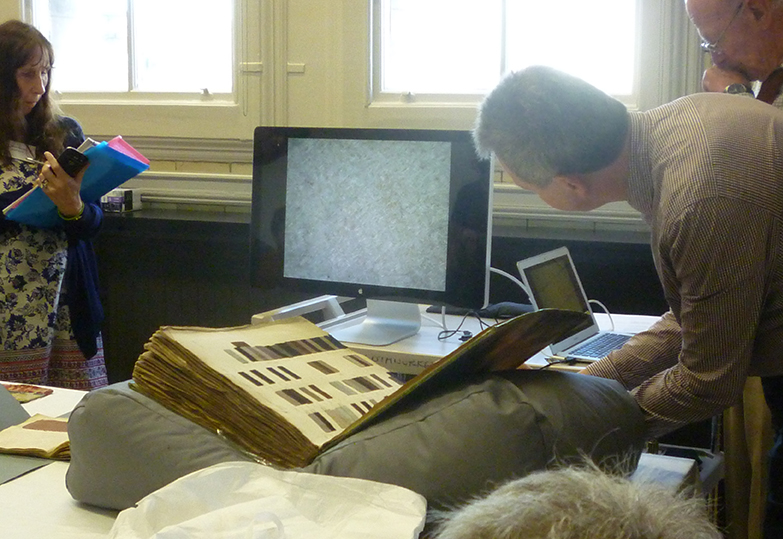
In 2014 I was invited to be one of the spinners demonstrating techniques at John Styles’ ‘Spinning in the era of the spinning wheel’ workshop at the Victoria and Albert Museum Clothworkers’ Centre in London. Historians and fibre arts handworkers met to discuss the making of an array of fabrics from the V&A’s immense collection. One of the items on display was a book of fabric samples, ‘T.350-1989: Bound sample book containing different types, qualities and colours of cassimere or kerseymere cloth.’ I’d first seen cassimere (also known as kerseymere) mentioned in Kerridge’s Textile Manufactures in Early Modern England as a cloth invented by Francis Yerbury and patented by him in 1766; I remembered it because of the name, which I had read somewhere is thought to have been derived from ‘cashmere’ to reflect its softness, and because it had never occurred to me that a fabric could be patented. And now here it was in front of me, or at least examples of what were known as cassimere in 1795.

25.Cassimerebook27.CassimereSample

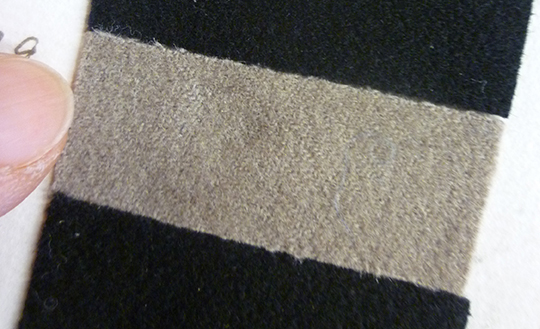
Note that my finger is NOT TOUCHING anything.
It’s hovering about 1cm above the fabric to give some idea of scale.

I was entranced. Moths and time had removed some patches of the surface fibre from one swatch (the one I photographed), revealing the twill structure and the beautifully-spun yarn. There were many other wonders spread out on the tables, but I left the workshop determined to find out more about this thing called cassimere. Kerridge focuses on the history of textile manufacturing, not the textiles themselves, and mentions cassimere again only as being responsible for bringing weavers into employment in large workshops, which was “possible because the looms were narrow and necessary because the weaves were new and intricate [compared with earlier standard weaves].”

The search for information

The internet rapidly made clear that cassimere/kerseymere continued in production until the 20th century and beyond, but also that these were very different fabrics from that patented by Yerbury… Aha! The patent! We were now living in Canada, so I couldn’t just pop down to the British Library in London. I emailed the Business & IP Centre asking if there was any way I could find a copy online, and will be eternally grateful to the  staff member who noticed I was writing from Canada and sent me a PDF.

Yerbury’s patent YerburyPatent1766-1

Page One of Yerbury’s patent.

Greetings from the 21st century, Francis. But I wish you’d given me more information! The meat of the patent is on pages 2 and 3, where Yerbury’s ‘New Invention’ is contrasted with the ‘common method of making cloth’. In short:

Common cloth warp is spun with a lot of twist, the weft with as little twist as possible and about 2/3 thicker than the warp, and the two should have different twist directions in order that they interlace tightly when woven. The fabric is a plain weave and the final fulled cloth is thick, water-resistant and durable.

Yerbury’s new Invention warp and weft are spun in the same manner “nearly about the same degree of smallness, weight and twist”. There is no specific weight or thickness of yarn but it should be spun from soft, good wool, all Spanish (i.e. merino) or a mix of Spanish and English. He describes two kinds of cloth distinguished in the weaving; one is clearly a straight twill, right or left; the other “quilled in the weaving with a flat whale [wale]” defeats my current understanding. According to the Google Books preview of The Dictionary of Fashion History, Beckinsale’s The Trowbridge Woollen Industry mentions only twill weave for cassimere.

Yerbury developed his new ‘cassimers’ fabrics to fill a niche in the market, which at that time was virtually crying out for lighter wools suitable for wear in warmer climates. But on the third page of his patent he mentions another reason for devising an innovative fabric: not only was the common cloth “hot, inconvenient and heavy for the summer wear at home and warmer climates abroad”, but it “hath also been introduction of many slight and whimsical things from our great rivals in trade the French”. In other words, the French were saying rude things about heavy, traditional English broadcloth.

So this is how I discovered cassimere. In Part II I’ll tell you how I found more information and began spinning.