Because WP doesn’t seem to have a way of doing this now …
[sidebar]
Many cultures have traditional methods of colouring textiles (and other things, but I’m only interested in textiles) with mud or soil.
In some traditions the colour is actually a stain: the particles that colour the textiles are suspended in a medium such as soy milk that is applied to the textile. The soy milk acts like a glue, holding the particles onto the textiles and protecting them when it dries; if the medium is removed by washing or wearing the colour will leave with it. In other traditions the mud or, more accurately, minerals in the mud, are dyes that form chemical bonds to the textiles or to mordants applied to the textiles for permanent or semi-permanent colour. [sidebar/]
The back story
I came across a source for ‘peace silk’ cocoons reared in the UK (no name because he’s no longer producing cocoons for sale). I bought some eri cocoons (Samia ricini or S. cynthia ricini) because, well, because I could. A Google search for different ways of preparing Eri cocoons for hand spinning also found the dorozome dyeing technique using volcanic mud to colour Eri tsumugi silk to weave oshima tsumugi fabric. [tsumugi silk is spun from the discontinuous silk of cocoons with holes or strands broken by the emerging adult moths, often known as ‘peace silk’.]
VOLCANIC MUD on SILK? If you know me you know I was doomed as soon as I read about it.
Dorozome
Dorozome is a traditional mud dyeing technique from the small volcanic island of Amami Oshima at the southern end of the Japanese archipelago. I’ve watched a lot of videos; if you want to see the technique as used in Japan, Evan Kinori’s video shows more of the process than most.
Basically the material to be dyed (fabric or yarn) is mordanted with a red-orange tannin extracted from the wood of Indian hawthorn (Rhaphiolepis umbellata), known as techi in the Okinawan dialect or sharinbai in Japanese (I think). The material is submerged and manipulated in a muddy pond of iron-rich grey volcanic mud, then dried and rinsed. Repeat the process as many times as necessary to get the desired shade of brown/grey/black.
What I did
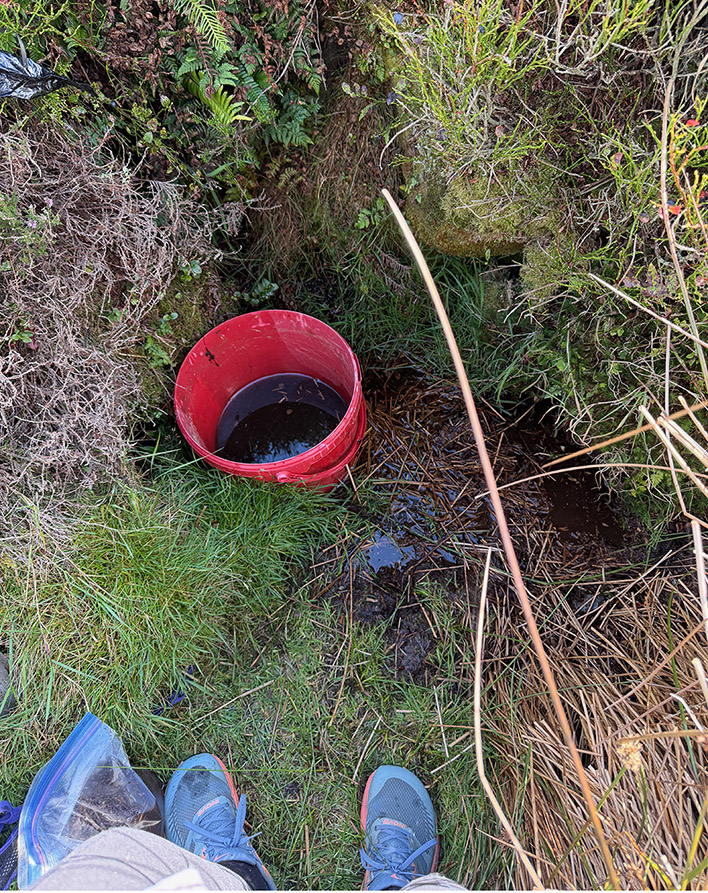
I needed iron-rich mud. Fortunately there is a lot of ironstone in Northeast England; ironstone and coal were the foundation stones of the Industrial Revolution. I found a chalybeate spring (a spring of iron-rich water) on a public right of way, filled three medium zip-lock bags with a mix of mud, water and rotting vegetation, discovered that my daypack would only hold two, so put the third and the rubbish I’d removed from the spring in a carrier bag and hauled the lot back to the car. The lethal-to-animals party balloon released by some idiot somewhere was huge, wet and heavy.
I needed tannin. I want this to be theoretically local, so I needed a tannin I could find locally. Native UK hawthorn wood is not orange and has no reputation as a mordant, so I opted for oak galls. Not wanting to hunt them down for the trial run, I bought some from Chiz at Froe Wood Coppice Products (he has lots of other cool stuff including lime bast).
The process is simple
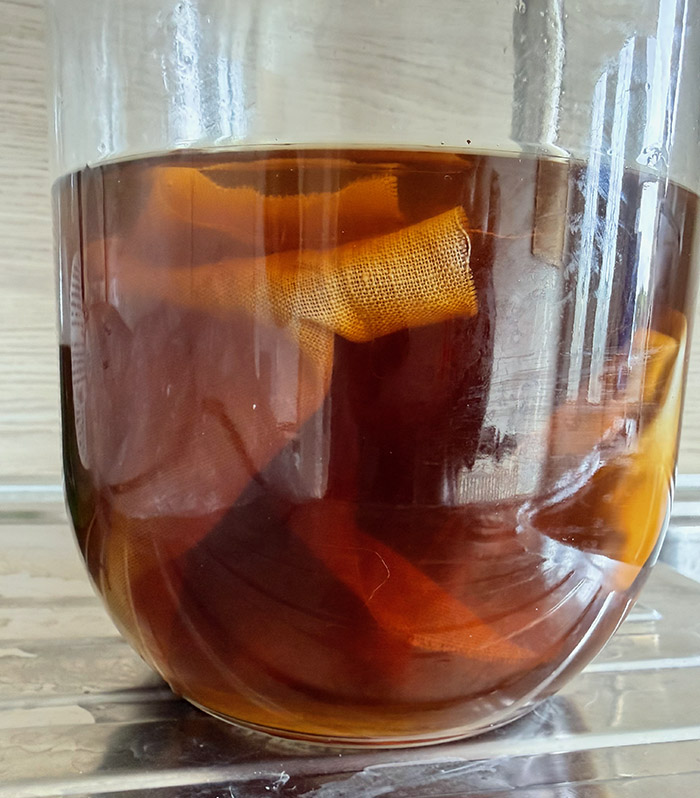
Crush the oak galls. I soaked them 24 hours to extract the tannin as a pale brown liquid: heating results in a darker brown tannin that might obscure the iron tint from the mud.
Scour the material to be dyed to remove anything that might interfere with absorption of the tannin.
Soak the materials in the tannin. I left them 24 hours to fully wet and absorb the various compounds from the oak galls.
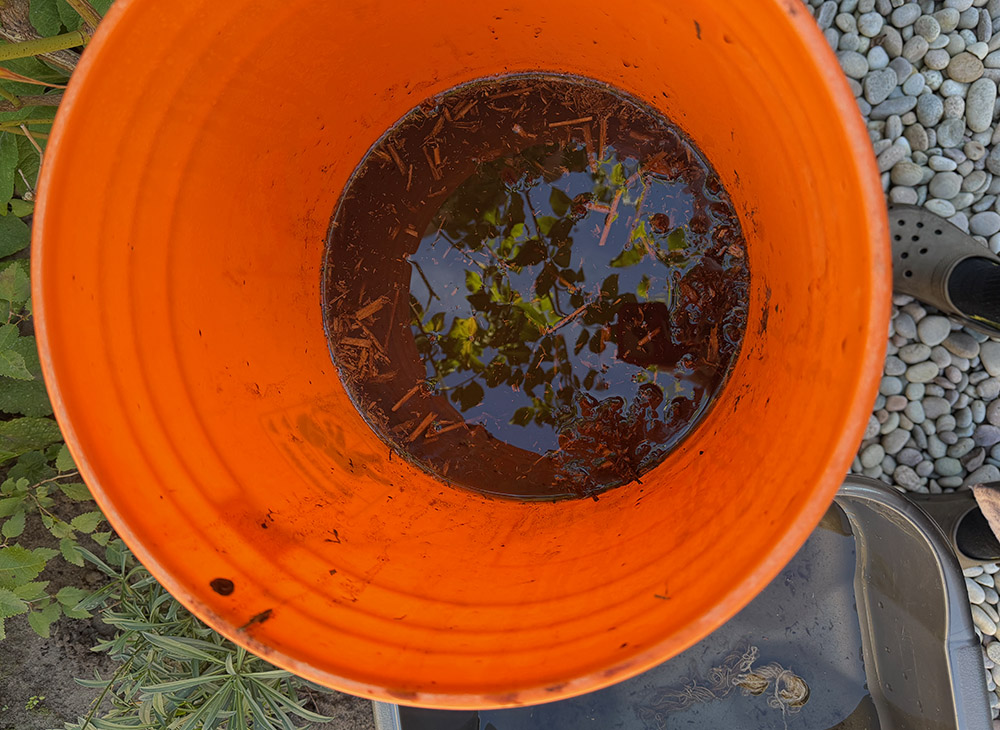
Squash the materials into the muck and water in the bucket, lift up and peer at them hopefully, then squash around in the mud again. Repeat for about a minute, then squeeze out the excess fluid, pick off some of the vegetable matter, watch them go grey! and leave to dry outside before rinsing and washing and rinsing.
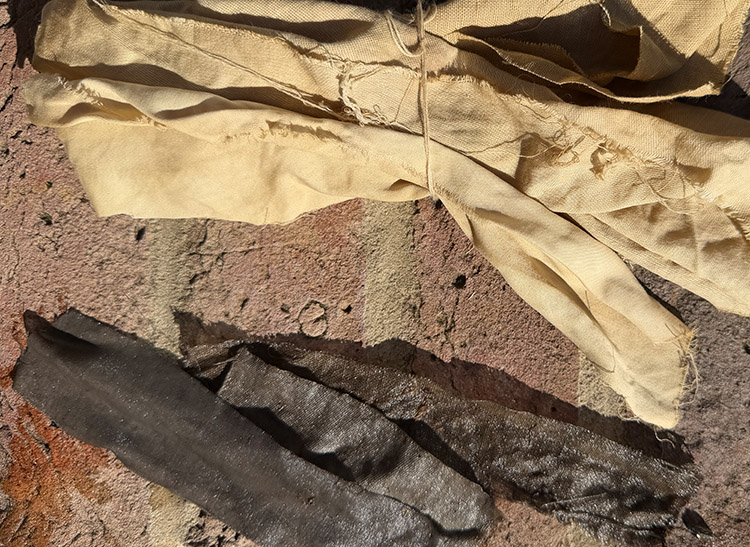
The cellulose fabrics: at top, linen (coarse weave) and two cottons as they look dry after mordanting in the oak gall solution. Below, samples of the same fabrics roughly rinsed after mud dyeing.
How does this work?
According to my reading, no one is absolutely certain how this works because there are Too Many Things involved. The chemical reactions are roughly similar to those that make medieval oak gall ink, so we know that oak gall mordant isn’t just tannic acid, it’s also gallic acid, pyrogallol, syringic acid and more, known simply as gallotannins. The gallotannins contain hydroxyl groups that happily bind to hydroxyl groups in the cellulose fibres and to metal ions, thus binding the iron to the fabric.
Ironstone can contain iron in many forms, including iron oxide (rust), magnetite, and other oxides and sulphides, none of which are soluble. Iron miners use heat to extract the iron from the rocks; we have to thank bacteria for the iron in the mud that dyes fabric. Bacteria and other organisms living in wet soil and peat around the ironstones consume oxygen and release acids as they break down organic matter. In those conditions iron loses electrons to become ferrous iron aka Fe2+ or IronII. IronII is soluble: water moving through the rocks will transport it away through the soil and the peat as long as the reducing conditions are maintained. When the IronII reaches the open air the oxygen and/or chemotrophic bacteria transform it to ferric iron aka Fe3+ or IronIII which is an insoluble black particle. If the dyer is lucky, the anaerobic conditions persist in the mud (perhaps there are bacteria rotting organic matter?) to maintain a supply of IronII ready to dye things.
In some places the chemotrophs create an oil-slick rainbow on the iron-rich waters and soils that is beautifully set off by the rich reds and oranges of rusting IronIII. I thought I had a picture of this but I can’t find it, so here’s a blog post from the University of Florida.
When people using natural dyes ‘sadden’ a colour with a tannin mordant followed by ferrous sulphate aka copperas, they’re using a shortcut through this process: ferrous sulphate (FeSO4) releases the soluble ferrous IronII which is converted to ferric IronIII and bound to the fabric.
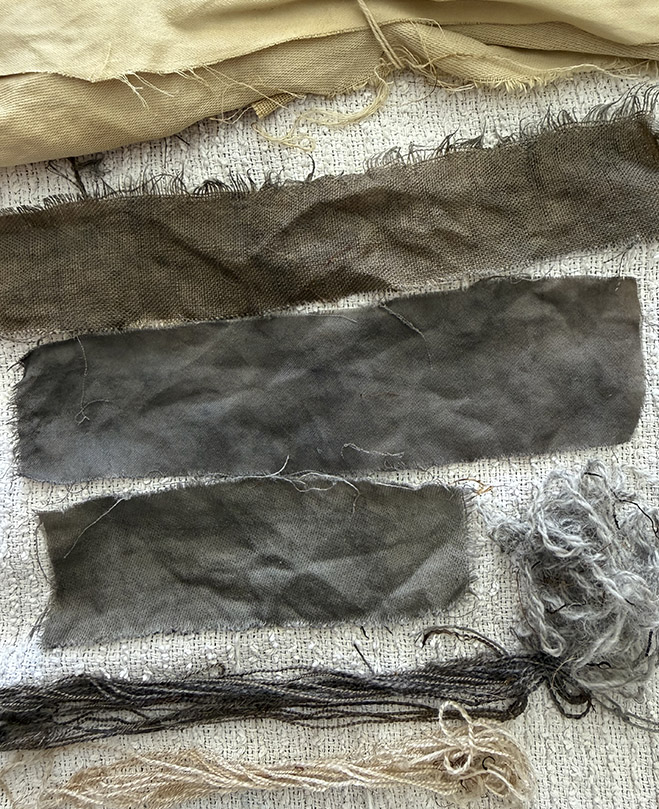
So: if I’ve understood the process correctly, the process that gives me beautiful warm iron-greys on fabric is the same reduction/oxidation that gives me indigo blue.
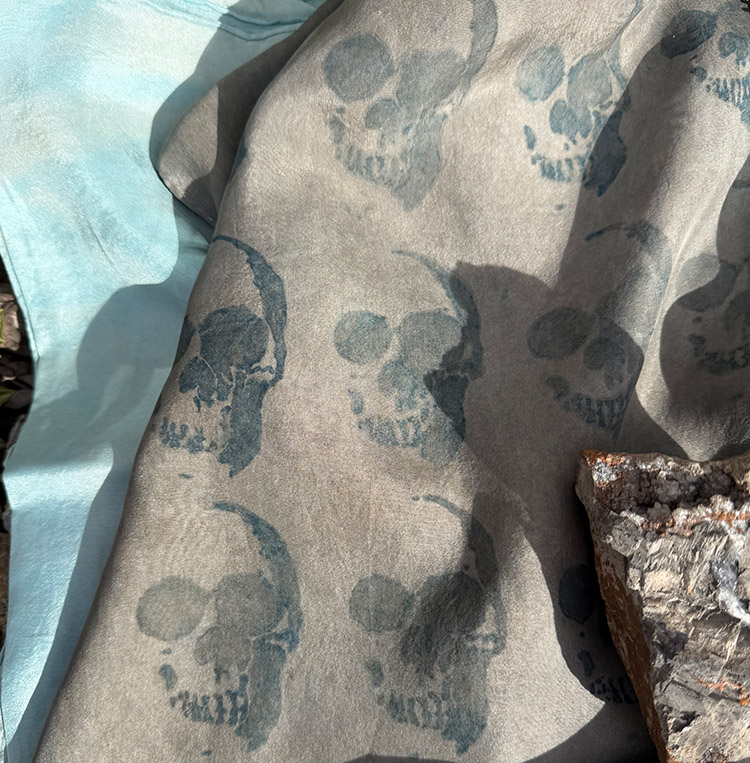
It’s appropriate that the first thing I dyed for real, as it were, was a scarf dyed and stencilled with fresh leaf Japanese indigo. The result was a perfect example of the fresh leaf on silk but far too bright for me to wear. I absolutely love it now.