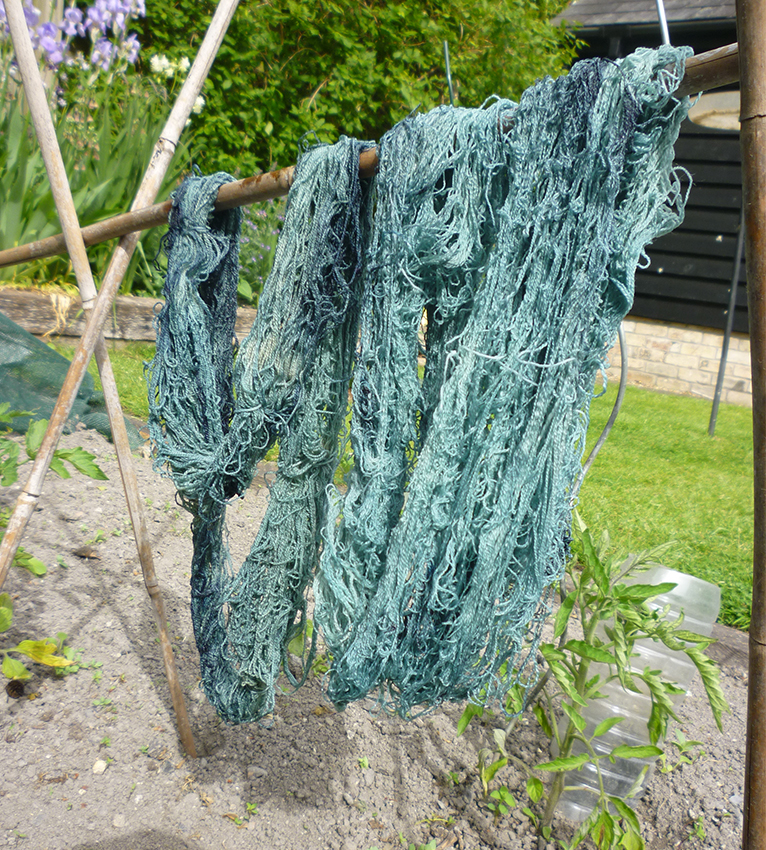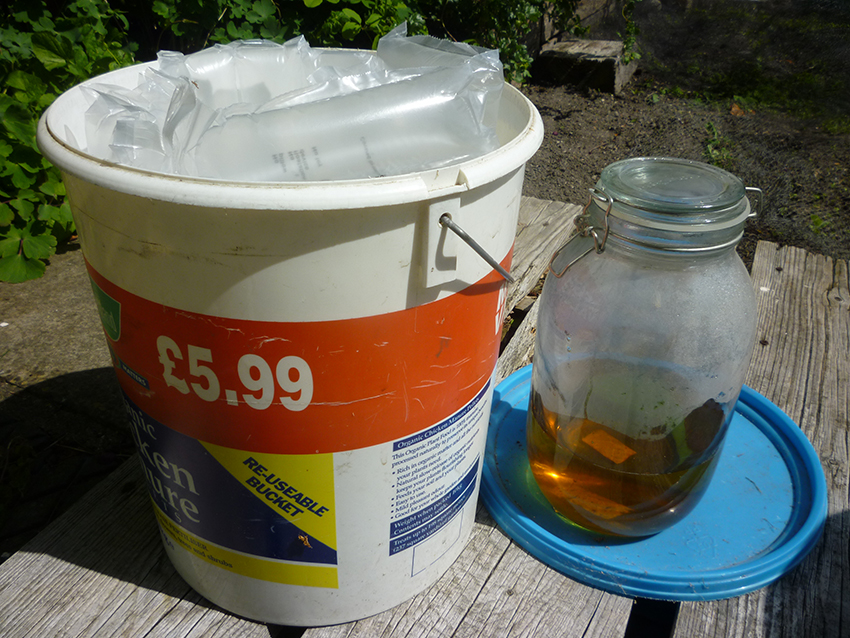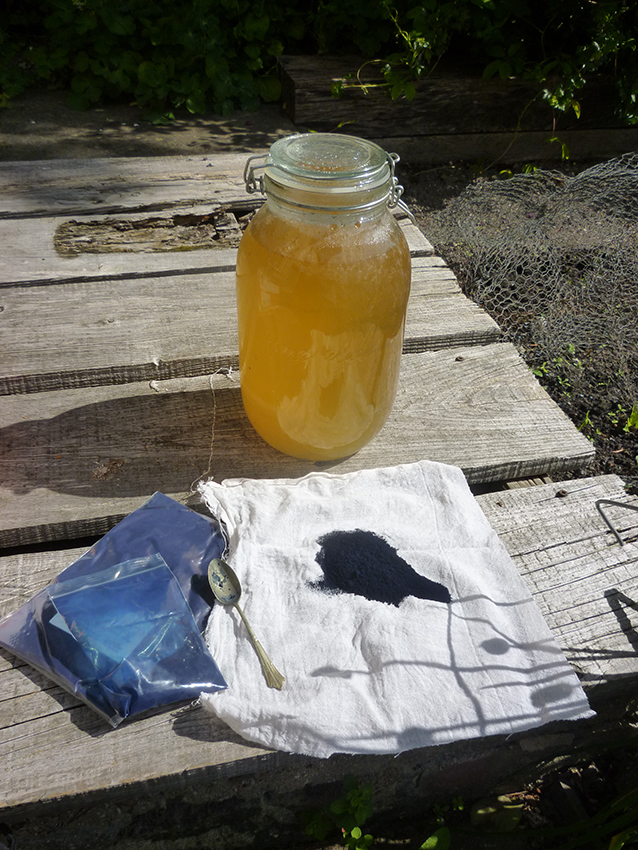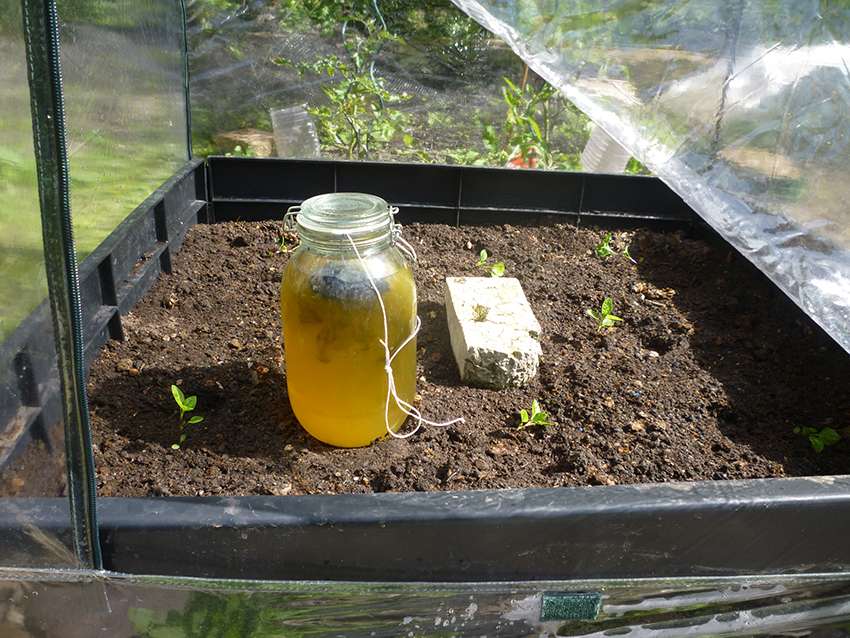
Woad Fermentation Vat No. One: Day Seven.

In fact a summary of days 2–7. In pictures and words. I really, REALLY wish I could share the smell as well, as I think that’s significant, but I daresay many of you wouldn’t enjoy the, er, pungency. It’s living in my office/spare bedroom, and I’m just hoping the smell won’t linger once the vat is finished. I had intended to keep it in the garage, but it wouldn’t be fair to inflict it on my husband.

According to the thermometer on the vat the brewing belt is running slightly hot, I think, nearer 28 than 23°C, so I’ve wedged a pencil between the belt and the vat to reduce the heat input.

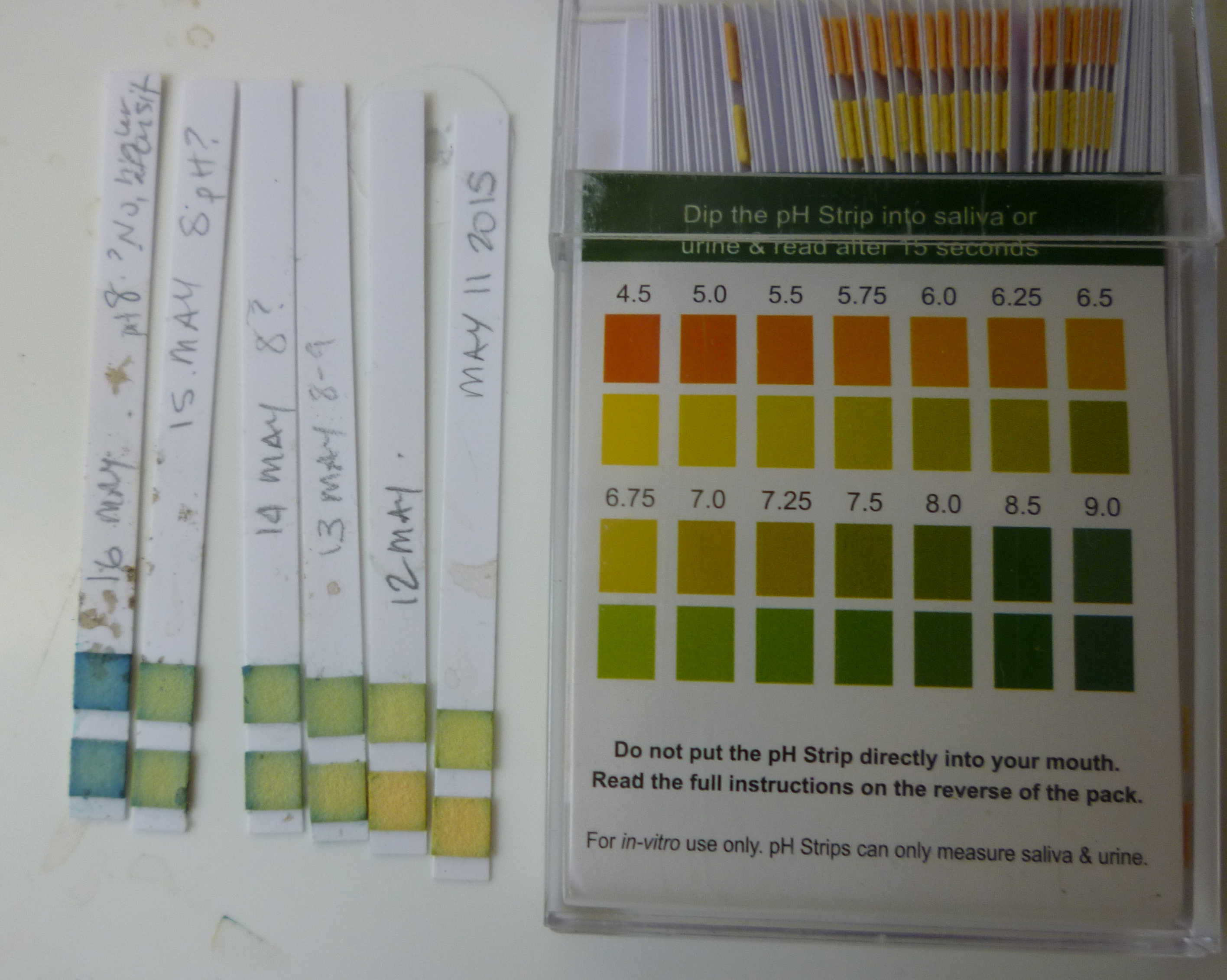
pH papers from vat testing over the week:

pH.papers.Day7

The vat on Day Three, 12 May. pH 8-9
The organic matter is waterlogged and has sunk to the bottom. There are a few bubbles, some patches of scum, the vat smells of rotting vegetation. The pH is low (acid): I sprinkled 1/2tsp of garden lime on the surface and stirred it briefly and gently.

Day3.Vat

Over the next three days the vat liquid became darker, the smell of rotting vegetation intensified, the greyish scum became thicker. Daily pH tests gave readings of 7–9, lowered by the acids produced by the rotting woad and bran; I sprinkled another 1/2 tsp of lime on the vat on Days 3–7. When in doubt, go alkaline as indigo will not convert to the soluble form in an acid environment. The smell became more complex. I can’t think of a good way to describe it, but no longer ordinary rotting vegetation. Richer, darker.
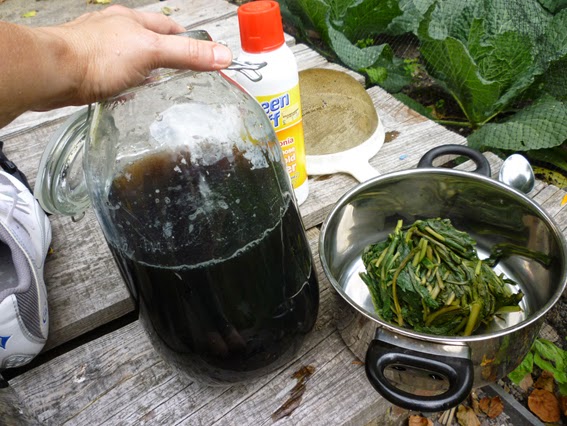
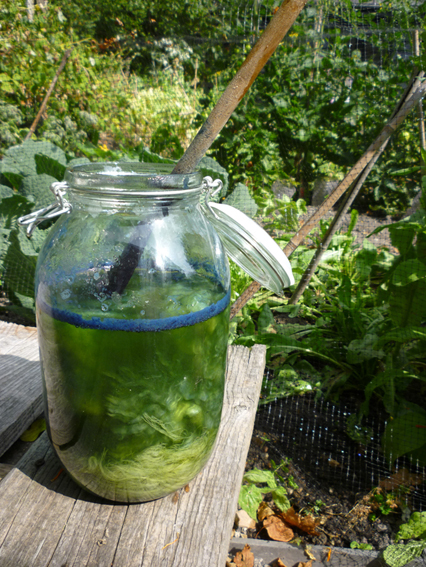
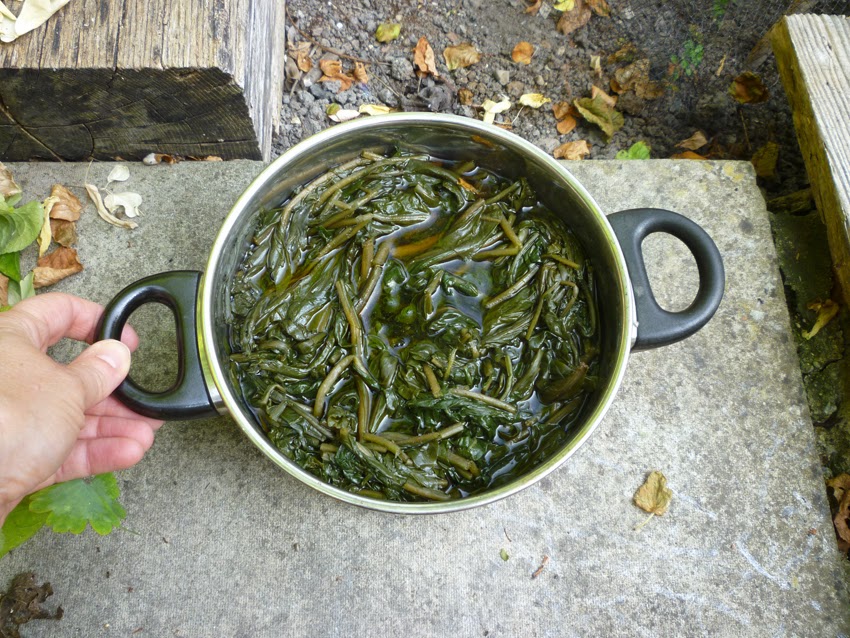
Day Seven. I suspect fermentation has peaked, as after yesterday’s lime the pH remains high – it’s well over 9, the maximum on my packet scale. The vat liquid is dark, there are now scattered patches of a thin shiny, almost metallic scum on the surface. The smell is richer, more complex, and not particularly pleasant (I much prefer the odour of a fermenting urine vat!).

Day7.Vat

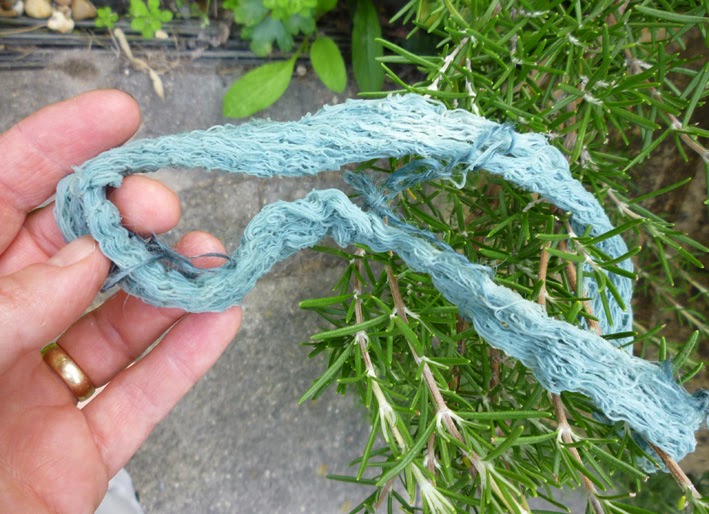
The combination of changed odour and high pH made me think it might be worth testing for blue: the strings are tied to some scraps of scoured muslin that I’ll leave in overnight, and for multiples of 12 hours. I have a strong suspicion that 100g of woad leaves won’t produce a strong blue in any case.

Woad Fermentation Vat No. One, Day One.

So it begins. Over the last couple of days I’ve been assembling and collating information about indigo, woad, and fermentation vats. I’ll post a summary in due course; today I started my first woad vat using my first ‘best guess’ for a process based on my reading. It’s largely based on the instructions for a woad vat in Liles’ The Art and Craft of Natural Dyeing, but without the addition of indigo powder: I want to see what blue I get from 100g of woad ball before I add indigo. I aimed for the pH levels described by Dorothy Miller in Indigo, from seed to dye.

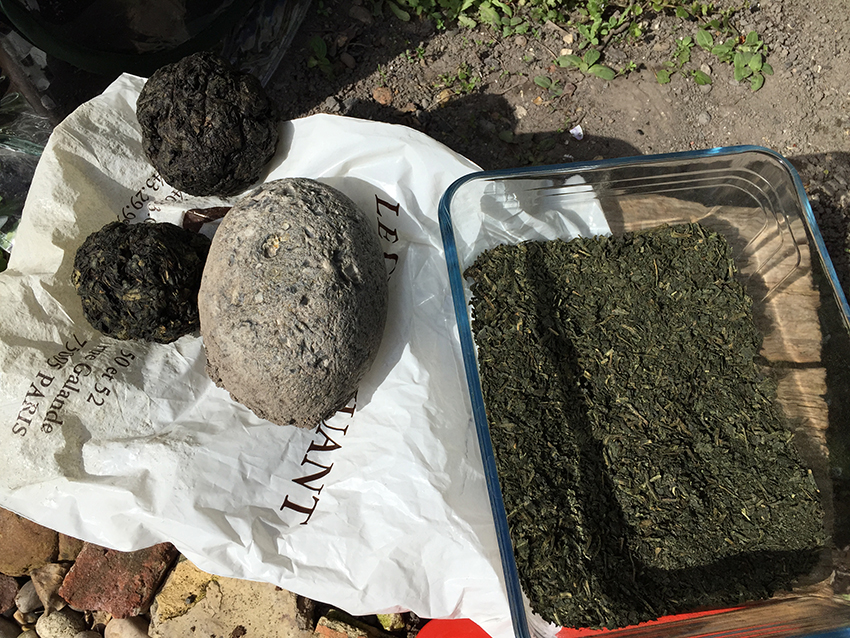
In Indigo Jenny Balfour-Jones describes the couching of woad balls. According to her sources, when the process is complete good woad is dry and mouldy, a condition known as “well beavered”. Mine wasn’t completely dry (I’d left it covered), but it was covered by a remarkable fine grey-white mould. The entire couching process seems to have taken place very quickly, perhaps because I used rainwater rather than tap water to avoid chlorine and other inhibitors of bacterial growth: on 7 May I crushed 100g of woad ball, moistened it with rainwater, and set it next to my desk so I could see what happened. I kept a lid on the dish to retain moisture. It heated up within hours; I turned it on the 8th and again on the 9th, by which time it was cool.

CouchedWoad.Finished

I assembled my kit. The white bin holds 25l/6 gallons; the black strip on it is a liquid crystal thermometer, and the orange thing is a ‘brewer’s belt’ that should maintain a good fermentation temperature, somewhere between 22-28°C. I plan to put that coil of plastic mesh or something similar at the bottom of the vat to keep cloth and fibre away from the fermentation debris.

Equipment

Liles gives quantities for 6-8 gallons; I halved them for a 3 gallon/12.5 litre vat to begin with, and used washing soda rather than lye as an alkali. I dissolved 0.5oz washing soda in 1 litre hot boiled tapwater (boiling should drive off the chlorine), added 0.5oz wheat bran (slow release carbohydrates to fuel fermentation) and 0.5oz madder root (traditionally added because the bacteria on the roots kickstart the fermentation process). I left this to soak for an hour to hydrate the bran before pouring it into the bin and adding 8 litres of rainwater (total 9 litres). I boiled 2 litres of tapwater, added 1.5 litres of rainwater, and brought the entire volume to 70°C on the stove: woad contains both indican, the precursor for indigo blue, and isatan B, a related compound that will create blue, but which according to Balfour-Paul requires a higher temperature at the start of the fermentation process followed by rapid cooling.

I scraped the couched woad into the hot water, stirred it thoroughly for 5 minutes, then dumped it into the vat solution to cool it rapidly.

Vat.Day1

Maintaining the correct pH range is critical for a healthy fermentation vat, and the dyeing process. If fermentation is too enthusiastic, lactic and other acids will drop the pH to the point that the vat will not dye. The acidity must be countered by an alkali, but if the pH is too high fermentation will cease and the vat will damage protein fibres. A pH of c. 10 appears to be good for both fermentation and dyeing, although the woad vat should operate down to pH 8. I decided to aim for pH10 in the vat before fermentation starts. According to my pH meter I was bang on. Remarkable! I therefore omitted the 1/2 tsp lime called for by Liles’ recipe; it may be that our rather alkaline tapwater (pH 8.4) rendered it unnecessary.

I bought pH paper – litmus paper – to check the pH of my fermentation vats a couple of years ago, but neglected to check that the range was appropriate. Mine are intended to check the pH of body fluids (don’t ask, I don’t know and I don’t want to know) and the chart only goes to pH 9 whereas for these vats you’ll need them to go all the way to 11. However it seems that the paper will indicate the higher readings, I just have to create my own calibration records based on the pH meter. Note that the pH 10 paper is in fact more blue-green than it appears. The very blue paper on the right was the 1 litre initial stock solution, which had a pH of 11.2.

pH.papers

One thing is very clear from my reading: a good working fermentation vat is as much a matter of luck as judgement. Japanese indigo artisans pray to Aizen Shin, the god of Ai (indigo) for success. I shall drink a toast to Ai tonight, just in case.
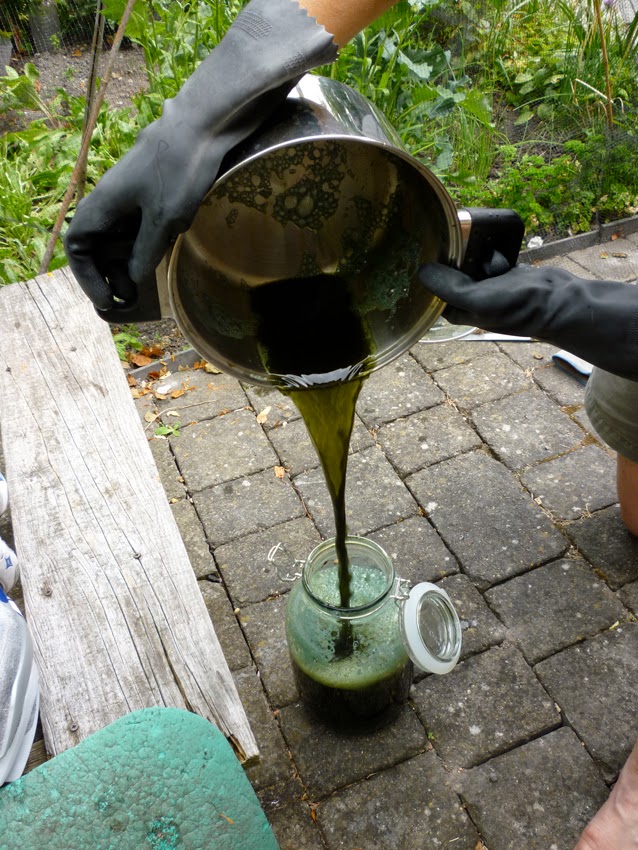
I’ve started preparing for the next vat, too. Guess what that will be based on?

urine

2015: A Summer of Blue

Or so I hope.

I’ve had a thing about indigo for longer than I care to remember. I think it started when my mother included indigo vats in a summer school dyeing class she taught in the early 1970s; in my mind’s eye I still see the shimmering metallic blue-copper-purple surface of the liquid and the cloth emerging from the vat green, turning deep indigo blue as I watched. Some years ago I started to recreate the magic. I began with the simplest chemical ‘colour run remover’ (I’ll explain these terms later) vat, and managed to dye some spinning fibre blue. I felted it too, but still: blue! I read of traditional fermentation vats and HAD to try to establish a sig vat based on the bacterial breakdown of urine. I briefly managed to get it working and saw a different blue, murkier and darker, on wool that 4 years later still retains the faint barnyard odour that for centuries indicated the finest blues.

Woad5

In 2013 my first attempt to grow Japanese indigo failed to thrive outside in a typical British summer, but I discovered that woad – the traditional blue of northern Europe – thrived. I wrote a blog post “Blue! From leaves!” about the fun I had crushing the leaves and extracting the indigo to dye blue, then using the ‘waste’ leaf matter to dye a second completely different colour known as woad pink.

The fabulous gift from A. of John Marshall’s new book on working with fresh indigo has inspired me to plan greater efforts this summer. Woad and the various plants known as ‘indigo’ that grow in warmer climates all contain the same compound – indigotin – that produces indigo blue, but woad contains less than most other indigos.

The summer of blue

I’ve made careful preparations. I want to try some of the interesting techniques that John describes; to be sure of them, I need fresh tadeai, the Japanese indigo Polygonum or Persicaria tinctoria. It won’t thrive in our semi-continental climate and clay soils; it requires a warmer maritime climate, higher humidity and reliable summer heat, and moist soil rich in organic matter. So I’ve bought a tiny greenhouse, the appropriate size for our tiny garden, complete with raised bed that I’ve filled with compost and leaf mould. I’m hoping this will allow me some control over heat and humidity.

IndigoHseGarden

I sowed the tadeai seed that John Marshall kindly included with the book indoors in April, keeping the seed tray in the warmth upstairs next to my computer. I even repurposed my drawing desk light with a grow light bulb. And I’ve had some success! Now the tadeai seedling are hardening off in the greenhouse, and seem to be thriving.

IndigoSeedlingsIndigoHse

In theory woad leaves could be used for the same techniques, although the colours might be fainter.  I need more woad! Sadly my first woad sowing either failed to germinate or, equally possible, the seedlings were eliminated by the horde of slugs and snails that reside in the garden. To the far left of the greenhouse there are three rows of woad re-sown a week ago, and I’m about to go outside to apply slug pellets and cover them to protect the birds and other animals.

Fortunately there are other sources of woad in the UK. The Woad Centre in Norfolk has been growing and harvesting it for some years. They sell indigo pigment extracted from the leaves and a variety of other products, but I am most interested in their woad balls. For centuries woad was a valuable commercial crop, preserved and transported to dyers in the form of balls formed from the chopped and kneaded fresh leaves, then left to dry. The balls can be reconsitituted for various forms of indigo vat, including the same extraction process I used in 2013. I’m now more interested in the various forms of fermentation vats, and have begun to prepare for my first attempt by ‘couching’ 100g of woad ball. This entails crushing the balls as finely as possible, moistening the mass, and leaving it to rot down/ferment into a dark green-black mass which is then used in the dye vat. I haven’t yet come across any explanation of the reason for the couching process; my guess is that the fermentation breaks down cell walls to ensure more of the indigotin compound is available to the dyeing process.

WoadBallPrepThe crushed woad ball in that dish were prepared and wetted with rainwater two days ago and I’m very happy: the mass is darker and warm to the touch. It’s working! It has a strong odour, the smell from the centre of a pile of grass clippings, and that seems right.

I have three 25litre plastic fermentation bins waiting in the garage, along with 2kg wheat bran (I can’t find rice bran) to fuel further fermentation, a pH meter, LCD thermometer strips and a ‘brewing belt’ heater to warm the vats if the British summer fails again. I have commercial natural indigo to add more pigment for a deeper blue. I am almost ready… I just have to set up a, er, urine donation facility next to the toilet :-)

This Friday is for fixed. And for making!

I finished repairing my tabi earlier in the week, and immediately bought a pair of flip-flops to protect the repaired surfaces, because I think they’re beautiful.

FinishedTabiRepair

I might even Pin(terest) my own work.

FinishedTabiRepair1

FinishedTabiRepair2

The spiralling stitches were much faster to work than the blocks, but that might have been because I wasn’t fiddling about deep inside the sock.

Having repaired them, it was time to think about making my own from the pattern and instructions in John Marshall’s book. More bits of my husband’s old trousers, plus some light white cotton sheeting for lining and heavier white cotton, almost canvas, for the outer soles.

NewTabiPieces

I found kohaze (the fasteners I need) on Etsy(!) and have ordered enough for two pairs of tabi. I’ve been Pinning images of tabi, paying special attention to those with sashiko stitched reinforcement or repair. I will embellish this pair, but have to decide whether the stitching should be done before assembly (far easier) or after (the stitching could be used to add shape to the structure). Decisions, decisions, but I don’t have to decide now. First I have to make muslins, as it were, testing the fit. I’ve cut the external fabric larger than the pattern piece, adding allowances to adjust for a high or low arch. I’ll start by basting to the line of the original pattern, and work from there.

I’ve discovered that this sort of hand-sewing is as safely executed as mindless spinning in the evenings while watching TV (unlike knitting the Orenburg lace scarf, which requires my full attention at all times). So I have another tiny project: to replace the little earbud pouch that A. finds invaluable for storing his keys in his pocket.

A.Keypouch

It has a sort of flex frame opening: there are two thin strips of metal either side of the opening. Or were; one cut through its pocket and was lost, and the fake leather fabric is disintegrating. Real flex frames have hinges and are supplied with one closed and a pin for the maker to close the other. I’ve made a prototype, adding darts to create more space for the keys. Only minor adjustments are needed – it’s a little too deep, and might benefit from fractionally greater width (longer darts) so I will test the next version in leather. I have leather needles, I have linen thread, I have beeswax. Maybe tonight.

Also, it occurs to me I could mention my previous Blogger blog at

http://cinereous.blogspot.co.uk

Fridays are for fixing.

Some time ago someone started a ‘Fridays are for Fixing’ thread in one of my Ravelry hangouts. It seemed a good idea – I have lots of fibre-ish things that need repairing – but I couldn’t bring myself to commit to the work. Last Friday evening found me sitting on the couch happily fixing something I love; I’d had a tiny lightbulb moment I’d like to share.

tabiOn

These are my tabi. Japanese sock/slippers, with a gap between the big toe and the rest so the owner can comfortably wear zori, which resemble UK flip-flops or what I called thongs in my Canadian childhood. It’s perfectly possible to ram feet wearing ordinary socks into a pair of flip-flops, but it’s very unkind to the socks. I like tabi. They’re comfortable.

tabiSide

The ankle opening is closed by interesting fasteners, faster than buttons: metal tabs that neatly slide over and behind threads, like hooks and eyes, but larger and very much more … Japanese. Elegant.
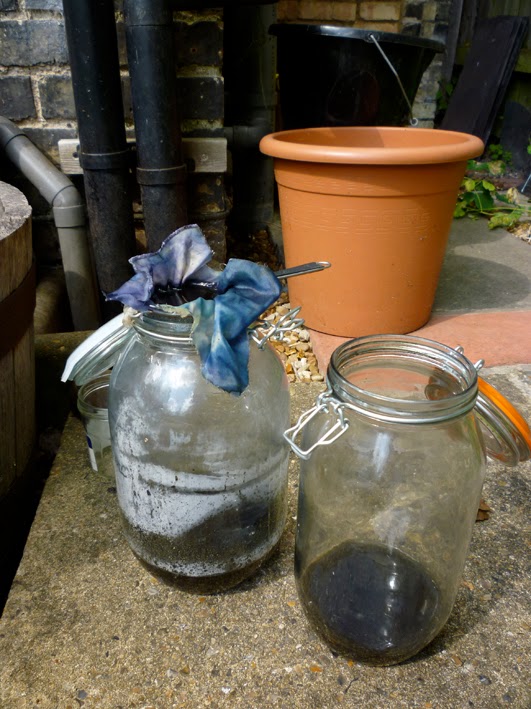
tabiFasten

Sadly I haven’t been wearing my tabi because they’re broken: they weren’t very well made and the snug fit that makes them comfortable and safe to wear has pulled the material of the sole out of its seam in several places on both.

tabiDamge

They’ve been sitting in the bag of things to do for almost a year because I was intimidated by the damage. I felt it should be repaired to be ‘as good as new’, and I couldn’t think of a good way to do that; there’s simply not enough fabric to mend that seam. I could handstitch entirely new soles, but for the work involved I might as well buy a new pair. Or make my own, which is on my short list of projects, but I’m waiting until I have some special fabric for that. Last week the solution became instantly obvious as I cut up an old pair of my husband’s trousers for scrap fabric to test slipper patterns, stacking the pieces next to my sashiko project bag. Sashiko is the Japanese art – it IS art – of repairing, reinforcing and embellishing fabric with simple stitches. I’m fascinated by it, and by boro, the textiles (usually indigo-dyed ‘country cloths’) that have been patched and mended using these stitches. Personal revelation: I didn’t have to make my tabi as good as new. I just had to make them function as they should. I didn’t have to use indigo cotton and white thread, I could use whatever I had, which is true to the tradition of clothing repair. What I have is pieces of trouser leg and a box of embroidery threads, some of which are over 40 years old.
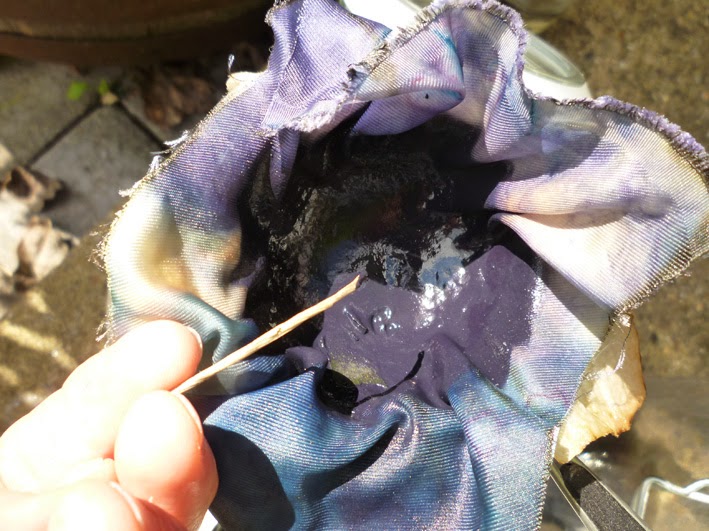
EmbThread

RepairDet

I tested the patches before I started and no, I can’t feel that overlap. The repair might not last a long time – the embroidery thread is probably a bit too fragile – but it should last long enough for me to make my own slippers.

I’m not a seamstress. I’ve done my best to avoid sewing for most of my life. But I’m beginning to enjoy it as part of the process of bringing real things into existence. I hope I’ll get better at it. I think I will.

RepairInSide

After all, practice makes perfect and I’ll get more practice now that I know perfection is not the goal. Fridays are indeed for fixing.

Blue! from Leaves!!!

The Hat has been my main focus for the last few months and I can’t blog about it because I hope it will be published. Sorry …
But I can tell you all about another chapter in My Adventures with Indigo. It’s a long one; you might want to make a cup of your favourite beverage now, before you start. 

About 12 months ago I ordered both Japanese Indigo and Woad seeds, my cunning plan being to throw cabbages to the wind and grow blue instead. Alas, I have no greenhouse: the bitterly cold winter and late, wet spring put paid to the Japanese Indigo, which even indoors scarcely showed a leaf before giving up the ghost. This isn’t the climate it was looking for. Woad, on the other hand, was and still is grown here as a crop, so I expected more of it. To its credit, it delivered. Woad is apparently a gross feeder, in this case meaning that it needs nutrients and lots of them, rather than having no table manners. I fed it regularly with blood, fish and bone, and watered regularly in dry weather. It’s biennial; the first year leaves give colour, the second year there is no colour (can’t vouch for this yet), but you get seeds to grow more. Harvest the leaves from midsummer on. This post depicts events on July 21, my first pick.

I have both Jenny Dean’s Wild Colour (I have an earlier edition) and Rita Buchanan’s A Dyer’s Garden, both of which give instructions for dying with fresh woad leaves. It’s extremely straightforward. 

First grow your woad. I suspect it’s important to move as quickly as possible from harvest to hot water, so I set up my kit next to the woad, which is the lowish, bright green, elongated leaves to the right of the cabbages. The net is essential: everything under the net is extremely dangerous is food for the caterpillars of Cabbage White butterflies. If you don’t prevent the adults from laying eggs on the leaves, you will have no leaves. Ignore our bike gear, it’s just drying out/absorbing UV to kill bacteria.


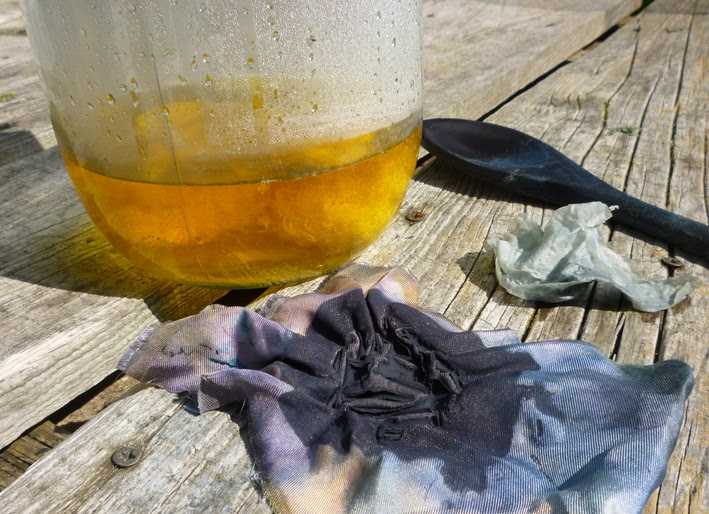
Basic equipment for an afternoon of fun: well-wetted materials to be dyed blue, plus a large container (I used a jar because I can see the colour of the liquid in it), a large wooden spoon, rubber gloves, a glug or two of household ammonia, a BIG saucepan or stockpot (it will hold only water), with trivet and a thermometer accurate from 0–100°C. For further excitement you’ll need a saucepan you don’t use for food, and 1 tsp of alum mordant. Read the instructions below to make sure you understand what you’ll be doing and why.

Fill the kettle (really full) and put it on for tea. 
Pick the leaves as quickly as possible, and stuff them into a container. A large glass jar is good because you can see the fluid change colour, which is helpful. No need to shred them finely or anything, I just grabbed handfuls, slugs and all, ripped them in half and stuffed them into that large jar. 
The kettle should be boiling by the time you finish: pour the boiling water into the jar, enough to cover the leaves. Make tea with the leftover, if you want any; I opted for squash instead. Leave the leaves to soak. 

If you plan to go straight to dyeing once you’ve got the indigo from the leaves, at this point you should half-fill a saucepan or stockpot large enough to hold your jar with water at least halfway up the sides, put the trivet in the bottom (to prevent the glass jar from overheating on the metal) and put it on low heat (you’re aiming for 100-120°F (38-48°C). If you haven’t got a trivet, I use a layer of metal table forks.

The jar of leaves soaking in hot water.
The fluid will change from water-clear to dark sherry-brown as the leaves wilt. After an hour, remove the leaves (I used a kitchen strainer), squeezing out every drop of fluid, and put them carefully to one side. You will use them again.
 
 
The chemistry of indigo dyeing is not complicated, but it’s important. The dark brown fluid in the jar contains indigo from the woad leaves in the form of indoxyl (more detailed info on Wikepedia, scroll down to Extraction). To extract the indigo from the fluid, add a glug (about 1 tablespoon for this jar) of household ammonia to the fluid. Buchanan says baking soda will also work, I haven’t tried it.). Now pour the fluid back and forth between two containers, exposing it to the air as much as possible. You want bubbles and lots of them!
 
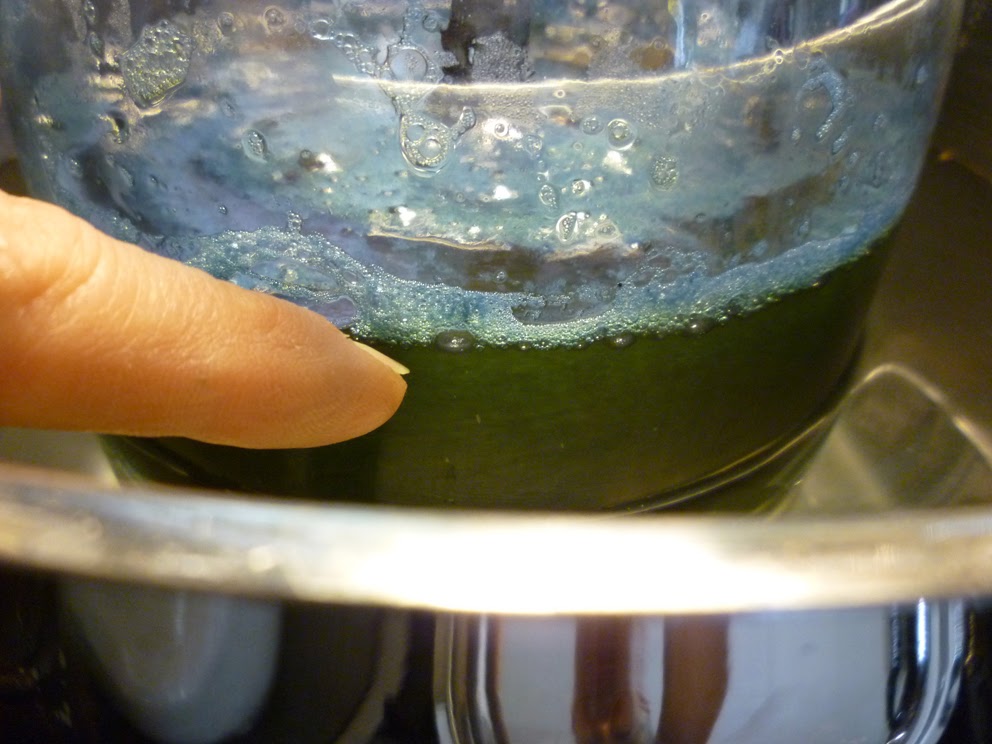
The foam starts yellow but turns a beautiful turquoise as the fluid is oxygenated, transforming the indoxyl into insoluble blue indigo. Once it’s as blue as blue can be, it’s decision time. You can dye with the fluid and indigo, or you can filter out the indigo particles and save them for another day. Filtering takes longer to do but much less time to describe, so I’ll show you that first. If you want to DYE NOW! skip the next section.

Filtering the indigo particles
My reading suggested that coffee filters and such aren’t fine enough to trap the bulk of the indigo particles. Some people use proper filter paper, but I didn’t have any. Instead I used two layers of extremely finely-woven commercial silk fabric to line a small tea strainer. Straining a smaller volume (I did this with the second batch of woad processed in August) took the best part of two days. Save the filtrate (the filtered fluid): it probably still contains enough indigo to dye something else blue if you follow the instructions for dyeing with the fresh indigo solution, below.


I suspect that’s very impure; there’s probably a lot of vegetable debris as well, but I see no reason for it not to work. 

I dyed a skein of cotton with the fluid that ran through the silk. A paler blue, but still blue!


Dyeing with the fresh indigo solution
If you decide to go ahead and dye with the solution, from this point the process is similar to a standard chemical indigo vat. Make a solution of reducing agent (thiourea or Spectralite), 1 tbsp in a jar of warm water and add it to the fluid in the jar. The reducing agent absorbs oxygen in the water, which transforms the insoluble blue indigo particles to the yellowish soluble form. In this form they are absorbed by the materials you want dyed. Now, given that you’re trying to REMOVE all the oxygen from the solution, once you’ve added the reducing agent you should take great care not to ADD oxygen (air!) unnecessarily. Stir gently, don’t create bubbles. To activate it, the solution must now be heated to 100-120°F (38-48°C) for about an hour. Check the temperature of your water bath and adjust it by adding boiling water or cold water as needed. Put the jar in. Stir it gently from time to time and check the colour of the fluid. It should become yellowish: with luck you can see that the bottom of the bubbles and the fluid is in fact yellowish.


When it looks like that it’s ready to use. Take the jar off the heat if it’s more convenient. Squeeze excess water from whatever it is you’re dyeing and add it to the jar.


Note the bluish tinge to the merino locks, which still contained some air. A hint of what is to come. I left the fibre and yarns (wool and silk) in the jar for about 15 minutes. When removed from the jar oxygen hits the pale green-yellow liquid: it begins to turn blue. First turquoise, then darkening further. 

You can dye more material in the jar until the indigo is exhausted, but remember that each batch adds oxygen. If the fluid becomes more blue than yellow, add more thiourea or Spectralite and repeat the heating process to drive off the excess oxygen, thus reducing the indigo to the soluble yellowish form that dyes.

Different fibres take and hold indigo differently: unlike ‘chemical’ dyes, in which the dye molecules chemically bond to the material, the soluble yellow indigo penetrates into microscopic cracks and crevices where, with luck, the insoluble blue particles are trapped, wedged firm. Those that aren’t trapped firmly will come off on your skin (and everything else) as the indigo blue ‘fades’ over time. Silk and other very smooth fibres have fewer places to trap indigo, so tend to end up paler than wool or cotton. But when they first come out of the vat, everything is simply glorious blue. In this case, glorious blue FROM LEAVES!!!


Well, not quite everything. That pinkish-brown skein of silk is just as magical, or even more. Remember I told you to save the leaves strained from the initial solution? 

Dyeing with indirubin: Woad ‘pink’
If you now treat the woad leaves from which the indigo was extracted as if they were standard fresh plant material, they will yield a totally different colour: woad pink. Mine was more brown than pink, but still absolutely astonishing to get two such different colours from a single leaf. The technique is simple: stir the strained leaves into a pan of water (I used rainwater, in case our very hard water affected the chemistry) and simmer for an hour or so.

Strain off the leaves – this time you can discard them! – and add 1tsp of alum mordant to the dye solution.


Add the material to be dyed and simmer for another 15 minutes or so, then allow the solution to cool with the material in it – leave it overnight if you can – as this yields a deeper colour. Here’s a closer view of the silk to show the indirubin colour:


A project for the Cotswold.

The ‘wrong fibre, wrong place’ Cotswold now has ambitions, or more accurately I have an ambitious goal for it. I was whining on Ravelry about lack of desire/inspiration for the 2013 Rampton Project of a Fun and Frivolous Hat when …

(insert wavy lines and flying calendar pages here). 

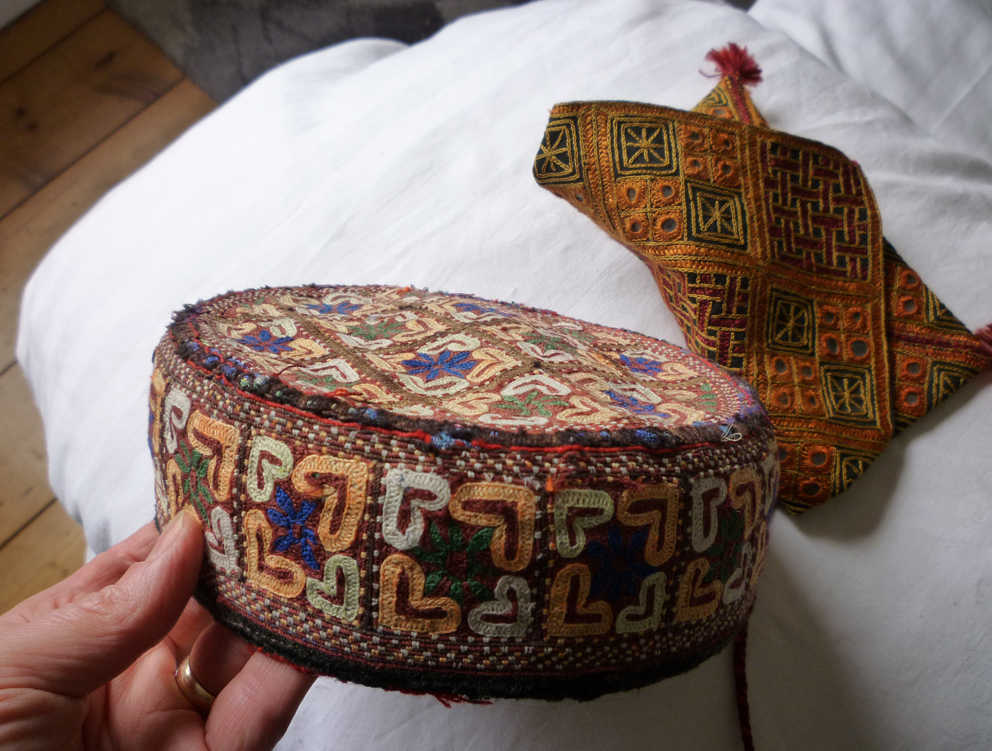
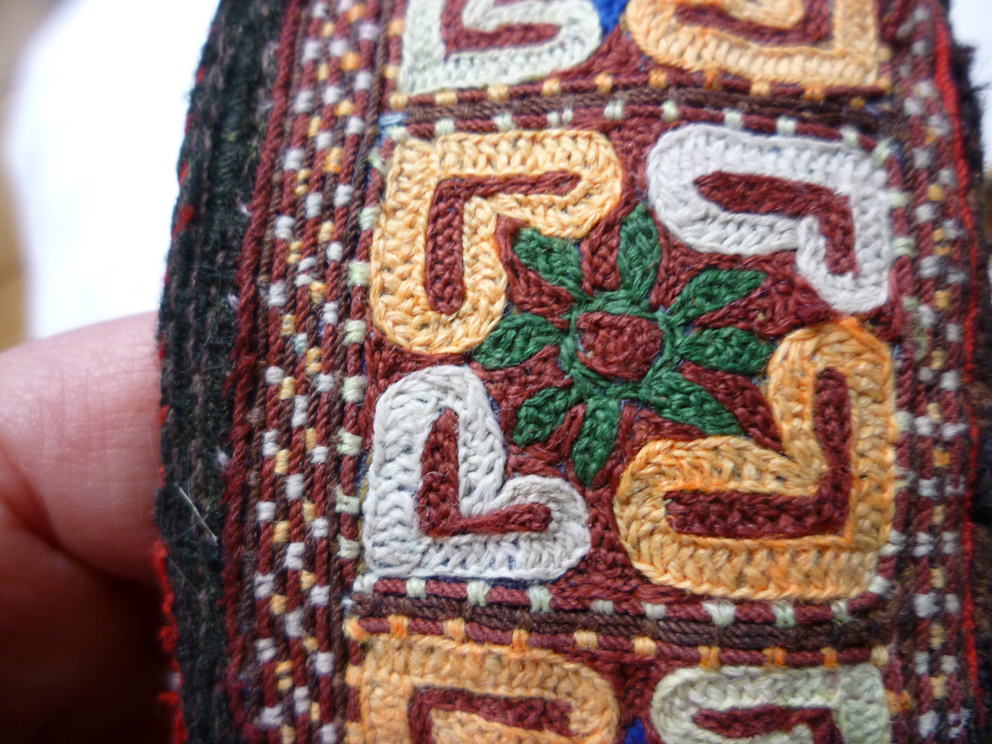
Some weeks previously Sara Lamb had recommended books by Sheila Paine as of use to someone else; I thought they sounded interesting and worked my way through the travel trilogy (begins with The Afghan Amulet) and then acquired Embroidery from Afghanistan. So naturally I began a search for hatty inspiration by looking for various hats from Afghanistan online. Google images promptly gave me this link, which I posted to Ravelry because one shares the good stuff, right? To cut a long story short, Sara suggested I make a similar hat from fulled handwoven handspun. Good plan, I said, or words to that effect, despite knowing next-to-nothing about how such a thing would be made. An expedition to a local purveyor of New Age crystals and ethnic jewellery proved unexpectedly rewarding: it’s a real one. Well-worn and faded: that pale orange was once fluorescent, and the pale grey-green was screaming lime. 
Close examination shows the embroidery almost completely conceals a blue woven cloth. I think a couple of layers of that are lined with other fabric, then quilted and embroidered. Most of the embroidery stitches are worked within the quilting.
As always, I am moved when my hands feel the work of someone else’s hands. Work, not art: an item made because the maker or someone she cares for truly needs or wants that thing, or the money that can be made by selling it.  
Although I don’t plan my hat to look much like that hat – it’s a man’s hat, to be worn with a turban wrapped around its sides, and sits foolishly on the top of my head – the women’s hats are so ornate that I can’t imagine wearing one. I am inspired instead by this child’s hat. I doubt mine will look much like that, but it’s a starting point. 
To make anything I need cloth, and to make that I need yarn. 
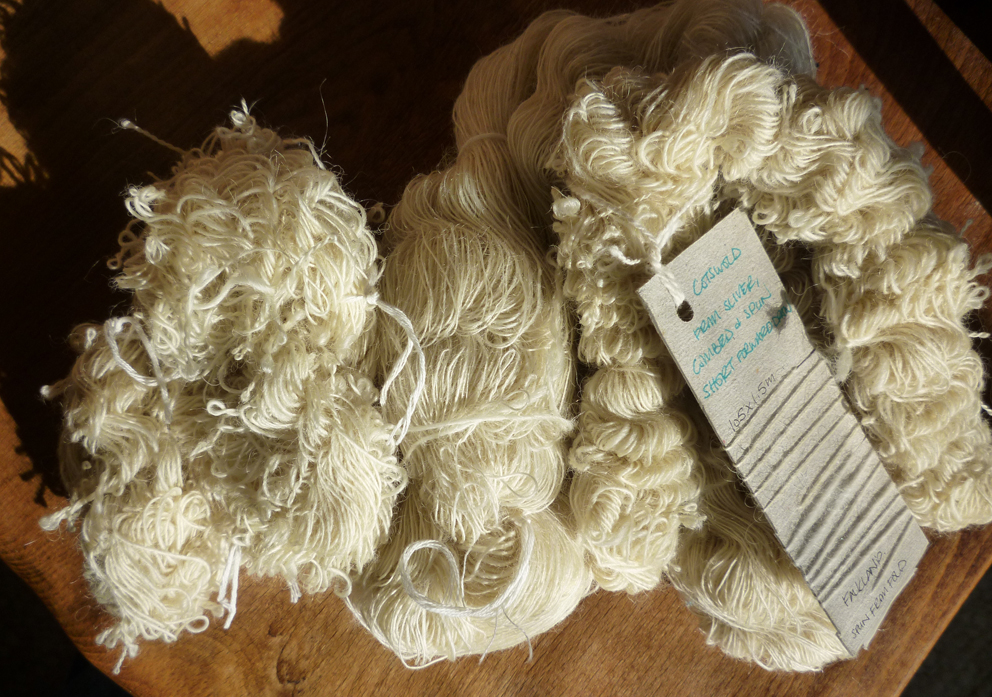
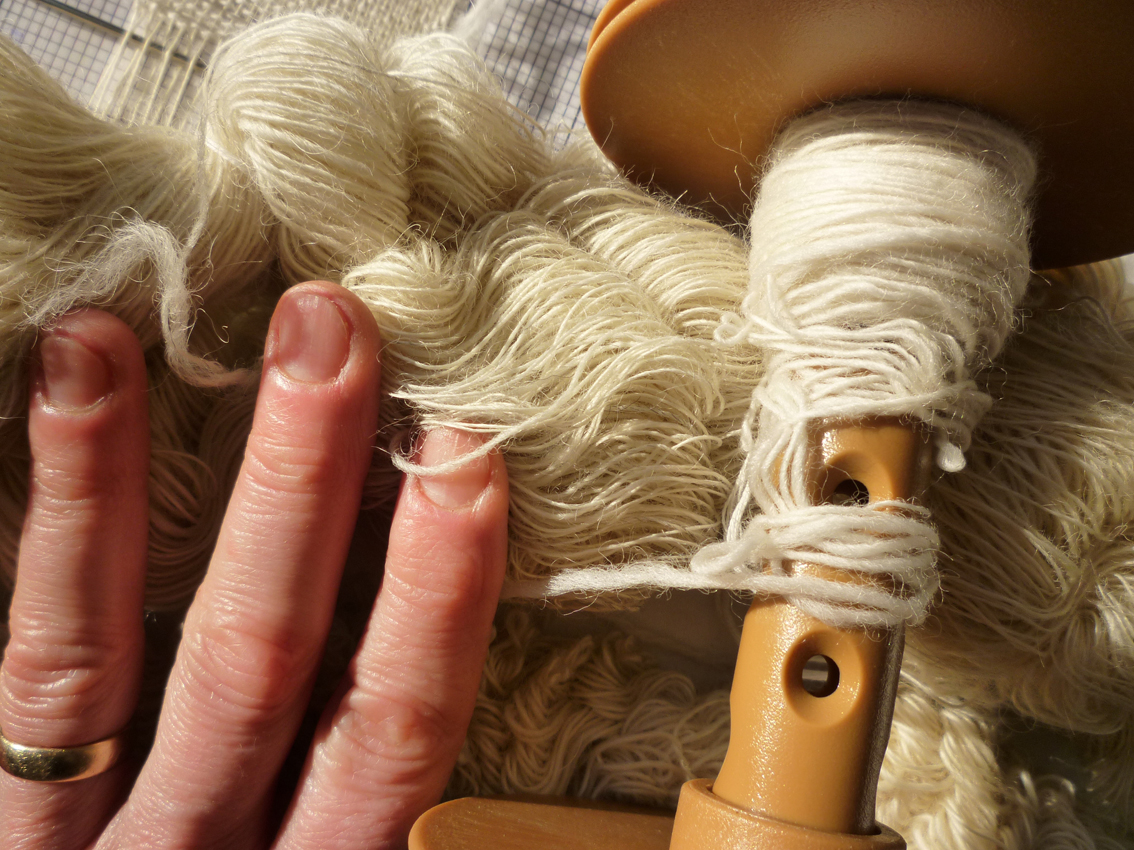
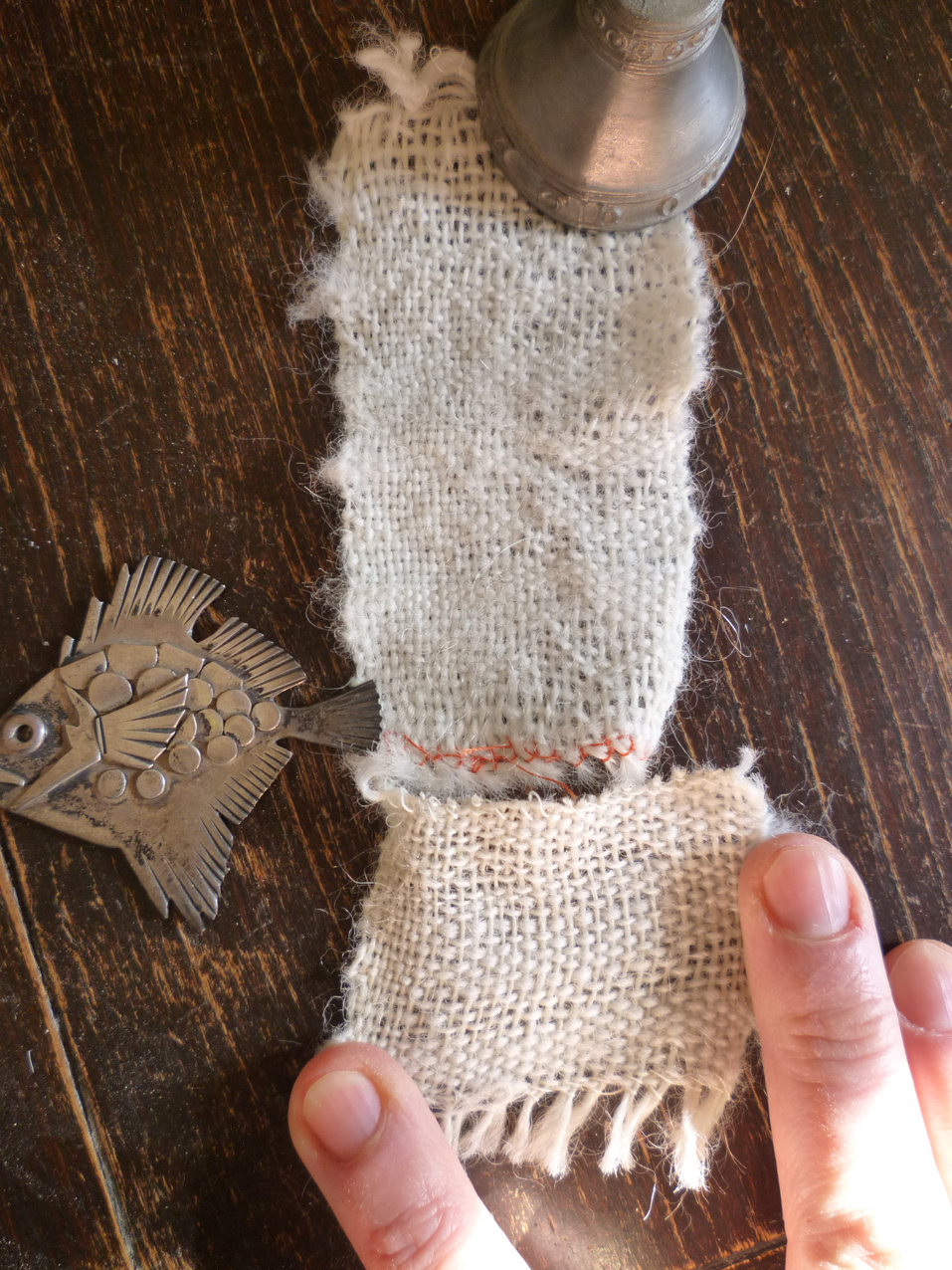
I had about 450g of the sliver, which yielded 171g of singles spun short forward draw. I’ve put 157m to one side in case I want to submit it as part of my work for the Guild of Weavers, Spinners and Dyers Certificate of Achievement in Spinning; that weighs 30g, so the remaining 141g should give me about 740m of warp. But what to use for weft? The combing waste was horrible, full of short cuts and nepps, dirt and dark hairs. I surveyed the stash. Not something precious, not my fine shetlands and other soft wools. And it has to full and/or felt, which ruled out the Dorset Horn and Southdown tops. I was looking thoughtfully at the BFL top when I remembered the Falkland. ‘Falkland’ is the wool clip from the Falkland Islands, originally Corriedale and Romney, now with Polwarth and some merino crosses.  Three minutes with soap and water told me it would full. So I spun a sample from the fold for a more woollen yarn (leave space for the fulled fibres to compact) to roughly the same grist as the warp (it looks thicker in that photo but that’s because it’s woollen). 
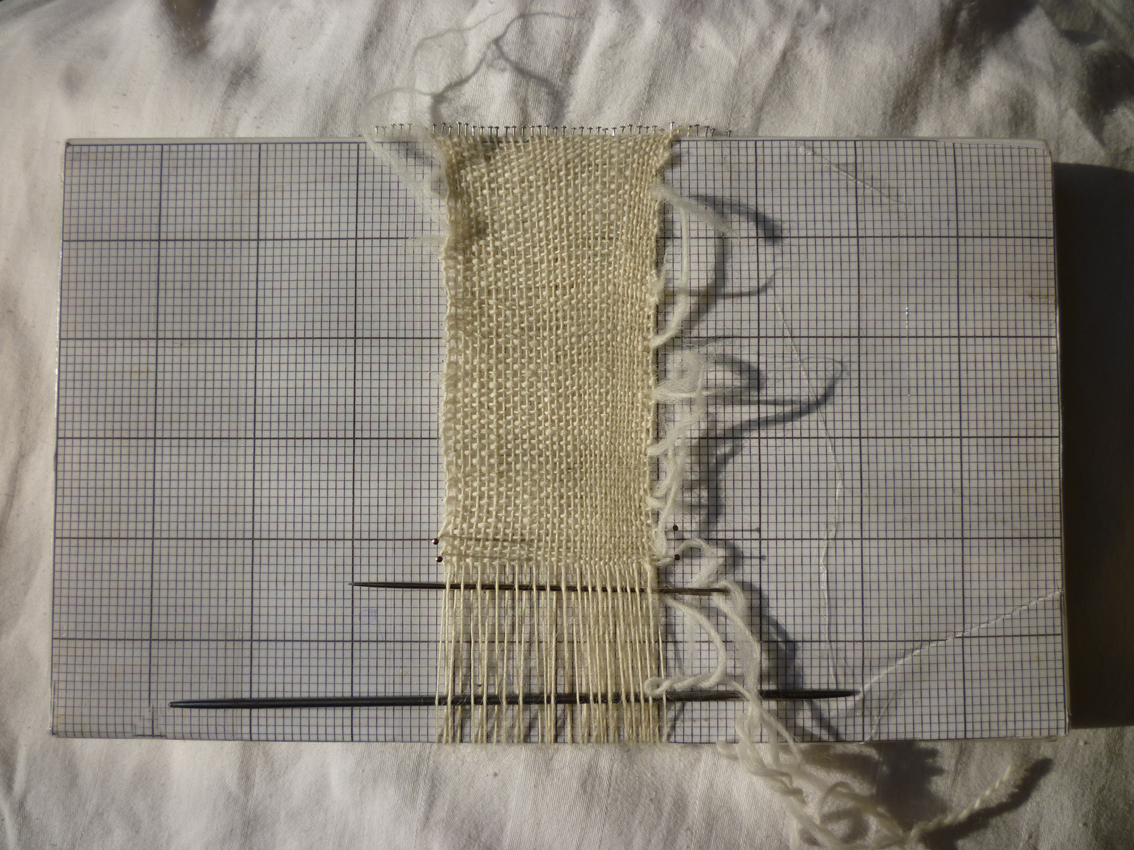
I’ve only once made a fulled fabric, and that was a tiny sample spun and woven for Stephenie Gaustad’s ‘Spinning for Historical Reenactment and Museum Replication’ class at SOAR. I needed some idea of what these yarns will do together. How much might the fulled fabric shrink? What sett should I use? I used a straightforward sampling tool, another gift from Sara Lamb. When I say I am fortunate and truly grateful for all that my mentors have given me, I am totally serious. All they ask in return is that I use it: so I do, and I pass the knowledge on.
It’s foamboard covered with graph paper, with pins along the top edge to space the warp. I use the knitting needle at the bottom of the warp as a heddle stick, holding the threads for one pass of the weft for plain weave; I needle-weave the other pass (using a heddle stick and beating with it gives better, denser fabric than needle-weaving alone). It’s faster than you might think. I hemstitched the edges, then hemstitched to isolate 1/3 of the strip to be cut off and kept as a loom-state sample. The other 2/3 I fulled by hand on the kitchen counter this morning.
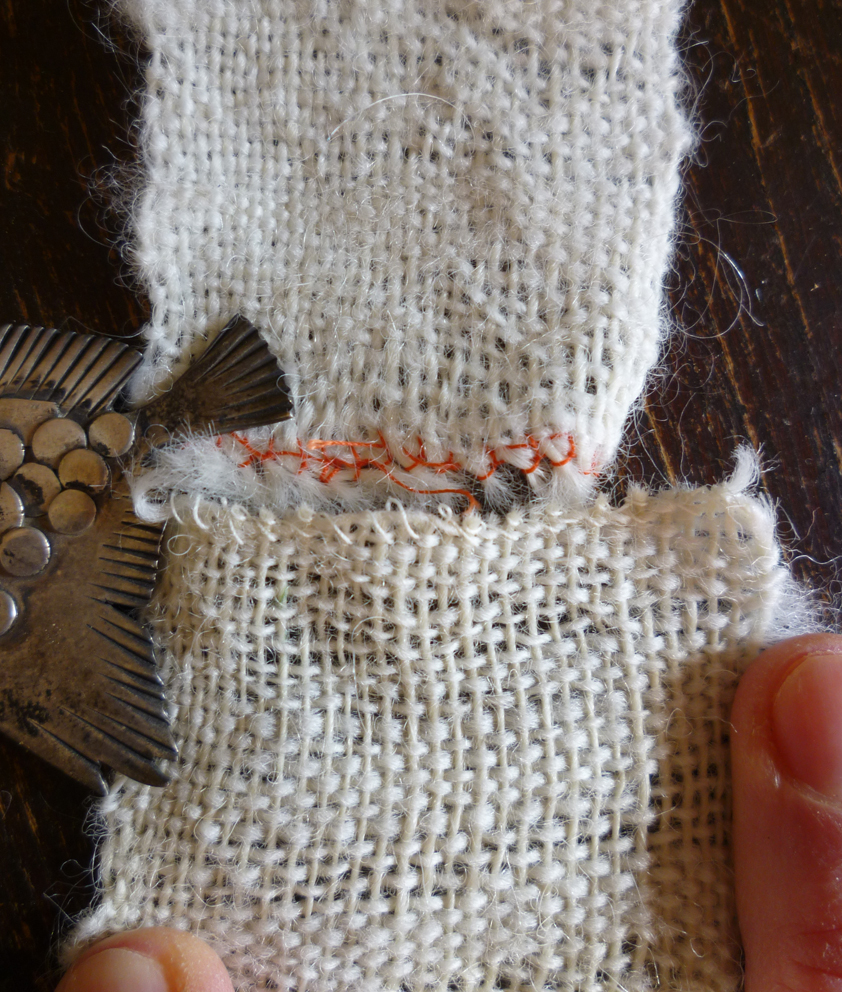
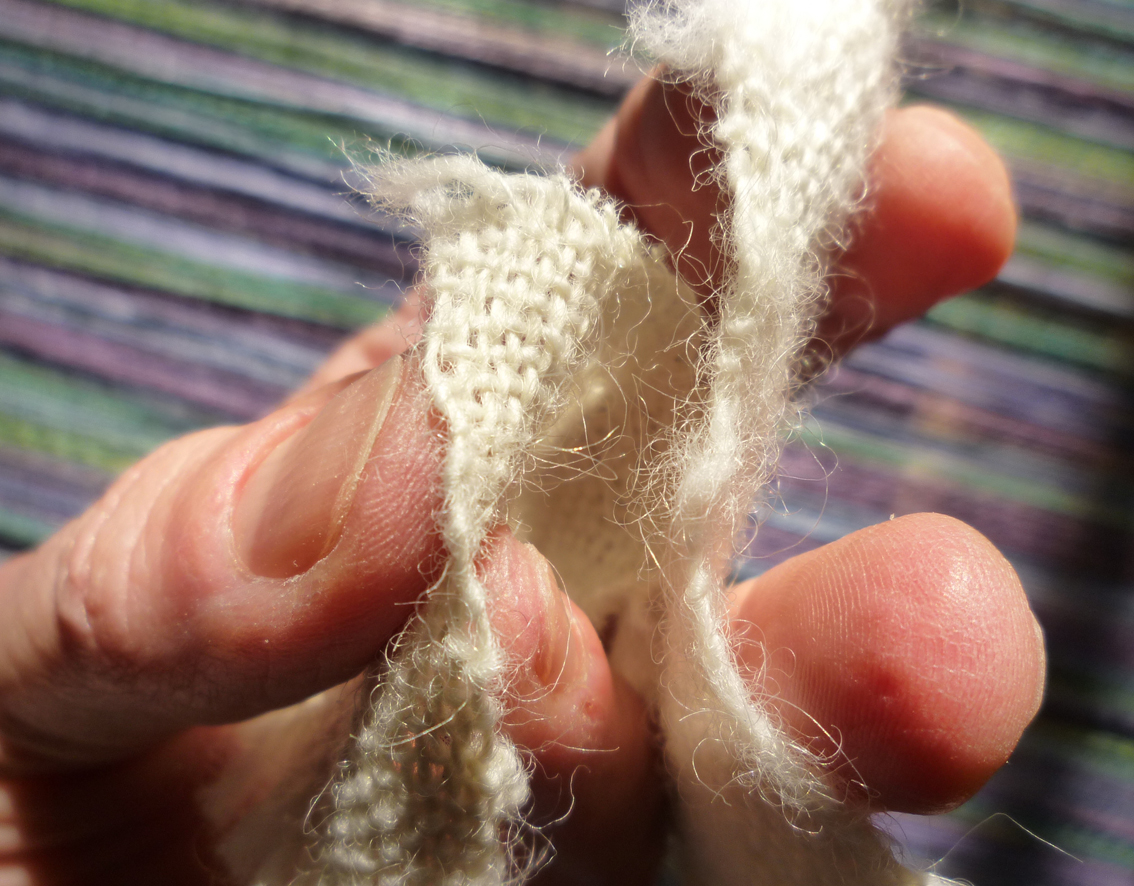
Although Cotswold will full slightly, the Falklands is much better at it: it’s lost 1cm in width. The strips are oriented in the same way, with that slightly denser band down the same side. I like the fabric, I like it a lot. The overall sett is 34 ends/2″, which is 17 epi. The denser areas have fulled to a tight plain weave; I have to check the loom-state sample/fragment (it’s a very small sample!), but I think that’s nearer 20 epi. If I use size to reduce hairiness and sticking in the warp I think I can achieve that lovely even plain weave fabric on the loom. So this tiny sample has told me a lot: my fibres do what I hoped and I have an approximate sett to make a functional fabric. I might put half the fulled sample through the washing machine to see how much denser it becomes after a normal wash cycle… but then again I may not.
 I don’t know if this fabric will be ideal for the purpose, but I think it will suffice. It’s not so thick and stiff that it will become cardboard when further stiffened by embroidery. It’s soft, but feels hardwearing; I can imagine a winter coat or cloak made of this. It’s fabric of character. I like it. And I’m so proud that I planned it from nothing and I made it real with my own hands.

The wrong fibre in the wrong place at the wrong time

That’s a remarkably vague title, but it’s what unites the two topics of this post. First, some spinning fibre: Cotswold sliver.

It doesn’t look too bad from a distance. Creamy white, reasonably lustrous… feels relatively soft, not harsh. Could be good, but look at it more closely.
There are inconsistencies, curds of shorter, finer fibre. Also, as you can see, sliver is a carded prep, not combed; the fibres are not parallel, they’re interlocked. But this is Cotswold… a long wool. What’s going on?
Above are Cotswold locks, unwashed and washed. Below, fibres pulled from the sliver to check staple length (and therefore more parallel, similar to top, than they were in the sliver itself).
Check the staple length: it is long. (With those embedded tufts of finer, shorter wool just waiting to add … character … to the spun yarn.) I did sample it; I can’t find the sample to show you, but spun with a point-of-contact long draw I assure you it seemed to me a relatively nasty yarn, hard to draft  (the long fibres run through both slubs and twist-locked thinner areas, so the slubs cannot be drafted unless the twist-locked areas are freed). Definitely characterful and not in a good way. The wrong fibre (Cotswold) in the wrong place (a carding machine) at the wrong time (when it was carding).

So. What to do? I could bin it, but 500g = £12 plus postage and I just can’t bring myself to throw the money out. But wait! I don’t have to. Gentlemen, we have the technology. We can rebuild him, er, it. With combs.

The fibres are unsorted, so ignore directionality such as butt and tip. Just lash the sliver on, then comb. In general more passes will give better results, assuming you don’t stress, weaken and snap the fibres. In any fibre prep, watch what you’re doing and if you notice more nepps than when you began, Stop! (And next time, stop before the nepps form.) I don’t think this was wonderful fibre to start with; some of the sliver contains a lot of darker hairs and other areas contain dull, short fibres, so I give it only two passes. I have fleeces more deserving of that processing time.

The photo clearly shows that combing has done a good job of separating the long fibres from the short. Diz off the long fibres and:

there is a nest of roughly-combed top. There are still some nepps in it, but I can live with that. Above the top is the combing waste, composed of second cuts plus shorter, finer fibres from the base of the fleece, plus nepps formed from longer fibres broken in the carding process. In the medieval period combing waste was spun woollen to become weft for relatively low-grade cloth that was finished by fulling and perhaps brushing to raise a nap on the surface. I plan to try that with this waste, but if it’s too nasty, I’ll use some other softer, fullable wool. The top will be the warp yarn for this cloth. It’s not too bad. That sheep was not shorn in vain.

Next, another fibre – or rather, fibres – in the wrong place at the wrong time.

Weaving! Janet Phillips showed me a different way to hold the lease sticks for threading, and I thought I’d share it – and my refinement of it – with you. For my first warps I had the lease sticks on lengths of string running from castle to back beam. I found this awkward, so was pleased to hear about Angel Wings, which attach to the Baby Wolf back beam to hold the lease sticks securely in a fixed position. But I found them awkward, too. The cross was a long way behind the heddles. Janet uses string but ties hers much nearer the castle, bringing the cross much nearer the heddles. I couldn’t find a good, quick way to try her tying method on the Baby Wolf, then realised I didn’t need to: two hooks off the kitchen pot rack would do the job. A loop of thick cord is passed between each end of the lease sticks, then hung from the hook. And, even better, the tube work light I bought for my husband sits across the hooks to shed light on the cross while I’m working. It works really, really well.

(The light is not so ferociously bright as it appears in the photo.) You may notice some strangely yellow heddles in that shot; they’re string heddles, tied to correct a stupid mistake: I miscounted the heddles when setting up to thread. I work from right to left, and the Baby Wolf shafts have a fitting in the middle that prevents heddles sliding across from the left side to the right. I could had pulled all 200-odd threads out, added more heddles, then re-threaded, but why would I want to do that? Far faster to cut some lengths of smooth, shiny mercerised cotton, loop it around the bottom of the shaft, tie two knots to define the heddle eye, then knot the ends loosely around the top of the shaft. Magic! The right fibre (cotton) in the right place (my thrums bag) at the right time (when I need it).

The wrong fibres (remnants of handspun lace yarn in tussah silk, cashmere, camel down) in the wrong place (on a loom) at the wrong time (as an unsized warp). I fear this will end badly, as the soft, blooming ends were catching on each other and causing uneven tension in the warp while I was winding it. I should have sized the warp after winding or, even better, skeined the balls of leftover yarn and sized it before winding the warp. But I was concerned only about the behaviour of the warp while weaving, so planned to size it on the loom. I’ll know better next time. I’ll persevere with this because dealing with the uneven tension will be educational (ha!) and, well. It’s just so pretty…

Passionate Weavers: thoughts on a great weaving weekend

See? I’m keeping my word. Another post, to share my ‘Natural Time Out’ weekend weaving with Janet Phillips, and some of my thoughts about it as I drove home. I’ll spare you the “oh, why aren’t I there yet?” thoughts (four hours on the road is even longer after a long, engrossing weekend).

So. After I returned from the gym on Friday morning I did the dishes, the housework, packed, etc, and started the long drive to Somerset. After three hours of motorway driving at a steady 68mph in deference to the age of my car (the oldest car on the road by a long stretch!) boredom won, and I left the motorway for Chippenham. Southwest for adventure!

Glastonbury Tor in the distance as I drove. Well, as I stopped to take the picture.


I had intended to climb the Tor, but it would have been a rather muddy walk from the car park in the centre of Glastonbury and I was trying to keep my shoes clean, so I settled for a wander around town –  right back to the early 1970s, complete with the same incense! – and a visit to the ruins of Glastonbury Abbey. I was thinking about pattern and colour as well as history:

Lines and blocks: arches in the ruins
Medieval encaustic tiles, a remnant of the medieval Abbey floor.
The Abbey did not have the atmosphere I’d expected for such a famous centre of mysticism, possibly because it is so thoroughly steeped in patchouli. Crowland Abbey and Rievaulx both made much deeper and longer-lasting impressions on me. Anyway, from Glastonbury it’s a straightforward drive to Nether Stowey. Past orchards (Somerset is famous for cider), and some very muddy sheep. I conveniently found the two together here; note the mistletoe on the apple trees. I suspect these are rams; one was definitely Texel, but the others turned their backs on me almost as I clicked the shutter.
I checked into the Rose and Crown (Be warned, mobile reception is almost non-existent in the village. They do have wifi in the bar, but you have to ask.) and the next morning after breakfast I walked up the hill to the remains of Nether Stowey Castle in search of phone signal. 
From the top of the Castle mound or motte looking south over the foundations of the keep to the Quantocks beyond.
And the view north over the village, with the cooling towers of Hinckley Point visible in the distance.
And then it was weaving. I took full advantage of the fact I was Janet’s only student on Saturday and Sunday (Tina arrived on Monday, and Amanda on Tuesday). I’d brought samples of my weaving to date, and Janet seemed genuinely impressed by what I’d achieved, particularly with handspun singles. I then laid out one of my favourite problems, an assortment of yarns I’d bought with a view to weaving fabric for a vest or other garment. 
I’d chosen colours to complement some Blue Moon Fiber Arts silk thread, but even with the added lustre of the silk as weft (I don’t want horizontal stripes in a garment!) wraps to test warp stripes looked like school uniform fabric. Uninspiring.
I’d thought of adding 60/2 silk in toning or contrasting colours to enliven the warp (sample wrap on left) and it seemed to work, but I wasn’t sure how best to do this in a fabric, or whether differential shrinkage would lead to the silk popping out of the wool after washing. Janet said “sample”, just like every other experienced weaver of my acquaintance – but this time I had to do as I was told. As I’d asked to wind a warp and warp my own loom because I’d learned what I knew from books and YouTube, I was guided through the process of winding a warp for a ‘Colour and Weave Effect’ sampler from the yarns I’d brought. Including 60/2 silk where I thought it useful. Beaming is so. much. easier. with someone to reassure me from time to time! Wind on with sticks to start with, then sections of vinyl flooring; I will have to try this again, as it was extremely easy to work with and, although using rough paper for the ‘tooth’ to hold yarns tightly makes sense, so does using a smooth surface to prevent damage to the yarn and ensure that a badly wound section can be improved by subsequent tight winding. I stayed late to finish the threading only to find I had two spare heddles. A quick check showed that the error, whatever it was, was near the beginning. I left, resolving to come in early to find and correct the error. The morning light revealed I was two ends short of one colour; I left two heddles for the ends and rethreaded the warp in record time. (I was almost genuinely pleased to have the threading practice. Almost.) I couldn’t have picked a better mistake to make at this stage, as Janet was able to show me how to add warp threads when needed. So easy! Then tie on, weave a header to check threading and tension (take up slack if necessary) and I was away. 
I used the Ashford 4-shaft table loom at back left, with a stick shuttle. On the dresser at right are cones of yarn and bins of samples, which Janet referred to almost constantly to answer questions or inspire thoughts. 
The sampler on the loom at 28epi. Note the subtle shifts of colour in the warp where silk threads are modifying the dull purple and gold.

Weaving. 0900–1600, every day for the next three days. With breaks for lunch, for quick lessons on the principles of weave design, to admire each others weaving, but still almost all weaving, almost all the time. It was WONDERFUL!

I fell in love with shadow weave. So I had a lesson on how both yarn colour and weave structure can be used to create a change in direction when and where required. And I brought home something to remind me that I want to do this, too.

Hard work, but full of wonders, of little flashes of enlightenment and inspiration. And laughter! We’re all concerned that Janet’s website photo makes her look entirely too stern :-) Tuesday pm came too soon, but we’ll all try to keep in touch and meet at Janet’s again.

I arrived home with tangible inspiration: a sampler. Four feet of sampler, including a host of patterns all woven on a straight twill threading. Not yet washed, but Janet’s class work with this particular yarn, a tightly spun worsted 2-ply, indicates it will not full and shrinks very little, even when machine washed (on a wool setting). So I will finish this properly once it’s hemmed and I’ve done something about the ends where I’ve tied in new warp to change some colours, but I am reasonably confident that – with this yarn – shrinkage of the wool won’t cause the silk to buckle.

The sampler and the process of weaving it has answered many other questions. 
Not only do I have more confidence winding and beaming a warp (and correcting mistakes!), I know how adding silk thread to the warp will work, and what it adds to the fabric. I know that the silk I planned to use for weft wouldn’t work as I thought. I can make a beautiful fabric without it, just by adding silk thread. I have some idea of the best way to add the silk to both warp and weft.

And I totally love what I made.

If you’ve survived reading this far, here are the thoughts I promised. I am extraordinarily fortunate to have been taught by three amazing weavers, Sara Lamb, Stephenie Gaustad, and Janet Phillips, each of whom has a different style of teaching and seems to be interested in different aspects of the craft of weaving. And yet, driving home, I found myself thinking about what unites them in my mind: their passion for weaving, their love of weaving, and their drive, their deep desire to convey this passion to their students. To me it’s this last that defines the very best teachers, because how can we, their students, fail to respond to such a gift?

I will thank them with the work of my hands. I will weave.

Hullo again!

It’s been a while, I know. I began a draft post last summer to tell you about Paradise Mill and the Silk Heritage Museums, in Macclesfield, but was distracted. But of late I’ve been thinking I should be doing more to document my fibre work, particularly my weaving, and this would be a good place to do that. I’d like to – I need to – acquire the habit of keeping records, and this is a good way to start. Also, I enjoy sharing my successes and, even more important, my failures.

In earnest of my good intentions, here’s some spinning I just finished. The story begins sometime in 2010, when I told a friend about de-hairing and de-wooling North Ronaldsay fleece to get 2gms of the fine, soft down that lurks at the base of the fleece. She mentioned that while grooming her goat (known as Goat) she’d found a much higher percentage of goat down than usual in the comb-fuls of hair, and asked if I’d be interested. Of course I said yes.

Why did I say “YES!”? Because I learned from Robin Russo that, while cashmere comes from goats, there is no such thing as a Cashmere Goat. Any goat down of sufficient fineness can legitimately be classed as cashmere. And of course, I was curious.

So in due course a bag of Goat down plus hair arrived in the post. It smelled a bit of Goat (who is, after all, a goat), so I washed it. Exceedingly carefully. The end result looked a bit like this, but browner, cleaner and with a little less hair:

Raw (unwashed) cashmere, exactly as it comes from the goat (not Goat, in this case).

I put it in a plastic bag and put that in the kitchen with a pair of tweezers and another empty bag beside it. And for two years, every now and then, I spent 5–20 minutes standing over the kitchen sink (where the light is good), pulling hair out of down with the tweezers. It was really, really boring work, which is why it happened only now and then. Nonetheless I finished in November, 2012 or thereabouts.

I have no picture of the tiny finished pile of down, but I did think to take a picture of the punis it became. The darker ones are from a smaller sample of de-haired goat down sent to me by Baydancer of Ravelry fame.

The singles were spun on my Majacraft Suzie Pro, using the lace flyer and fat bobbin.

My goal was a relatively hard-wearing yarn that would nonetheless bloom. I’m reasonably happy with this; I suspect the singles are slightly over-twisted but the proof of the pudding is in the eating. (Or rather, the proof of the spinning will be in the wearing.) There isn’t an awful lot of it despite my spinning quite thin, so I decided to ply it against silk, Orenburg-style. I am extremely lucky; at SOAR 2009, Michael Cook gave me 2 bobbins of hand-reeled silk (I’d helped him clear his teaching room).

This silk still contains sericin, the glue that bonds the strands of silk together to form a cocoon. To de-gum it requires washing soda and heat, which would be arrant cruelty to my Goat cashmere-equivalent. So I wound off 15′ as a sample skein to test my degumming; it worked, but without any twist at all, I had great difficulty unwinding it to ply. So I spent a happy hour spinning several hundred meters of the reeled silk onto a bobbin at high speed, adding just enough twist to hold what would be a singles together, before bringing about 1tsp washing soda in 1litre water to the boil to dissolve, then reducing to a slow simmer before adding a few drops of Fairy and my extremely well-tied skein of silk and simmering for about 25 minutes. Rinse several times, acidulating the last rinse with vinegar to neutralise any traces of washing soda. The end result is VERY pretty.

The silk went on the skein winder, the bobbin of Goat cashmere on the kate and I was away, debating precisely how much plying twist I wanted. My dim memory of real Orenburg yarn was of relatively loose plying; this is my yarn and I prefer something that holds together while I knit it. I hate picking up only one ply.

On the bobbin, to the left is Goat+silk, to the right is Baydancer’s goat+silk. Despite trying to spin all punis to the same grist, Goat’s down is finer and silkier, so thinner and more even.

The end result is, I have to say, gorgeous.

I love it dearly. I’ve got just under 300m. It is of course coarser than true Orenburg yarn, but I’ll make a sample Four Seasons Orenburg scarf to test my theory of yarn design. I’ll modify the twist if necessary (the plied skein was very lightly weighted as it dried, to straighten some pigtails. After all, lace will be blocked.) and then I have an entire bag of Lesley Prior’s English Cashmere that needs no de-hairing!

And in weaving news:
I want to weave my handspun, but I can weave faster than I can spin, especially as I can’t stop knitting lace as well. So I’m alternating handspun and millspun projects, which means the next one is handspun, or largely so.

With the exception of the grey skein at right, and the large ball of multi-coloured wool below it (two prospective wefts), the rest of this is warp. Only the skein and ball at top left are millspun; the rest are laceweight shawl leftovers, all a bit darker than they appear here. All are no less than 50% silk, which I hope will reduce the intensity of seer suckering (the puckering that can occur if the warp (or the weft, for that matter) contains yarns that shrink differently on finishing. I’m winding the warp slowly, often combining two very thin yarns, or one very thin and a thicker, just to see what happens. Here are the first 120 ends:

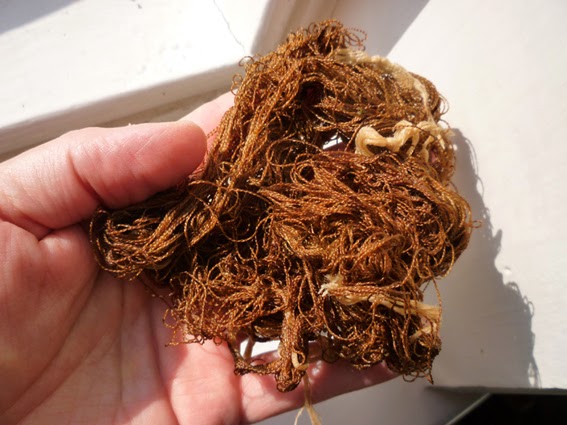
I think I might have something over 360, to be set (sucks teeth and thinks) about 25epi for plain weave, maybe 28 for a twill. I will thread for the twill but might weave it plain if the pattern doesn’t work. Weft is difficult. After winding the first 120 ends, I decided the two candidates in the photo are out. Current leader is a mess (literally) of 20/2 silk I massacred in the dregs of an indigo vat a couple of years ago. I might want it greyer; if so, I have the technology (black and brown dye, vinegar and heat).

There, not only a post, but a longish one with pictures. I wish I’d taken my camera to London on Saturday so I could tell the tale of the Neckinger, but maybe I can persuade my husband to walk it again on a warmer day.

p.s. I’ll try to remember to disinter my photos from Macclesfield for another post. In the interim, if you’re near enough, go and visit yourself! After all, Macclesfield is the western end of the Silk Road. Is that not amazing?