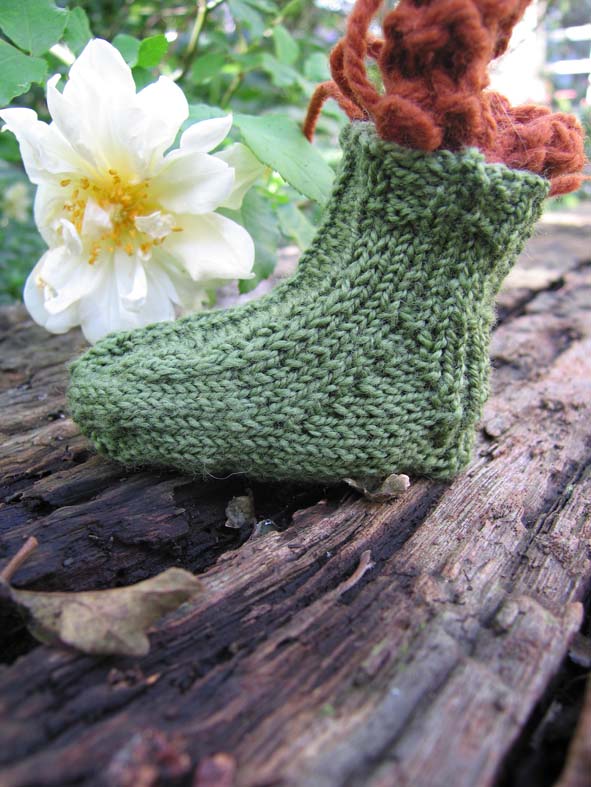
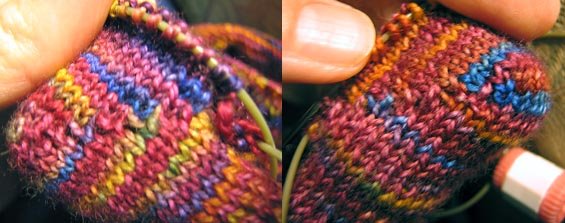
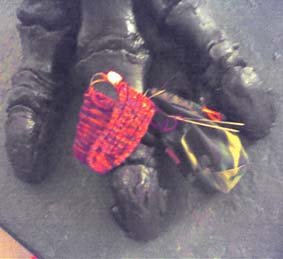
I’m fairly certain I know a Class Sock when I see one (some of Eunny’s socks and Grumperina’s spring instantly to mind), and this isn’t one of them. But I think it’s awesome. I wouldn’t have believed a couple of hours (total) and 28 stitches could have taught me so much. I think I begin to understand why some people swear by gusset/heelflap construction: the marked differentiation between the parts of the sock makes it easier to contemplate changes to the size/shape of each unit. I suspect I could get the same effect by carefully planning increases and decreases in the sole of a short-row heel sock, though, which might result in some really interesting stitch flows (see the feet of Grumperina’s sock).
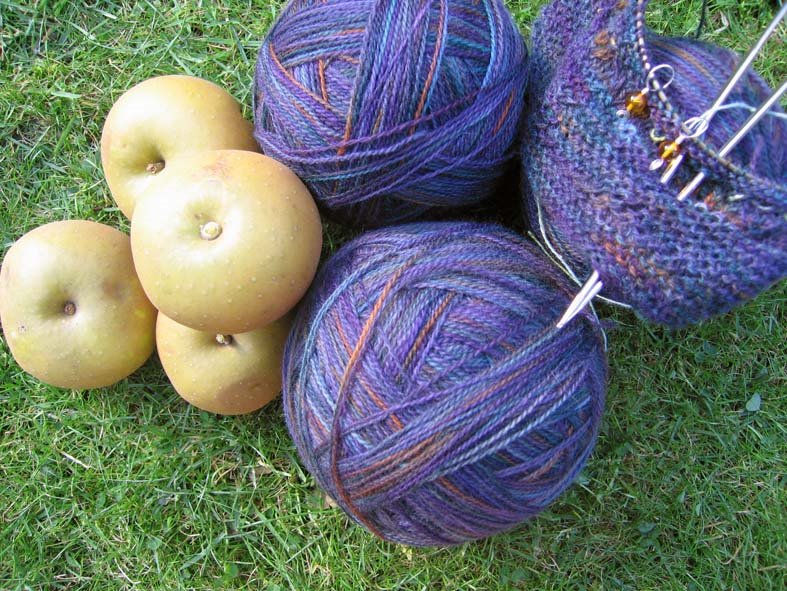
This was knitted toe-up starting with 8st on two 2.5mm circs, growing to 28st in diameter and finishing on one needle as a magic loop. Everything I do on two circs ends up as a magic loop on one if I’m not careful — it seems to be my natural mode of knitting. I worked out roughly what to do from Charlene Schurch’s Sensational Knitted Socks (and used the slip stitch rib from the patterns) to start with, but her instructions for circs are for socks knitted the other way. The gusset I worked out from first principles while looking at pictures of socks: it gets wider, must be increases. Turning the heel proved more complicated. I started with Widdershins as a toe-up sock reference, but that’s based on 4dpns using needle numbers as reference. I hate that. I briefly tried to work out the translation to my magic loop, but having had a couple of glasses of wine it seemed too complicated. Widdershins said something about short rows so I winged it, with a tiny short-row heel just in case and just to prove I could now do it right without looking at my notes. The gusset seemed to be worked by working back up the gusset from the short-row heel by knitting together a heel stitch and a gusset stitch, then knitting one more gusset stitch (presumably to close the gap as the short-row wrap does), then turn the work and work back to do the same on the other side. I can’t have got that right, as the vertical line of my heelflap is nothing like as tidy as that on Widdershins. The point of the exercise is that I can clearly see how the gusset can be used to increase the circumference of the sock to accommodate a high instep, as the brilliant Charlene Schurch suggests. Just start the gusset a bit further forward on the foot and make a few more increases to make a higher gusset. The pointy top of the gusset will extend higher up the ankle, but that’s a small price to pay for a better-fitting sock. I can see combining that with a section of k2p2 ribbing on the sole to pull the sock up onto arch of the foot if the higher instep is combined with a high arch. The short-row heel was unnecessary and/or not properly executed — it makes a neat 90° bend, but in combination with my gusset it’s tiny and pointy. I think the strip of stitches that are the heel will bend nicely anyway as the strip climbs back up the gusset, as it were.
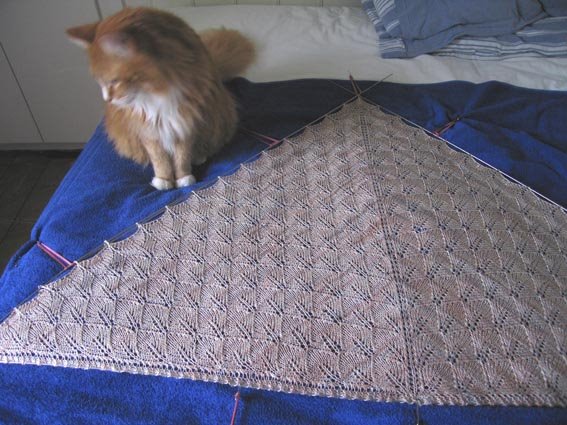
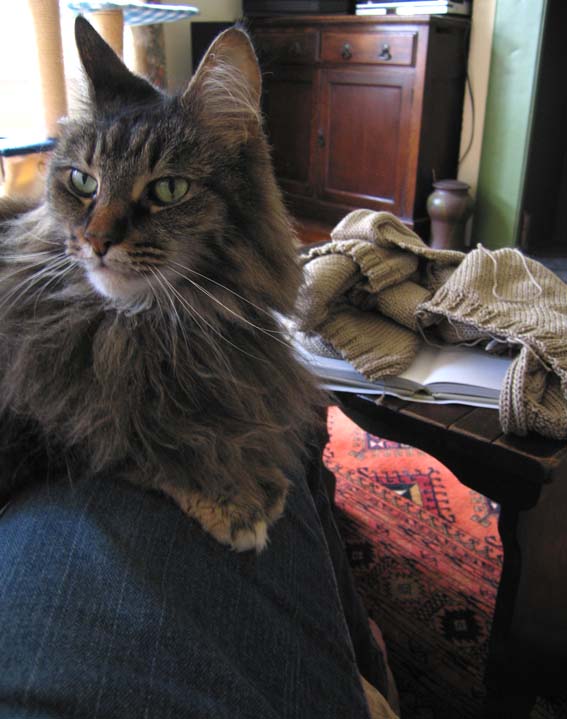
After all that I’m not certain I’ll knit a toe-up heelflap sock for D’s Sock Token; I want to be certain I can do it right if it’s for someone else. But the next pair for me will be. And the Class Sock? I think I’ll add catnip to its filling of shawl test patterns, sew it closed, and see what the faithful henchcat thinks of it.












 carpe diem!