Now it seems like a dream

But I have more than memories.
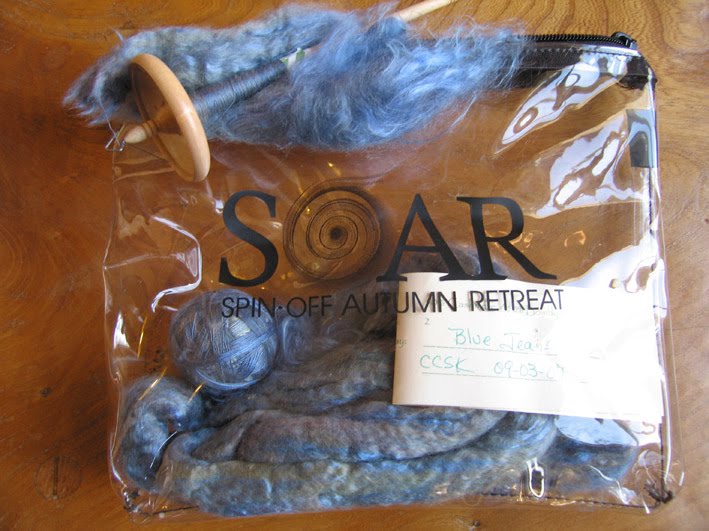
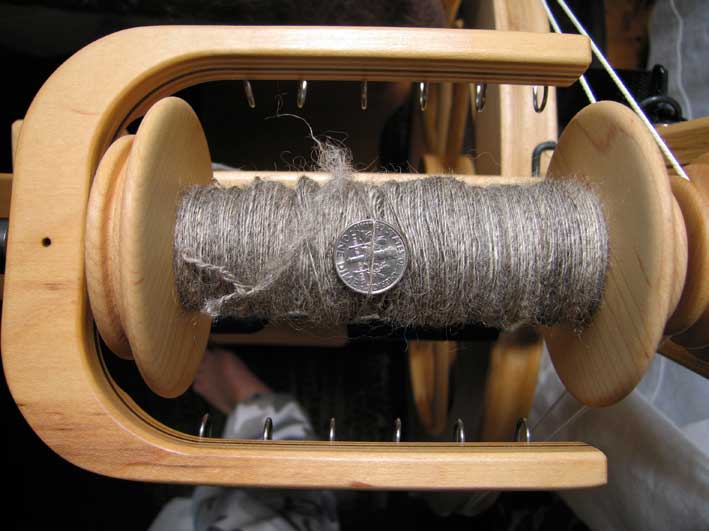
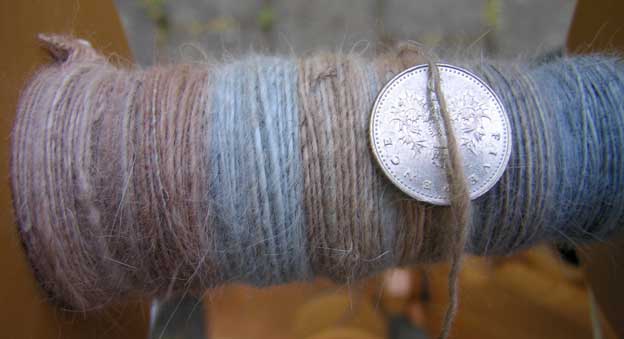
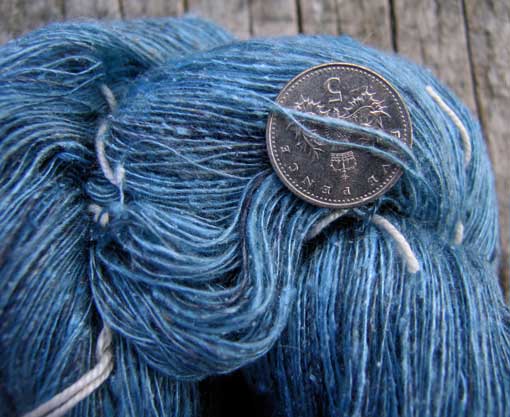
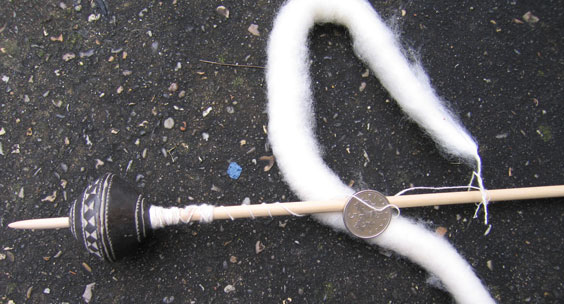
Spirit Trail ‘Blue Jeans’ silk/cashmere and Spindlewood spindle, 10g, birds-eye maple

When I was trying to decide whether to try for SOAR I spent a lot of time googling for hard information about it. What actually happened? OK, it was clearly memorable, even life-changing, and people had fun and drank a lot, but what did they learn? Having been, I now understand why it’s so hard to describe. Yes, you learn, or at least I did. A lot. I learned about spinning, and fibre: I learned that I really am a better spinner than I thought, and I was able to get a glimpse of just how much more there is to learn. I learned about teaching: I want to be a mentor, I want to give people the knowledge that they desire. I learned about having fun, in a way that I’ve never had fun before because never before have I been part of a group of women old enough to know what they want and young enough to go for it. But it’s exhausting, physically and mentally. My single room was expensive, but absolutely worth it for me, because I was able to get enough rest (bed at 2130 most nights, I am not joking) and get up early enough to get some exercise. Also: Vitamin C and echinacea+zinc. Placebo effect or not, it may have saved me from the SOAR ‘Crud’, which this year turned out to be H1N1 for many attendees.

There’s a group pool of SOAR 2009 photos over on Flickr that’s worth trolling through. What can I show you?
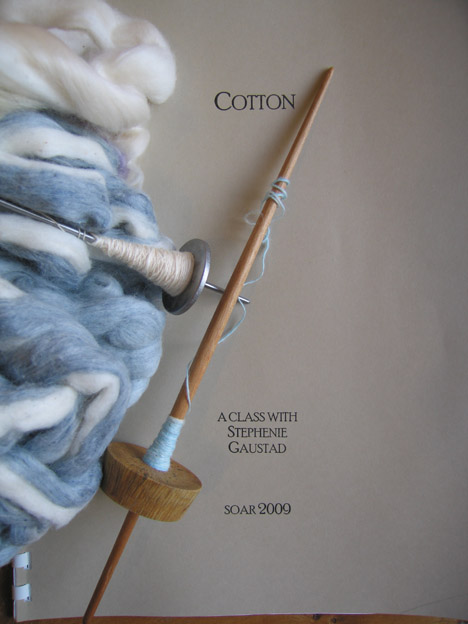
Over the three days of the workshop, Stephenie told us about the history of cotton, the varieties, where they come from and how their physical characteristics affect the processing and spinning of their fibre. We spun cotton from the seed; we ginned seeds to separate the fibre from the seed, we ‘willowed’ and ‘bowed’ the resulting compressed fibre to see how vibration opens it up for spinning. We carded it and made punis (and a lot of very bad jokes based on Canadian slang. Google it :-) We spun our punis and commercially-available Indian punis, we spun top from many cotton varieties and blends. We spun on our wheels (the Journey Wheel was fine), we spun on spindles, tahklis, akhas, southwestern spindles, we spun on box charkhas and banjo charkhas, we spun on bull pups, and a great wheel. While we were spinning, Stephenie passed around samples of handknitted and handwoven cotton to show us what we could do with our handspun.
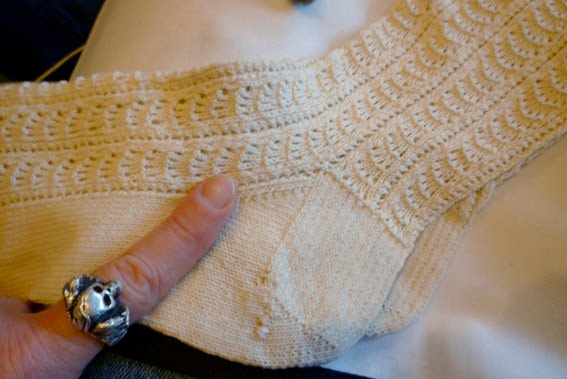
It’s the item Stephenie didn’t bring that is clearest in my memory: her re-creation of Native American weaving for a museum in the southwest, and the look on her face as she spoke of it.

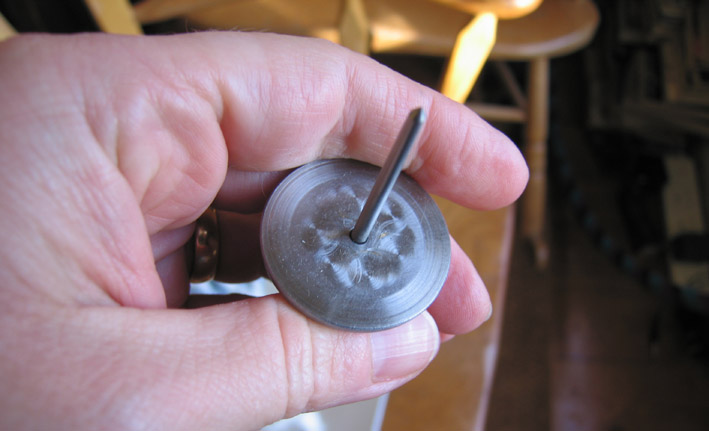
Much of the equipment we used was made by Alden Amos (the box charkhas were Bosworths, or from India). Talking with Stephanie about textile history and spindles, she brought out a spindle Alden had made for her, and put it in my hands. How can I describe it to you? Have you ever felt that something was perfect, that it could be no other shape? Light and shadow emphasize the perfection of line and, if it’s something you can touch, you HAVE to touch it because, well, you have to. The spindle was not ‘like’ that, it was that. The simple, elegant perfection of the line of the shaft, the grain of the section of wood used as a whorl. I can’t help it, beauty makes me cry, and tears were in my eyes as I handed it back. And then Stephenie gave it back to me to keep. It’s sitting on the desk in front of me as I type, and I look at it and… it still makes me cry. Both for its beauty, and the memories it evokes. Anyway. I also have an AA tahkli. I tried several in the course of the class, and liked this one for its weight and persistance. I can’t think of the right word to describe its insistence on spinning long and fast. Look, it’s got whirlwinds on it!
On Wednesday evening the various workshop groups set up displays to show ‘everyone’ what we’d done and what we’d learned. We decided to emphasise the fact that cotton gets a raw deal: it isn’t difficult to spin provided you approach it with an open mind. We set out samples of the fibres, the tools we’d used, and the skeins we’d spun. We included ALL the waste fibre discarded over the three days (only a double handful), labelled ‘Cotton is NOT difficult to spin’. We enthusiastically demonstrated spinning on tahklis (Avedan and Stetson excel at this) and an ordinary wheel.

Stetson holds/spins a tahkli while the amazingly talented Denny spins cotton from it. Lyn/enallagma9 (centre), Ellenspn (far right) and others watch, bemused by their teamwork.


Stetson I think realised that someone spinning looks a bit… ordinary… sat behind the wheel, so he decided to try something different. At his request I brought the wheel out, turned it so the orifice faced into the room and bent down to adjust something. And the rest is history, recorded on YouTube and the memories of anyone in the room. The purple lump treadling is me; Stetson is the handsome chap who takes a bow after the singles finally gives up the ghost. None of the video and photos I’ve seen so far have caught Denny and the others who were limbo-dancing under the singles, or the moment when my hair got caught in it!

Thursday was a rest day, or meant to be. But the Market opened, which was not at all restful. The queue to get in began to form an hour or so beforehand, most of it being the proto-queue for the Rovings booth. The first five minutes were mayhem; I took refuge in Carolina Homespun, whence I emerged considerably richer in Abbybatts and Spirit Trail fibre. I am not saying how much poorer in cash terms! I then surveyed the field. My goal was to acquire stuff I cannot get in the UK, or that is best chosen in person. It was a great pleasure to finally meet Steve of Spindlewood, and I was thrilled to discover that 10g spindle. A Verb for Keeping Warm was on my list; I tried to buy enough fibre that I won’t be immediately frustrated when I run short. The colours are so, so pretty.
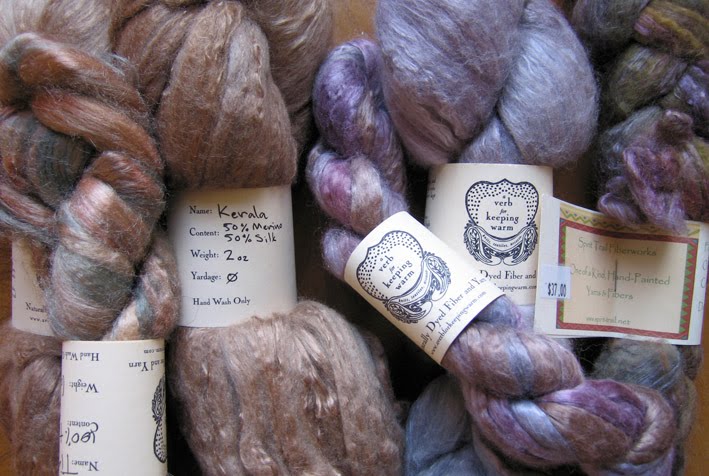
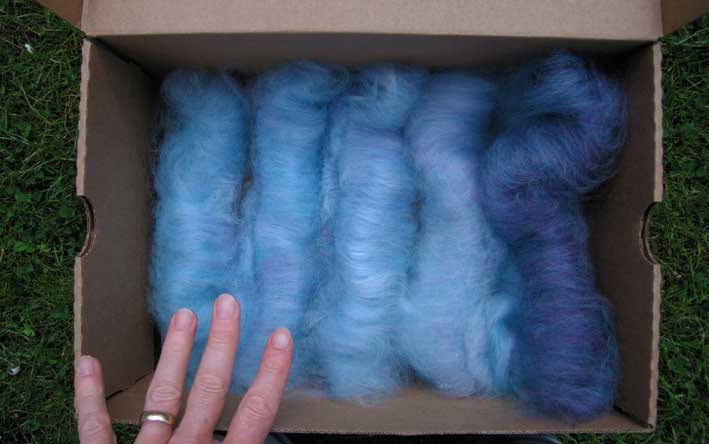
There’s some Spirit Trail in there, too.

I almost forgot to mention the special SOAR blend. Black BFL and silk, 8oz for $15, limit of three per person. I got three.
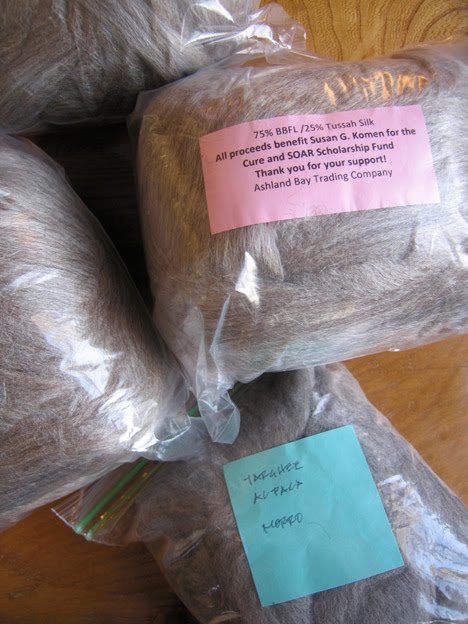
Also a gift bag from Jimbobspins!

There is a lot more fibre, I mean A LOT MORE FIBRE to be revealed. I’m going to ration it in case it overwhelms you, or inspires fibre-holics to raid my house. It’s currently bagged by colour, and there’s the ‘brights’ and the ‘blues’ yet to be revealed. Also the Rovings black polwarth/silk blend.

Back to what I learned, rather than what I bought or was given!
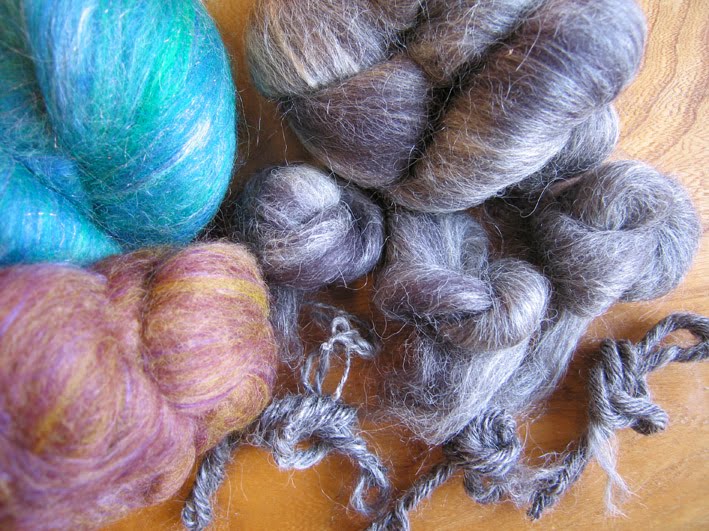
Friday am was Blending on a Drumcarder with Abby Franquemont. Amazing, intense three hours. Started with chunks of black merino, silver alpaca, and silk, used to teach us how to feed the carder, how to sandwich slick fibres, and how successive passes make more effective blends. Those tiny twists are my plied samples, one from each pass. I’ve rarely spindle-spun so fast… We used a range of carders, from small manual to ‘Judith’s carder’, a huge motorised beast that just ate fibre. Don’t worry about presenting the fibre correctly; don’t put your hands anywhere NEAR it! Just toss the fibre at it like flesh to a hungry lion. I was interested to note that the batts from the Strauch were more finely blended, but wow, it was fast. For the next exercise we were given dyed silk. merino and glitz to blend. Not allowed to choose: we learned that even apparently ugly colours can result in lovely blends. My maroon and mustard merino plus lavender silk ended up looking like lavender-shot mahogany. Rather lovely. But now I want a drumcarder. What do I remember most clearly? Abby’s hand on mine, pressing down to show me how to feed the fibre into the carder. Knowledge passing from hand to hand.
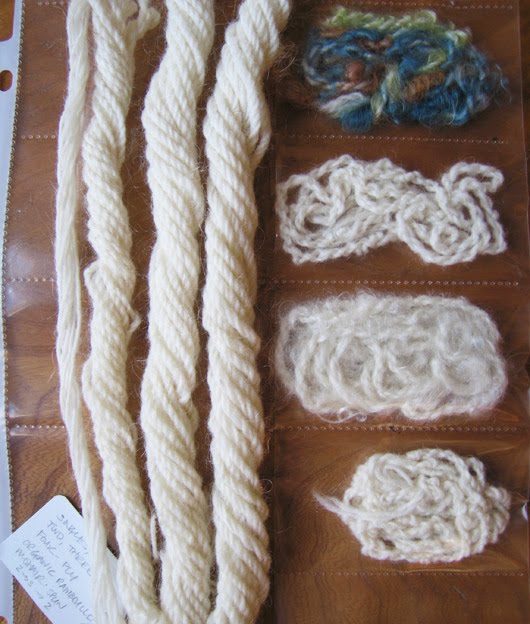
Friday pm was Plying with Judith Mackenzie Mckuin. Slightly less intense, but still… wow. We used millspun singles, Judith’s Rambouillet/Mohair blend, to create 2-ply, 3-ply, and 4-ply. (Judith said my plying was beautiful!) We talked about the benefits of plying and how the structure affects its performance in knitted fabric. And then we played with novelty yarns created by plying. And Judith talked about her work with Native Americans, projects to preserve and pass on their knowledge of fibre.

I don’t have any photos from my Saturday am class, American Long Draw with Maggie Casey. I don’t have any samples, save what’s still on the JW bobbin. That’s because I didn’t stop spinning. I learned… my hands learned that my right hand’s habit of pulling forward was causing slubs: the right hand should do nothing but control the twist while my left hand pulls the fibre back and away. And I did the Beerdrinkers’s Long Draw! From the fold or from the end, makes no odds. Should I wish to, I can now drink and spin at the same time. And I got to watch Maggie’s hands, spinning.
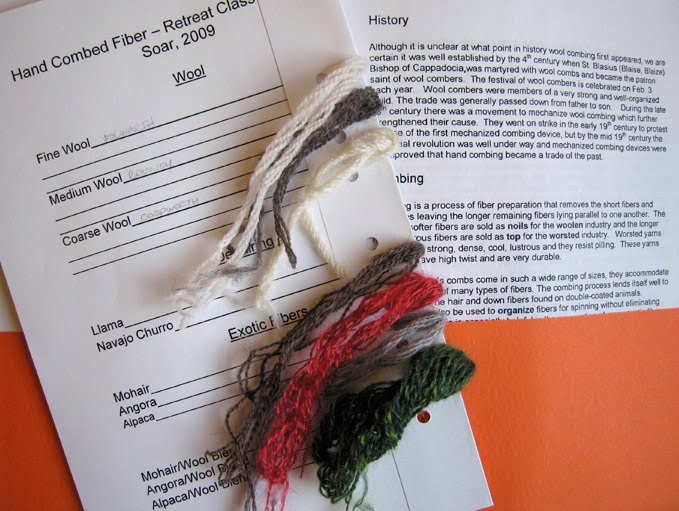
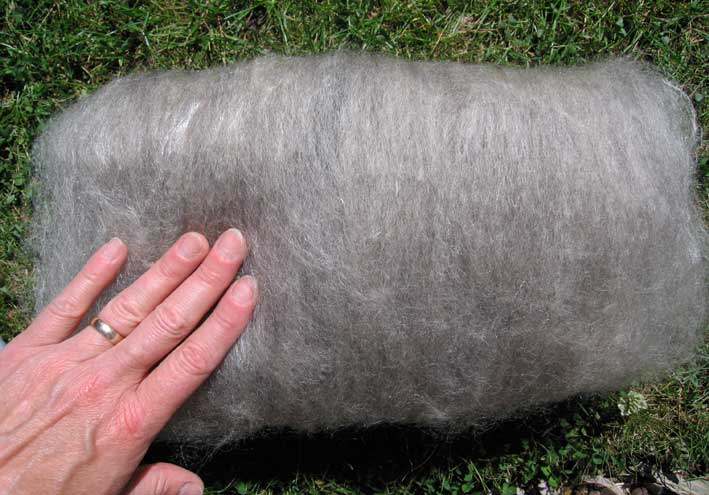
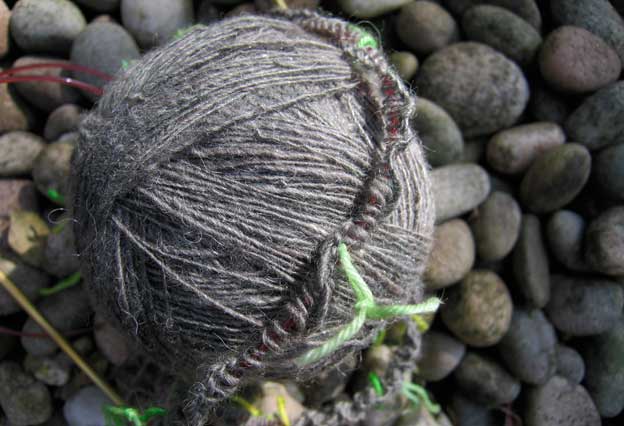
Saturday pm was Handcombing with Robin Russo. Peter Teal’s precision produces true worsted, but it is possible to produce perfectly useable prep by lashing on fibre as it comes, by the handful. Faster, too. And we did it with a range of fibres on a range of combs, from Navajo Churro on Viking combs (de-hair and comb), Polwarth and Romney on smaller combs, down to angora on mini-combs. See that grey skein on the card? That’s hand-combed, handspun angora. How cool is that? And the red stuff is my first pure mohair. Such fun!

But my word, we were tired by the end of it. Saturday evening was Hallowe’en, dinner in costume (I wore my best clothes with button eyes and behaved very properly as the Other Sarah. Which makes no sense unless you’ve seen Coraline) a spin-in of sorts, plus disco/karaoke. Far too loud for me. I went back to my room, changed into my travelling clothes and packed my suitcase bar my toothbrush so I’d have time for a last long pre-breakfast walk before leaving on Sunday. Then I went back to the Great Hall to watch, entranced, as Michael Cook/wormspit demonstrated silk reeling. One of the Sunriver staff leant over his shoulder and I couldn’t help overhearing as he was told he had to clear his workroom within the hour. And I saw his face – he’d been promised the room until Sunday, allowing him to pack all the class equipment. I volunteered to clear it, packing everything onto trolleys (commandeered from the kitchen) to be taken to a different room. When I’d done so (interrupted only by Tsocktsarina’s summons to help give Abby the final installment of the FOAY (Ravelry group) gifts), I was stunned by Michael’s insistence that I accept 2 bobbins of hand-reeled silk, plus 2 empty bobbins, a frictionless clip, and a 3-minute summation of what to do to turn it into laceweight yarn.
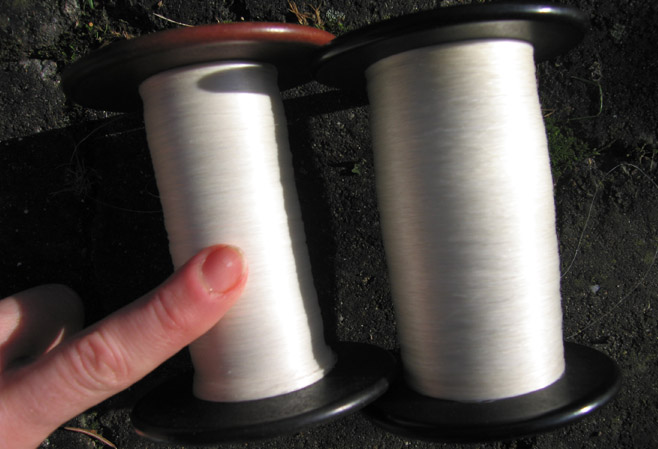
I’d had to sit on my suitcase (full of fibre) to close it. I’d already thrown away a pair of old socks in order make space… could I fit these in? Of course I could. So I did. And the suitcase weighed 49lb 8oz on the scales at Redmond Airport on Sunday morning, which is why my right elbow has been Not Quite Right ever since. Very Painful, in fact. But at least it doesn’t stop me spinning.

From Redmond I flew to Victoria, where we spent three days with his family before flying back to Heathrow. It hurt to leave, even more than my elbow, it hurt my heart. Western Canada is Home. I console myself with the thought that I carry it with me in my bones, but I still couldn’t bear the view from the windows on the other side of the terminal, the ones that showed the sea and the mountains beyond which lies Home.


SOAR: it’s about people

I walked to the Lodge for Registration with some trepidation: I knew *nobody* here In Real Life, only as digital entities on Ravelry and via email. I’d tried to memorise ravatars, but I’m bad at faces, and pictures of someone’s dog or favourite FO are no help at all…

Abby was unmistakable, and gave me the first of many, many SOAR hugs (for which I later gave her the beer I’d brought from England). If someone asks if it’s your first SOAR, and you say ‘yes’, they’ll probably hug you. Inspired by this, I did my share of hugging, to thank Beth of The Spinning Loft for all the stuff she’s sent to me ( OK, I did buy it, but it was all good). Wearing my Camo Laminaria I was stunned when ElizF (on Ravelry), who designed it, came up to me to see mine – the first she’d seen in the wild. Her first time at SOAR too, so I hugged her for that AND the fabulous patterns. I hugged Tsocks, and Lynn (Enallagma9) and JimBobSpins and Sandi. All around me other people were hugging each other, friends who saw each other only at SOAR. And speaking regretfully of those they’d hoped to see who hadn’t been able to attend.

The three-day workshop session was about people, too (as well as cotton). Other students, learning. Our mentor, Stephanie Gaustad, who poured a generous flood of information, skill and experience into the room. The people who’d made the tools we used (Alden Amos’ work is so beautiful that some pieces made me
cry) the people who devised the techniques we learned, who used them to clothe their families. We are part of a tradition stretching back into the mists of time. Stephanie talked of duplicating ancient textiles, and people who’d done similar work spoke of feeling that the original makers were there, present, helping and approving of the effort to keep the tradition alive.

Pass it on, people.

— posted on the move

A glorious morning


Mt Bachelor at 0730 this morning. After a brisk walk during which I saw a family of otters in the river!!! And a deer. And a dead garter snake :-( I decided to try the gym. Which was good – but the spa pools afterward are even better. Registration next, then the fun really begins :-)

— posted on the move

No end in sight

It’s usually considered best to start at the beginning and proceed to the end. There’s no end in sight, though. A couple of weeks ago I watched with interest as a friend blended her colours for the Rampton Project 2009 on her Louet drum carder. I eventually asked if I could borrow it, and recently I tried it for myself. I don’t think I’ve put the Romney fleece on record (can you sense my embarrassment? my third fleece?)

From Ashford in New Zealand via Treenways in Canada. Isn’t it gorgeous?
So… I decided to try a Romney/tussah silk blend, just to see what happens. The washed locks were flicked open and spread carefully across the tray thing while I turned the drum carder handle as slowly as possible, then more slowly still. Once I’d built up a layer of Romney on the drum, I lashed a finely-spread layer of tussah
directly onto the drum, then covered it with more Romney. 60g of Romney and 9g of silk later, I removed the batt and fed it through again. I’d have done a third (I tried lashing some silk across the drum, but these strands didn’t blend on that pass, the action just brought them together in a solid strip), but the silk was starting to think about nepps. The end result:
And this is what it looks like on the bobbin:

I like it a lot. I want to make MORE.

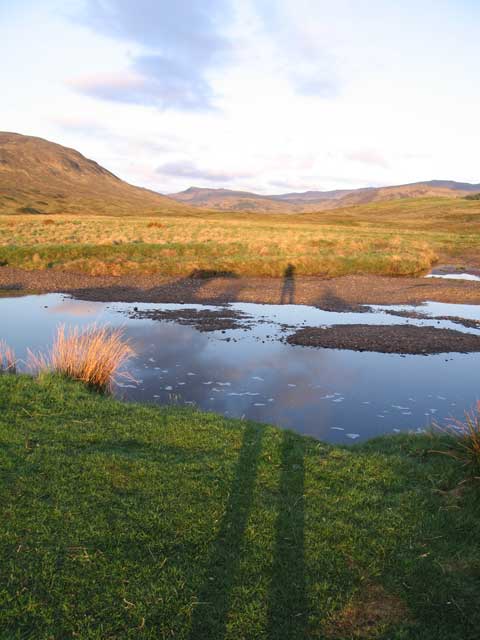
Speaking of the Rampton Project, there’s been some progress. Here’s the photo I’m working from, just to remind you.
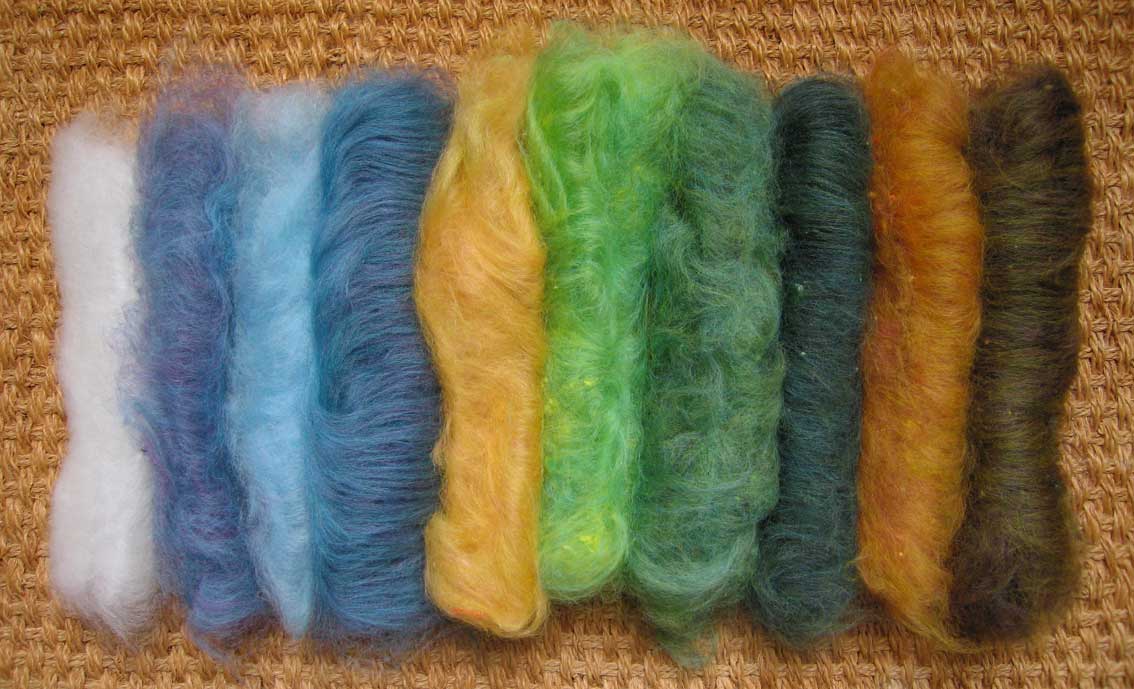
I chose colours from that photo and tried to match them or at least come close, by blending dyed wool on handcards (see this post for more details). I added white and black silk to some blends, and others have silk noil in shades of green and orange to reflect some of the variation in the colours of the photo. The final list is Dawn Sky, River/Cloud Purple, Grass Gold, Beach Bronze, Islet Brown, Bright Grass Green, Mid Grass Green, Dark Grass Green, Shadow Blue, and Cloud White. The fibre for each was weighed as I created it, so I can blend more to match. Which is just as well.

This is an array of batts based on that photo:
The p-chullo pattern requires 10 colours, and there are 10 in that shot, but after looking at them laid out I realised that the beach bronze (second from right) was too bright, and the shadow blue (fourth from left) was too similar to the river/cloud. So I added some black to the bronze, and lots of black and more magenta to another attempt at the blue. The pattern is written for Berocco Ultra Alpaca, a 3-ply, so I blended 3 batts of each colour. I happen to have some, so I unraveled a length, made a sample card and started spinning.’X’ marks the wrong blue; I have to say its replacement, next to it, is one of the prettiest colours I’ve seen anywhere. This is how to get colours of the beauty and subtlety of the Starmore collections. Also I am very, very proud of the quality of some of that handspun!
I think the effect is close enough to be going on with. I need to think very carefully about the balance of the colours, and how to echo the combinations that stand out in the photo. Next? I have to get gauge, or close to it. First I have to finish this:

Another Aeolian in BMFA Rook-y, like the first. Hand-dyed yarn varies: this isn’t as pretty as the first, the colours are brighter, but I can fix that with a bath in 10 or 20% black dye before I block it.

But before I can finish that, I have to cut the hedge. I’ll deserve an afternoon sitting and knitting after that!

More foolishness

Silly things to do on a walk: No. 1


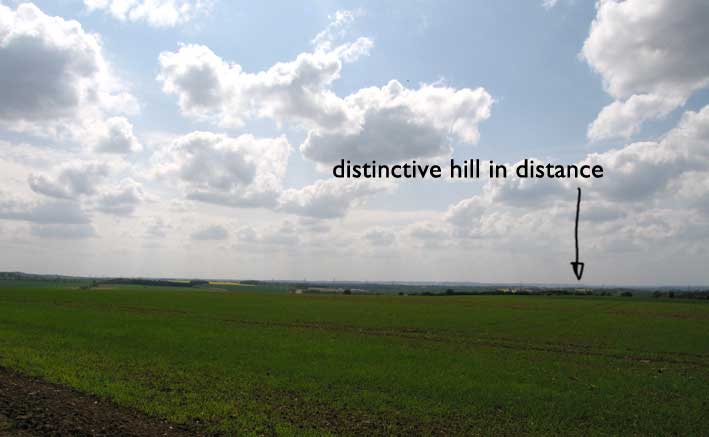
Imagine walking across this vast field on a lovely sunny afternoon. Be invisible (it’s your imagination, you can do it) so as not to disturb two people having an intense discussion, one waving something in its hand in the air. Drift closer and discover it’s us, me and him, trying to work out what/where that distinctive ‘lump’ on the horizon might be. Could it be the theoretically visible Sharpenhoe Clappers? We need a compass, but haven’t got one. So I pull out my iPhone, download and install GPS software from iTunes (the waving about was trying to get the best signal), then we waste 10 minutes trying to walk fast enough to get the GPS compass to pay attention to us. FAIL. Double FAIL, once for being sad enough to download and install software to use on my phone when we’re meant to be walking in the countryside, and again for enjoying the experience and thinking it perfectly justifiable.

Here’s another kind of fail… I am rapidly concluding I don’t like spinning angora. The end result is soft (the Fetchings I knitted from a handspun Wooly Rabbit angora blend are lovely to wear), but the stuff sticks together even when it’s not felted. I find it very difficult to draft; even semi-longdraw is proving problematic. Which is a nuisance, as I’d planned to spin it from the fold. I need to practice that.
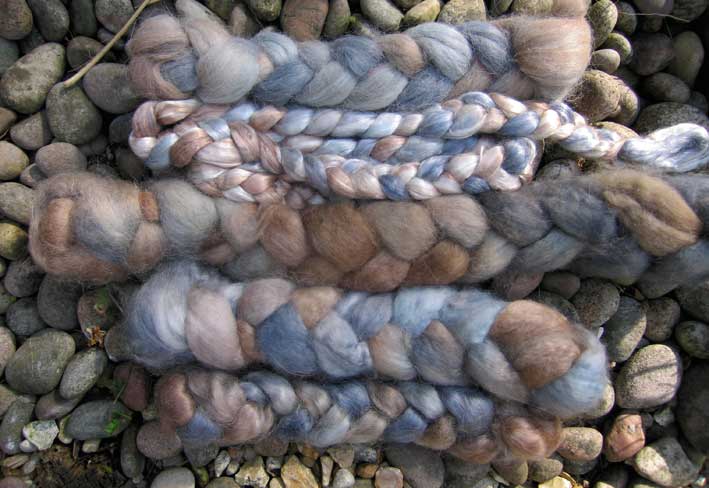
But isn’t it pretty? The brown is slightly pinker than I like, but it still reminds me of the sea washing over pebbles and sand. I just have to finish spinning it at home because two people at the spinning group are allergic to angora. It’s part of one of Spindlefrog‘s Spinner’s Sets, roughly 6 oz of luxury fibres dyed in the same colourway. Mine is angora, cashmere, silk, baby camel, baby alpaca, kid mohair. Here’s the rest of the fibres, all their potential as yet untapped.


More foolishness. I’m beginning to realise my handspun falls into two quite clearly defined categories. One is
WOW!! I can’t believe I made that. It’s far to beautiful to knit. No pattern does it justice. The second is
Ho Hum. Look at this, and that… nope. I can’t knit that, it’s not good enough for any pattern.

Which is really silly. I know it’s silly. I’m too new at this to expect perfection and yet, I hurt a bit when I don’t achieve it every time. Look at this:
That’s about 490m of singles spun from two ‘Spanish Moss’ Abby batts, part of a swap with Fernmonkey on Ravelry. It’s a lovely silvery grey-green, the singles are reasonably soft, not over-twisted. I think it will make a reasonable, perhaps even a nice shawl (I’m casting on for one from the Icelandic shawl book Thrihyrnur og langsjol: Three-cornered and long shawls). But I feel dissatisfied with every inch of yarn passing through my fingers; it’s too thin or too thick, there’s a slub of silk… I really do have to get over this. It’s MY OWN YARN, for pity’s sake. I made it. It’s a miraculous thing, the product of my own hands. I should love every inch of it.

Grrr. Perhaps I need chocolate?

No. I just need to remind myself that, barring accidents and other unpleasantnesses, I AM GOING TO SOAR!!


Anguish

RIP, Aeolian Shawl

Physical and mental. Let’s get the mental over first. In short, my cunning plan proved to be a turnip: yes, a hammer trumps a bead every time (ok, might take two or three careful blows) but, where my trial beads turned into glittering dust, those on the shawl shattered into shards. Sharp ones. After cheerfully demolishing about 20 beads I realised the fragments had cut the yarn in two places. I repaired them, but BMFA Silk Thread II is, well, silk: it doesn’t stick to itself, it’s thin and shiny and the repairs are visible). However, I was committed, so I continued much, much more carefully – the next c. 100 beads required only two more repairs. I sat in the sun with my heart sliding into my socks as I realised that, at this speed, I’d still be breaking beads in two weeks’ time, and the shawl would be a higgledy-piggledy mess of repairs. I looked at that beautiful silk gleaming in the light and realised that my selfishness had ruined that shawl and wasted weeks of my precious spare time. After all, if I didn’t like the glitter, I could have given it to someone who did. But no, I wanted that lovely yarn, that shawl sans beads for me. Therein lies the anguish: I was Stupid. And now I think no one will have it, even though after I announced that I’d binned it the Tsocksarina decided to attempt to salvage something from the wreck. As soon as its chaperones arrive (no knitting can travel unaccompanied) the mess will be on its way.

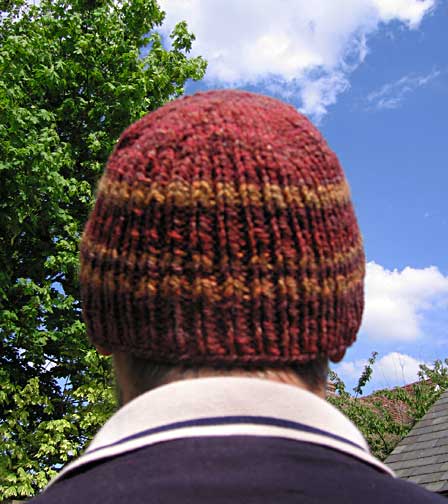
I distracted myself from the mess by casting on for a hat in my handspun. It’s still a novelty, knitting yarn I made myself. I used the ‘Come in Spinner’ Polwarth from the first installment of the Socktopus Fibre Academy, which I’d spun as a thick 3-ply. I’d known it was more worsted than I’d wanted, but only when I started to knit with it did I realise just how ‘solid’ it was. It’s made a very… sturdy… hat. Weighs about twice as much as any of our technical gear, so it will not come on long treks, but it’s pretty. And, alas, too big for me. Suits him, though:
Then there’s the physical anguish. We did it to ourselves, too. The weather forecast was good, dry but cool, so on Friday evening we pulled the Big Packs out of the cupboard and packed them with almost all the stuff we’d be carrying in Scotland (mine weighed 15.5kg, about 35lb), and at 0630 yesterday morning we threw them (figuratively speaking; they’re far too heavy to throw!) with the rest of our walking gear in the back of the car and hammered up the M1 to our nearest hills in Derbyshire. Again. After discovering that the concentration needed to do Emily Ocker’s circular cast-on with two circular knitting needles instead of a crochet hook in a car travelling on a winding road left me feeling distinctly poorly, I didn’t get a lot of knitting done! But by the time we reached Chesterfield I had the map open and was formulating a plan. It went something like this: arrive Edale, park, start walking. Good one, eh? It expanded to: arrive Edale, walk up to path along Rushup Edge,

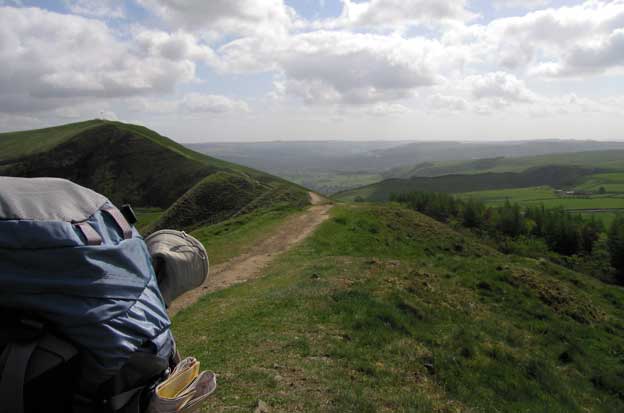
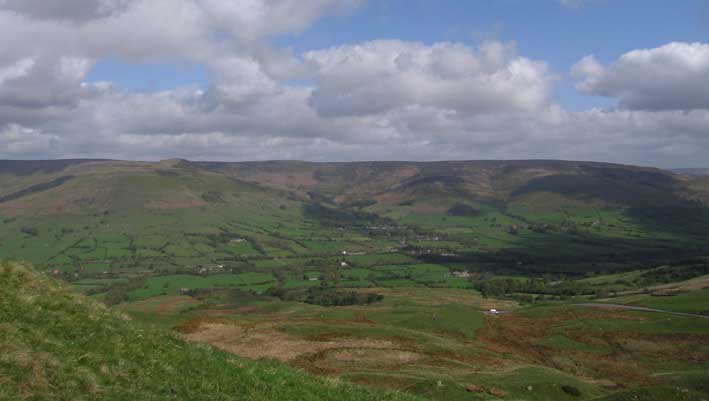
Above, the view east along Rushup Edge. Mam Tor on left above my pack, Castleton at right.
Below, the view north to Edale village and the Kinder plateau.

then northwest and north over the top of Colborne and Brown Knoll

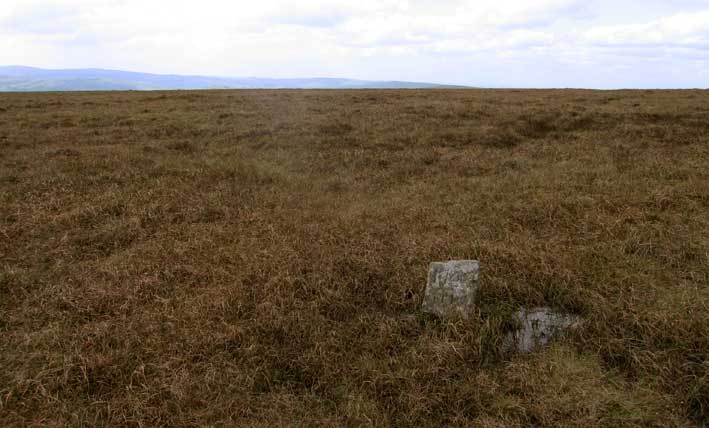
This Boundary Stone inscribed ‘1748’ lies on what fell-runners say is the driest line along the top of the moor. They’re probably right, but it was wet nonetheless. And I finally tested the depth of a bog hole: only 18″ or so in diameter, it was nearly 4′ deep!

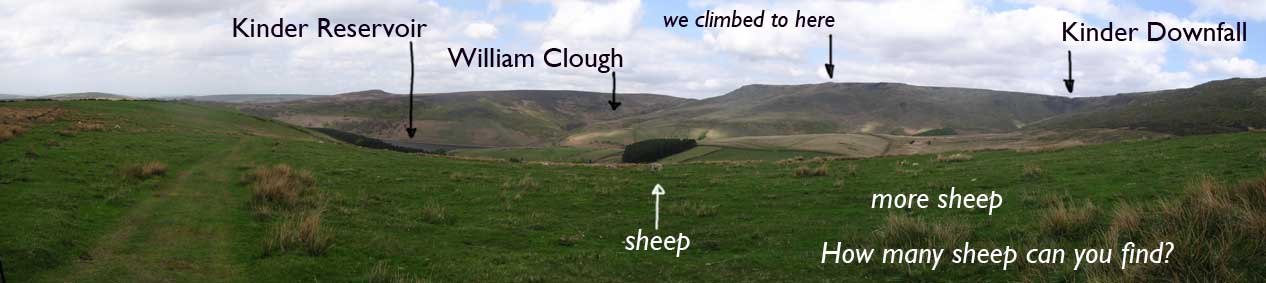
stop for lunch in the shelter of a quarry and stone wall (the wind was cold!), strike west along the flank of Kinder, then north until we had to decide: take the ‘easy, short’ path that slides up the western slope to the top of Kinder, or carry on around Kinder Reservoir and up William Clough to the far northwest corner of the plateau. For several minutes we fidgeted, thoughtfully shifting the packs on our shoulders, trying to balance time, pack weight, energy level, distance and knee condition, before basically saying ‘Sod it, we can eat at McDonald’s if the pub is full – let’s go!’ and committing to the lunacy of the longer route. Besides which, we were carrying tent, sleeping gear, water filter, stove, fuel, and food for 6 days. We could take our time.

click for bigger…

So we took the path in the left of that panorama over the lovely soft green dotted with sheep and lambs, down the hill to the reservoir, along the baking hot path on the other side to the start of William Clough, where we realised there was Another Choice: an unofficial path heading straight up the side of Kinder. It would be shorter, no question of it, but it was much steeper. Time was pressing… I’m really bad at uphill; given my pauses for breath (remember I’m carrying a 15kg pack!), would it be faster than the Clough? Nothing ventured, nothing gained: we headed up the hill. Unfortunately, while pausing allows me to catch my breath, it does little to persuade my duff knee to pull itself together and by the time we reached the top, I was hurting. But the view was… ok, no, it wasn’t worth the pain. Not by itself. Add the sense of achievement and the two together were worth it :-)

The view west from the top. Good but not quite good enough :-) The panorama was taken from the top of that long green hill above the dark trees on the left of the picture.

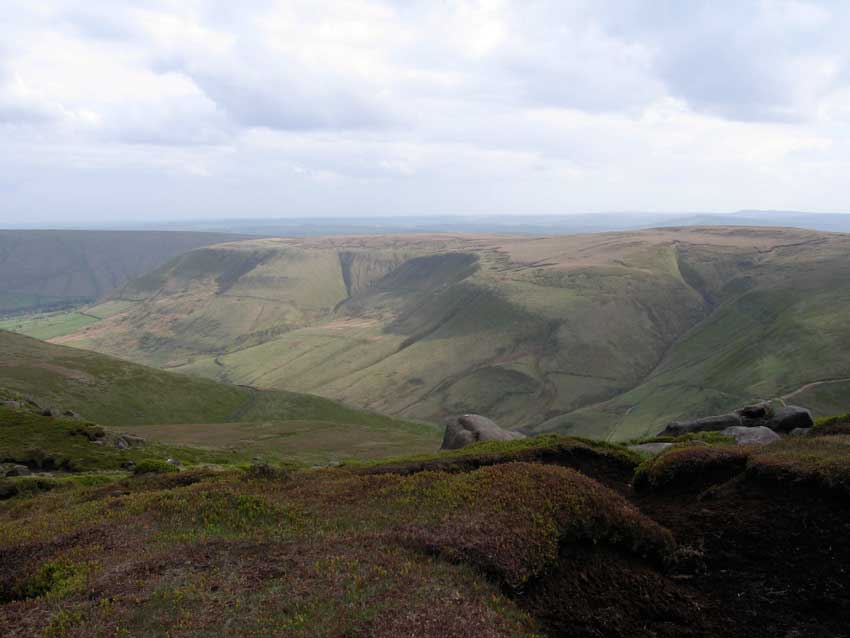
The familiar Pennine Way stretched ahead of us and we did our best to set a good pace past Kinder Downfall to Kinderlow, (but were scarcely able to stay ahead of the school groups. Oh, to be 16 again!) then left on a minor path to the main path running along the southern edge of the Plateau, high above Edale. The late afternoon sun revealed a wealth of detail on the hillside south and west of us;
The ridge in shadow to the left in the distance is Rushup Edge; in the middle distance is Brown Knoll. The blanket of peat on the flattish top of the hill is clearly visible, broken up at the edges by erosion and by old peat cuttings. You can also clearly see some of the post-glacial landslips for which Edale is famous.
As we strode, kneesore but determined, we discussed the best route down. The plateau stands about 300m above the floor of the valley; given the weight on our backs and the condition of our knees, were we better trying to lose height as quickly as possible (the c. 75° drop down the rockfall of Grindsbrook Clough), or more slowly (the unfamiliar path down Grindslow). We opted to get it over with and paused for an SIS isogel (those things work wonders when you need a quick boost of energy for a specific task) before carefully making our way down the rockfall. The energy ran out about halfway down the path to Edale, but it didn’t matter, we were down. End result: over 15 miles/24k, roughly estimated, including more ascent/descent than we’re likely to encounter on any day on the Sutherland Trail. Conclusion: we did it; we can do it again. Barring accidents, we’re up to the task, in every sense.

And this morning? We’re fine. If we had a hill, we’d be up it :-) In the interim, I will do some lace knitting!

A box full of sky

That’s what this is. Remember that post about colour blending with handcards in which I mentioned the 2009 Rampton Project? I said I was going to make a bag for my head? I’ve made some decisions since then. (Well of course I have, that was weeks, er, months ago. Bother. Where has the time gone?)

I’m going to make something based on Susette’s p-chullo pattern, a simply beautiful hat available free on Ravelry and from her blog, Knitting Letters: A to Z. If you’ve never heard of it, go and read the first entry now, then savour the rest slowly. I ration myself to one per week as I re-read them. The pattern requires 10 colours; I’m going to work from a photograph, as I did for ‘Hellebore’. This photo.
Taken just as the early morning sun rose above the hills east of Inveroran on the West Highland Way, it was the start of one of the best days of my life. What better way to commemorate it than by using those colours in a hat? In the margin of my colour laser hardcopy I’ve written: dawn sky; river/cloud; grassgold; beachbrown; islet brown; bright grass green; mid grass green; dark grass green; shadowblue; cloud. The list has been laughing at me for nearly a month while I tried to find both the time and the space in my head to make these colours from dyed wool and silk. This weekend is the beginning. I’ve got sky, river/cloud, and a start on grassgold, which looks like this on the handcard and as a rolag:
The white is filament silk cut to roughly the same length as the dyed merino. Note the dyed silk noil; I’m using dabs of bright yellow, an orange, and a few hints of bright green. I’ll use the same colours in the browns and in the greens, but the proportions of each will change. I might add some heather pink/purple to one of the browns. I haven’t started spinning this yet; I’ll save any rolags that end up the wrong colour (one so far) to practice. The pattern calls for Berroco Ultra Alpaca and, fortunately, I have some so I’ve made a control card from a small sample, including one of the singles (it’s a 3-ply). I want to roughly match the weight so I don’t have to fiddle overmuch if at all with the stitch count. I’ve got at least another two afternoons of carding before I deserve to spin any of this. Yes, spinning is the reward. I’m warning you, if you don’t spin, beware: it’s addictive. I had no difficulty kicking my trivial Geo Defense habit… I’d much rather be spinning :-)

Let’s see, what else can I show off? I love to post pictures of a shawl blocking, but you’ll have to settle for Aeolian on the needles ready to bind off.
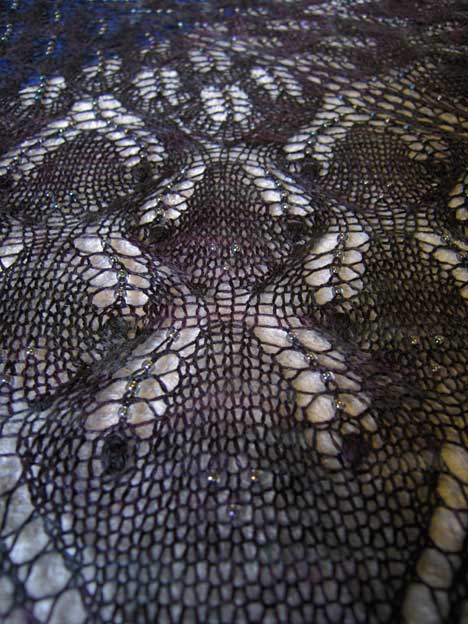
Once again I CANNOT get the photo to do justice to the yarn. That’s Blue Moon Fiber Arts silk thread II in Rook-y, and it’s simply, utterly gorgeous. The Raven Clan colours are striking on wool, but on silk they’re beyond beautiful. The shawl pattern is great fun, but I have serious reservations about the beads. There are a LOT of beads on this. The shawl is so heavy that I’ve wondered whether a heavily beaded shawl, say one with a border of real silver beads, could be used as a lethal weapon. Swing this thing by one corner and the entire length would wrap tightly around someone else’s throat like a bolas. Beading it added at least a third to the time needed to knit it and… I’m almost certain I don’t like it. Just too much glitter. So I’ll bind it off tonight, block it tomorrow and I might just attack it with a hammer on Tuesday. Beads are glass. In a contest with a hammer, they’ll lose.

No photos of any walks, though. Of course there have been walks! We broke out the big packs a fortnight ago for 13 miles there-and-back on the Monsal Trail, along the Wye in Derbyshire. Last weekend we took my sister and her husband to Ashopton and walked about 12 miles along Derwent Edge. Next weekend… who knows? But it’s no wonder I’ve had difficulty finding spare afternoons for the Rampton Project. Especially as there has been spinning.

Hullo, my name is Sarah, I have a problem… and I love it!

This is 640m of noiled silk singles, spun from Gnomespun‘s Surprise Sapphire (a custom blend). Dan’s got a really good eye for colour. This wanted to be a weaving yarn, so it’s gone to Lynn.

This was fun: 255m of 2-ply lace spun from a 50g (less a good handful given away as samples) cloud of dehaired guanaco from Heathylee in Derbyshire. Treated harshly in hot water, then thoroughly thwacked, it’s very soft. I’ve decided I really, really like spinning shortish fibres from clouds; it’s good fun and I just rather like the imagery :-)

What else… this is 88m of 3-ply ‘Jackaroo’, ‘Come in Spinner’ dyed Polwarth from the Socktopus Fibre Academy Club. I’ve decided this club will be an opportunity to challenge myself by spinning outside my comfort zone; for this I wanted something bouncy and warm and significantly thicker than my usual lace singles.
I think there’s enough to make a hat to replace the one I lost on Derwent Edge a month or so back. There’s more, but I have to go and deal with the hamburglar* buns for dinner tonight. Lesson for today: if you alternate making bread and making rolags, you might be able to avoid bits of dough in the rolags, but you will not be able to avoid bits of rolag in the dough. I picked the big lumps out, maybe he won’t be able to distinguish the rest from the usual cat hair.

A final thought. If you like being active outdoors, if you climb or ski or dream of whitewater kayaking, there’s a podcast for you at The Dirtbag Diaries. Good stories, well told, with well-chosen music and silence, as appropriate.

*Don’t mess with my stash. Srsly.*

*not really.

Before I forget what I did

Here’s a recipe for cinnamon-pecan-raisin sticky buns. With the dough rising at cool room temperature this batch took about 8 hours from start to finish; I made the dough at about 0900 and took the end result out of the oven at about 1700. I froze half, and we’re eating the rest for weekend breakfast reheated sticky-side-up in a 100°C oven for about 8–10 minutes. I used a pan 13″x8″x1.5″; if you can fit a pan that size in your refrigerator, then you could try starting the dough at about 1800, leave to rise 4 hours or a little less, make the rolls and arrange them in the pan, then leave them to rise in the refrigerator overnight (I suggest putting something to catch overflowing sugar syrup under the pan, just in case). The next morning, set an alarm for about an hour before you want to get up, stumble downstairs, take the pan out of the refrigerator, set the oven to 375°F, go back to bed. When you do get up, put the rolls in the oven before you start making coffee and they’ll come out of the oven hot, indigestible, and completely delicious about 30 minutes later.

The recipe started with Greenstein’s ‘Sweet Rolls’ in Secrets of a Jewish Baker. There are a lot of interesting breads in there, and it seems to be much cheaper now than when I bought it!

For the dough:
1 1/4 cup warm water
1 tsp ‘active’ dry yeast (the one intended for breadmakers)
1/2 cup sugar
4 tbsp butter
2 eggs
1/3 cup skim milk powder
4 cups bread flour
1 tsp salt
rum, at least 1 tbsp, but add up to another tbsp as you knead if you can manage the softer dough.

To make the sticky:
1/4 cup melted butter
at least one cup brown sugar
1 tsp water or 1 tbsp corn syrup
50g (2-ish oz) pecan halves

To make the rolls:
another 4tbsp or so of butter
2/3 cup brown sugar (light brown, not dark) mixed with 1/2tsp ground cinnamon
100g (3-and-a-bit oz?) pecans chopped to the size you’d like to find in a cinnamon bun
1 handful really nice raisins

To make the icing:
about 1 cup icing sugar
a drop of vanilla essence
a dribble of hot water to make a drizzleable paste.

Note: I lined the pan with non-stick teflon paper before doing anything. If you can, do, as this makes it much easier to get the buns out. If you haven’t got any you’ll need to pay some attention when you’re turning the buns out of the pan (more detail at the time).

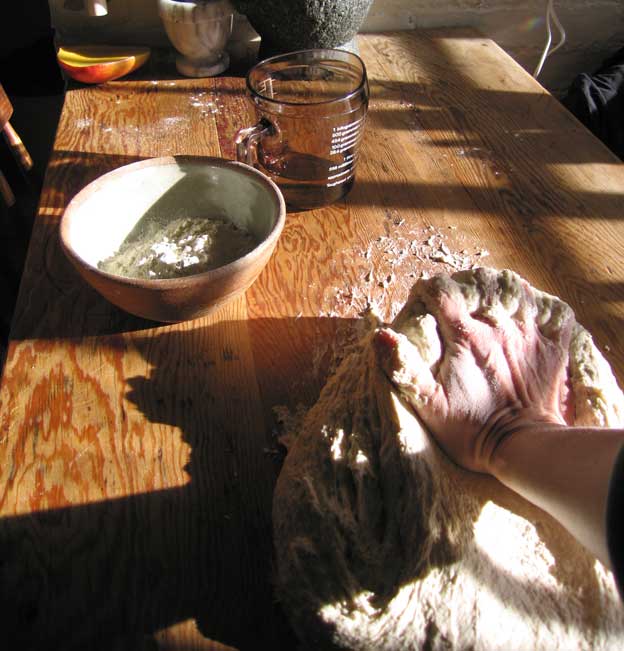
Mix all the dough ingredients together. If you’ve got a breadmixer, use it, but I knead by hand. Not the two-handed wrist-flexing method my mother used for bread and clay, but the technique I was taught by a professional baker. You’ll need a straight-edged dough scraper, ideally with a flexible blade (the stiff blades are a pain for this), or improvise with a piece of perspex, windshield ice-scraper… anything that will scrape the dough along the surface without cutting into the surface the way a knife blade might. With the scraper it’s simple: dump the dough on the surface and put the heel of your hand in/onto it, then drive the heel of your hand away across the table. Feel the dough stretching and breaking as it’s trapped between your hand and the table. Push from your shoulder, not your wrist or elbow; it’s a straight-arm power move. This photo isn’t bun dough, I didn’t think to take a picture. It’s sourdough bread dough from one I made earlier.
When you’ve gone as far as is comfortable, curl your fingers down to catch the ridge of dough in front of your hand and pull that back as you bring your hand/arm back. Use the dough scraper in your other hand to bring stray bits back into the lump, then push away again. Try to build a circular move that rotates the lump of dough as you knead to bring every bit of it into the kneading process. It feels awkward to start with, but persevere: it’s much kinder to your joints and is particularly good for handling sticky, wet doughs. When the gluten is reasonably well-developed I use the two-hand method to form a nice tidy ball to be put well-buttered bowl, covered with a towel and left to rise until doubled in bulk. This increase in volume is the key to a nice light bread, as opposed to the brick-like objects I insisted were bread when I first started baking. I mean, they were flour and salt and yeast… had to be edible, right? :-)

While the dough is rising, make the sticky: mix the sugar and butter together to make a thick gooey paste and put 12 big dollops of this in three rows of four down the pan, roughly where you plan to put each roll. Put a couple or three pecans on top of each lump.

When the dough is doubled, flour your work surface and pat/pull/spread the dough into a rectangle about 12″ wide, 16-18″ long and just under 1″ thick (those measurements are guesswork and memory, but the proportions are roughly right and the details really don’t matter too much as you’ll make 12 rolls regardless). Leaving about 1/4″ clear along one long edge, drizzle the melted butter evenly over the surface and spread with a brush/spoon. Sprinkle the cinnamon sugar, the chopped pecans on it. Dot the raisins as a surprise for raisin-lovers in your life. Work a little cold water gently into that clear strip to make it sticky, then roll up from the other long side. Press/pinch the join to hold it together. Press a sharp knife into the centre of the cylinder, then divide each half into half, then divide each quarter into three (feel free to use a measuring tape, I used to). The end rolls will be slightly smaller than the middle, which makes it easier to be slightly less self-indulgent, or subtly penalize someone who has offended you. Place one bun-to-be on top of each dollop of sticky, remembering to mix big and small in each row (if you cram all the centre buns in one place, they won’t have room and the little ones will be lost and sad). Leave to rise for another three to four hours, until the buns have joined at the edges and are looking puffy and, well, risen. Preheat the oven to 375°F over the last hour.
bake until the tops are really well-browned.

While the buns are in the pan it’s hard to check that the toffee base has worked so what I do is: remove the buns from the oven when the tops look done. Leave sit for about a minute, no more than three, to allow the toffee to set a little bit, then run a knife around the edge of the pan and turn the buns out as a slab, scrape any toffee left behind off the pan and apply to naked bun-bottoms. If you haven’t used teflon paper and you wait too long, the toffee will stick the buns to the pan; if that happens, carefully and evenly heat the bottom of the pan over a low burner to melt the toffee a bit, then turn out. Best to avoid this if you can. If, when you’ve turned the buns out, the toffee isn’t quite toffee enough, you can put the entire slab under the grill for a couple of minutes to properly melt the sugar and butter. Watch like a hawk to ensure nothing burns.

By this time the smell will be driving you mad, so as the toffee sets, turn the buns over, drizzle icing over the top and rip the slab apart like slavering wolves falling on a hapless caribou. Or hungry people on fresh cinnamon buns.

Plying balls are made of win.

Well, actually they’re made of singles and win. Simultaneously. Isn’t that clever? They are clever. I learned of them from Abby Franquemont and, just after Christmas 2008, when I decided I could not spin another millimetre on my Victoria, I wound the singles I’d created so far for a 2-ply project off the Louet bobbins into plying balls with the intention of trying the technique.
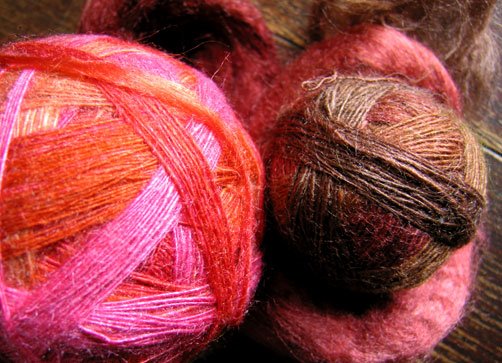
That’s Treenways Silks tussah silk in ‘Sunset Swing’ (left) and ‘Musgrave Medley’ (right and roving). Wind the balls very, very tightly – these are like those elastic-wound golfball centres, they bounce – because it’s essential to control the twist in the singles. That picture also explains the project. I passionately hate pink, but I’ve gradually begun to realise it actually does things for me when combined with bronze and orange. I think that ball on the left is gorgeous (you should have seen the roving) but I’d never wear it. Never, ever, ever. I had the notion that if those brilliant, bright colours were plied with similar but much darker colours, the end result would be toned down to the point that I could bear to look at them in sunlight. And maybe even wear them.
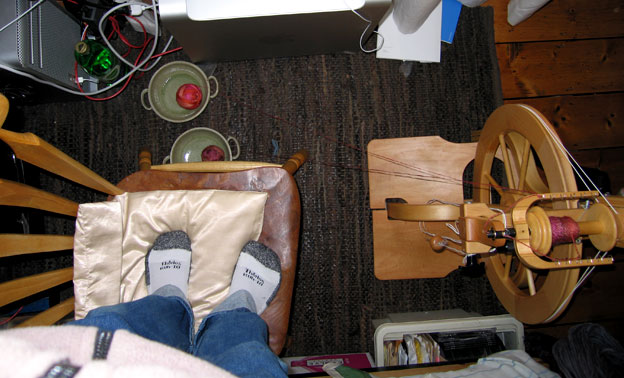
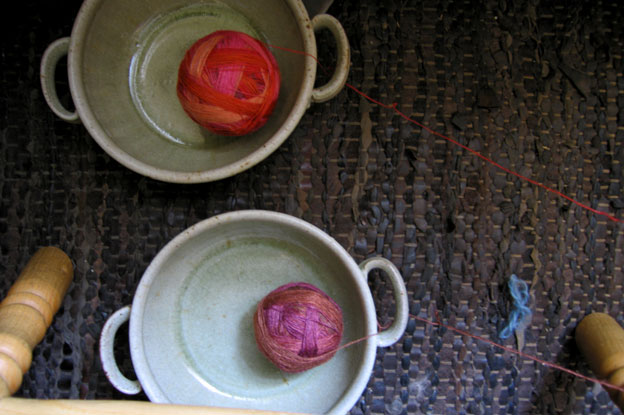
There’s my setup for using them. Looking down from my chair, you can see two ceramic bowls (the handles are important), one for each ball, and the singles running to the wheel. A closer shot shows the singles running from the ball UNDER the handle and away to the wheel. Under the handle is good because it stops me pulling the balls out of the bowls: the plying balls just sit nicely, each in its bowl, rotating to feed an otherwise very temperamental lively single to my left hand.

What do you think? Does it work?


Despite Pshop, these photos does not do it justice. In sunlight that skein GLOWS. 460-odd metres of every shade of warm from the dying embers of a woodfire to the most beautiful sunset you’ve ever seen. I love it, and I love it even more because my guess was right and it’s taught me something. I want to wear it.

Last weekend was hectic. On Saturday we walked (3 hour drive each way); on Sunday I put both the Schacht Matchless and the Suzie Pro in the back seat of his car and carefully fastened their seatbelts (he said it looked as though I was taking my children out) and drove (an hour and a half) to Socktopus for Diane Mulholland’s ‘Spin Short’ class. Well worth the drive, both for Alice’s shop (full of beautiful, colourful, desirable sock and lace yarns) and to meet Diane, who is a very good teacher indeed. We started with fine merino to learn spinning from the fold, something that has previously eluded me, moving on to camel down (soft!) and cashmere (unbelievably soft!) spun from the fold and long-draw from the end of the top.
From left merino, camel, cashmere (the palest tan). We spun on featherweight spindles and on wheels; I started on the Schacht with the silly fast whorl (one size up from the tiny stupid fast whorl) while Diane used the SuzieP with the extra-fast whorl, then we swapped so she could try the Schacht. And then we moved to cotton. Wow. Just… wow. I am glad I had someone to tell me everyone who thinks they can spin will have problems when they first try cotton. It’s not like other fibres. Try for Beginner’s Mind. The fibres are short (we started with long cotton because the short-staple stuff is just ridiculous) and they tend to stick to each other: drafting requires both a knack and some effort.
Nonetheless it is strangely compelling. Perhaps it’s the challenge? That’s the ‘easy’ long staple, spun from my own punis(!) followed by some sliver in natural colours, brown, cream and greenish. The class was such fun and Socktopus is such a delightful place (pretty cupcakes, cheerful Sunday knitters) that I will be back. I’ll find a reason. The drive home had added interest: the M25 Northbound was closed at J17. I left for the M40 at J16, left that at the first opportunity, and joined the horde of motorists flooding across Berkshire. It was absolutely hilarious. Main roads were 5mph, nose-to-tail at with drivers blindly following the instructions from their GPS systems, faces lit with blue light from the screens. The small roads were were alive with people like me, working from roadmap atlases, diving into laybys or onto verges to flick the interior light on and work out what to do next before the light goes off and we peel out again into the darkness. I was an hour or so late getting home and I haven’t had that much fun for ages!

Look what I accidentally bought when I got home. That’s a traditional Mali bead spindle for supported spinning of cotton from Amanda Hannaford which meant I spent Tuesday lunchtime playing with cotton again. When I’ve spun enough I’ll try finishing some; I think it has to be tortured, boiled alive or something similar. I seem to remember washing soda might be involved.
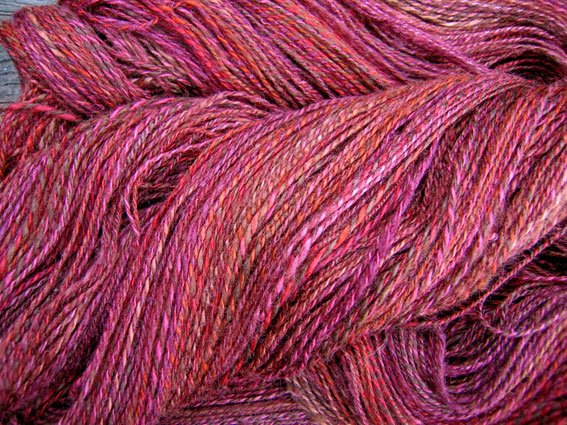
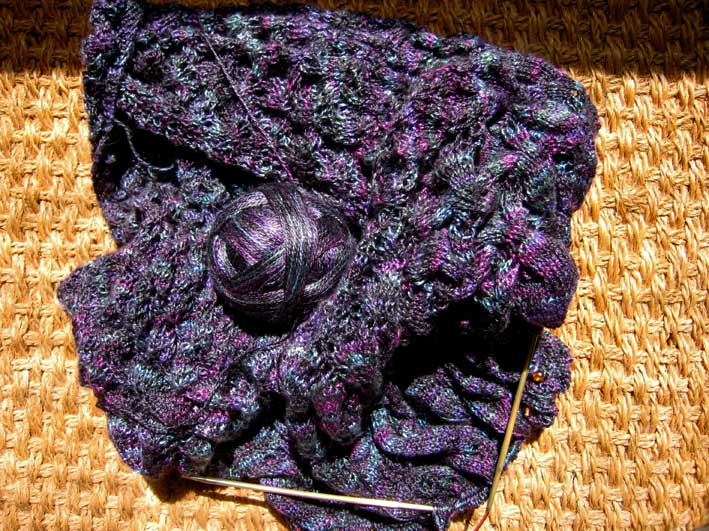
Lastly, a quick glimpse of some extremely slow knitting. The Yarn Harlot recently posted about some issues with a shawl; this is the shawl that’s nearly defeated me.
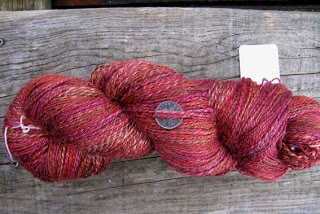
That will be (it will, I swear it) Sigga from Føroysk Bindingarmynstur/Faroese Knitting Patterns. How hard can it be? 601st cast on is a bit wearing, but with care and stitch markers every 25st, it’s bearable. Then there’s a lot of knitting (not even any purling). I can do that. The decreases that drive the shaping? no problem. Lace insertion? Come on, YO k2tog or ssk. Where’s the prob… ah. Try running the decrease lines in the other direction, just to be different, don’t like the result, rip back 6 rows (that’s 6x almost 601st), pick up the live stitches and try again. Realise you somehow missed the bit in the instructions about the additional decreases for the first 30-odd rows, decide to wing a solution and carry on knitting. Realise you’ve messed up the YO/decrease pattern in the central panel and, on the next round, drop every one of 21 stitches back 6 rows and remake the decreases in a different direction with a crochet hook. Finish the lace, breathe a sigh of relief, charge ahead and realise you’ve forgotten the final YO/decrease row *and* 15 garter ridges after that. Grit teeth, rip out 5 rows, pick up live stitches, carry on. I am learning lessons here about patience, and thinking before jumping. And that it’s next-to-impossible to face ripping 2000-odd stitches when you’ve just finished knitting them. Easier to do it first thing in the morning, fast. A bit like ripping a band-aid off.
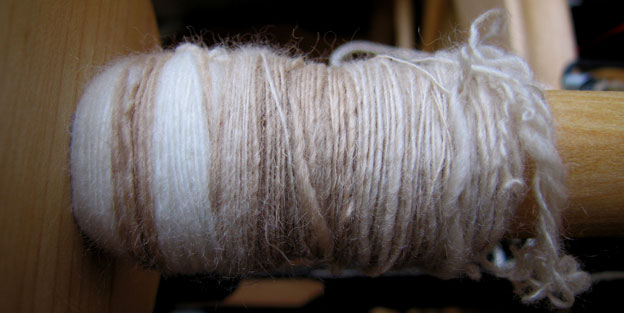
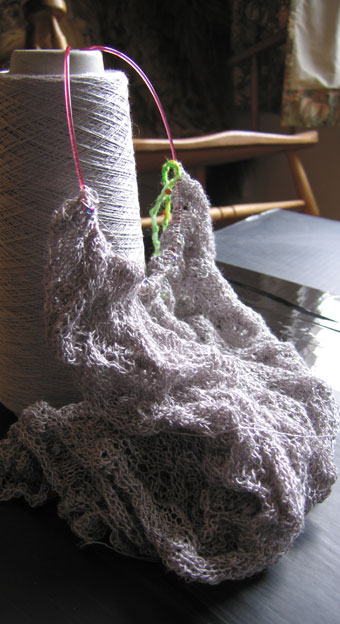
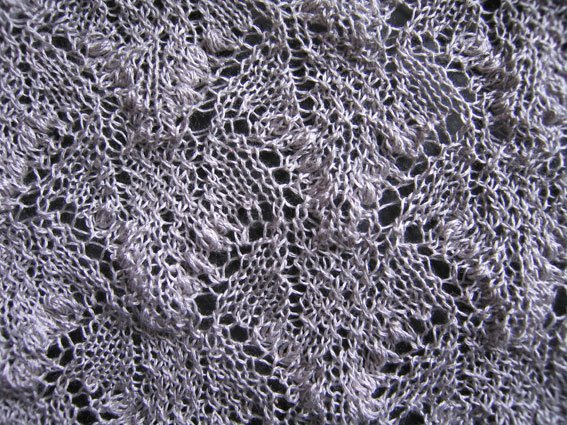
Here’s a lesson in slow-but-steady: my version of the Maikell Shawl from ‘Knitted Lace of Estonia‘. The cone is 2500m of loosely plied 2-ply silk from Colourmart, and the blob is about 8 repeats of the centre panel. The pattern calls for 12, but I’m using smaller needles and finer yarn, so to get something of decent size I think I’ll need at least 15, perhaps 18. This is what it looks like laid flat.

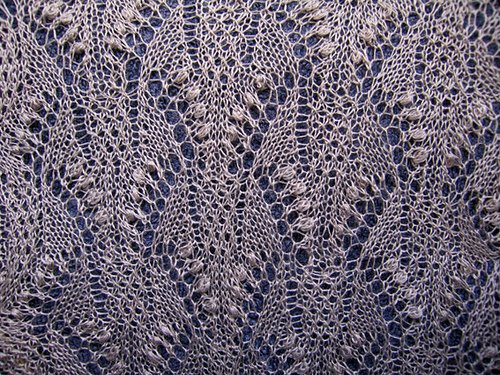
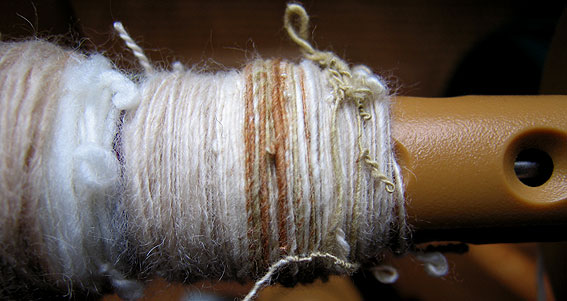
And this is pinned to show more detail. And the numerous nupps. This shawl is teaching me that choosing to knit 7-stitch nupps in fine, inelastic silk thread is NOT clever. Very not clever. But other knitting has taught me to persevere, so I shall.
Just not tomorrow. Tomorrow is for walking! Which also teaches perseverance. A useful lesson to learn.