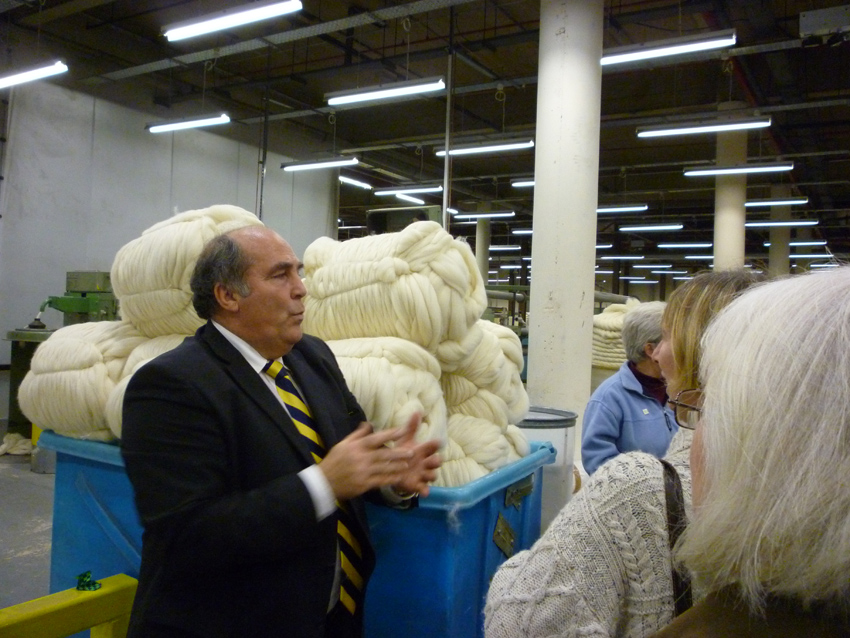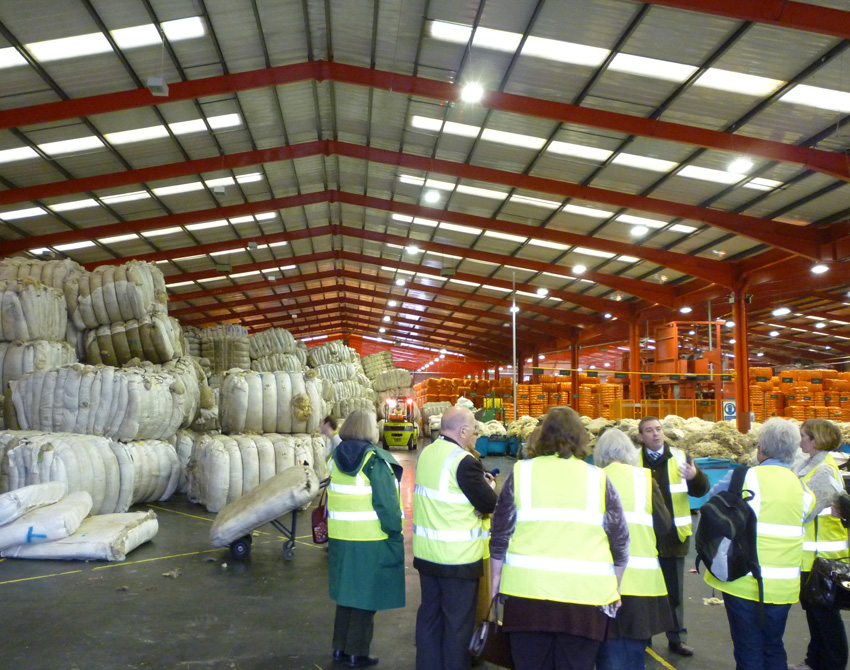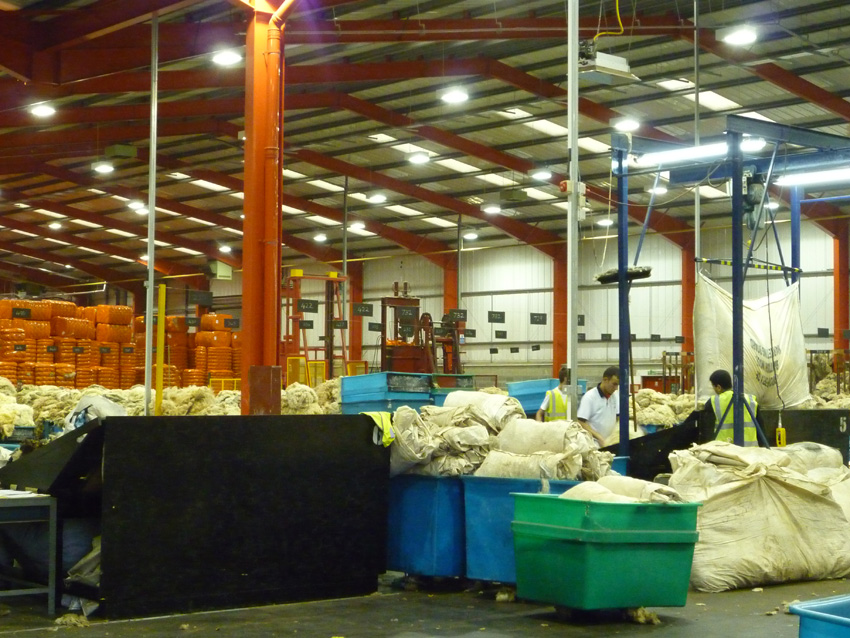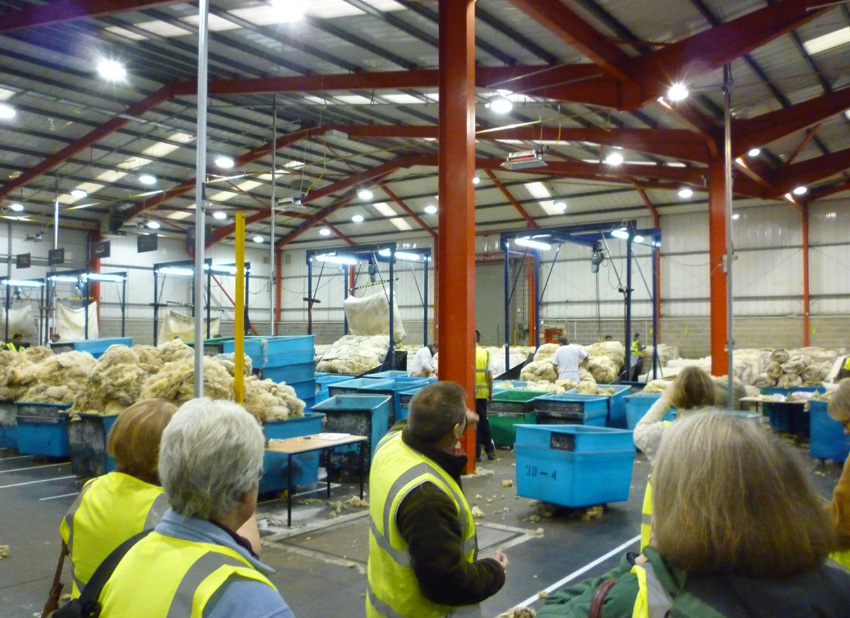
A Bradford Adventure part II: the Haworth Scouring and Combing Company

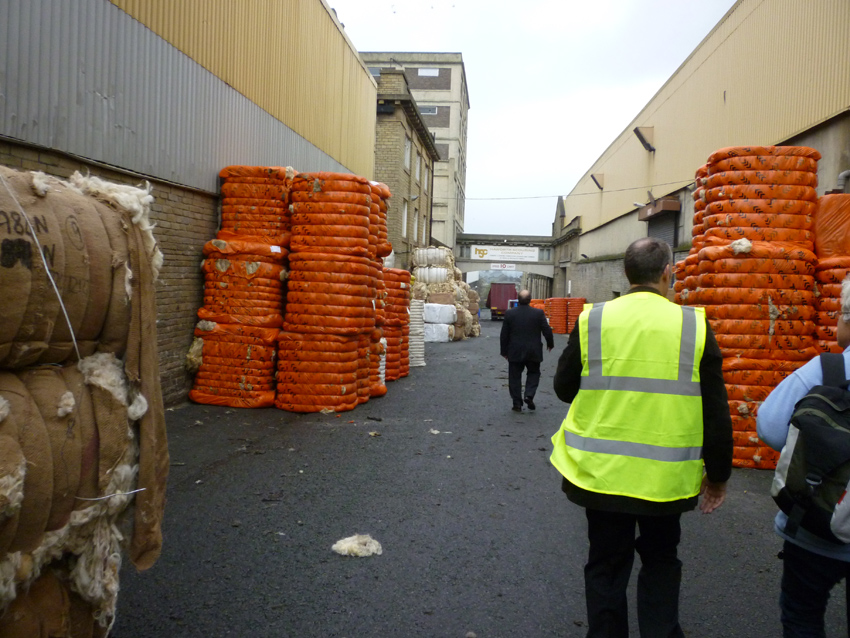
At the end of the Depot tour we handed back the hi-viz vests, piled into the vans and headed at some speed (we were running late) for the Haworth Scouring Plant, itself once a cashmere processing plant, passing other disused cashmere processing plants and discussing the sad, rapid decline of the industrial north. We parked outside a nondescript building, with odd scraps of fleece on the ground suggesting there was wool-processing nearby. A gate opened to reveal even more fleece on the ground:

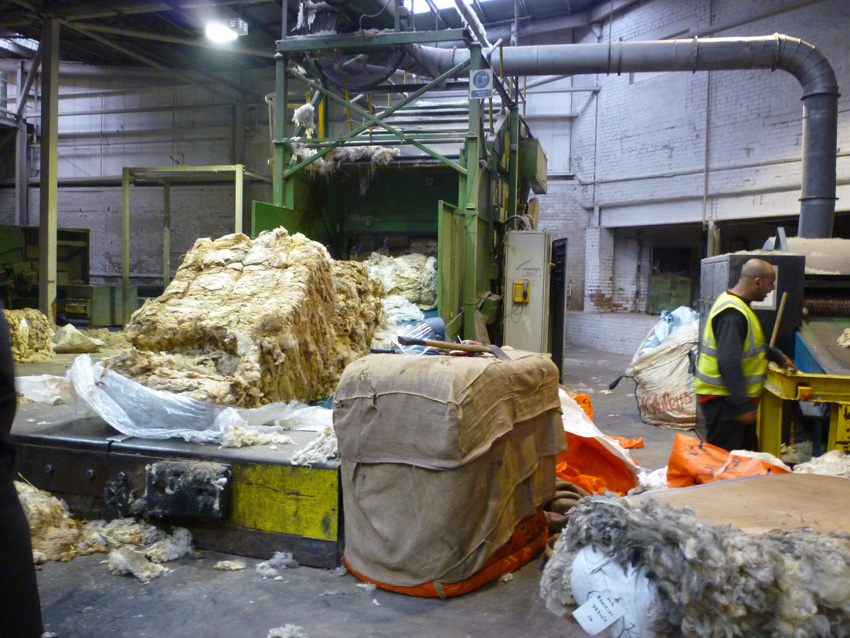
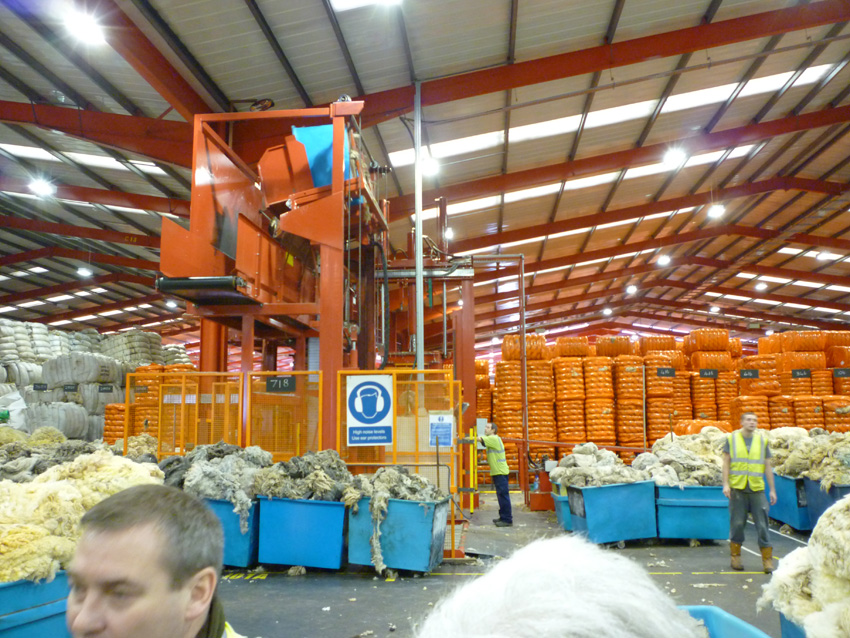
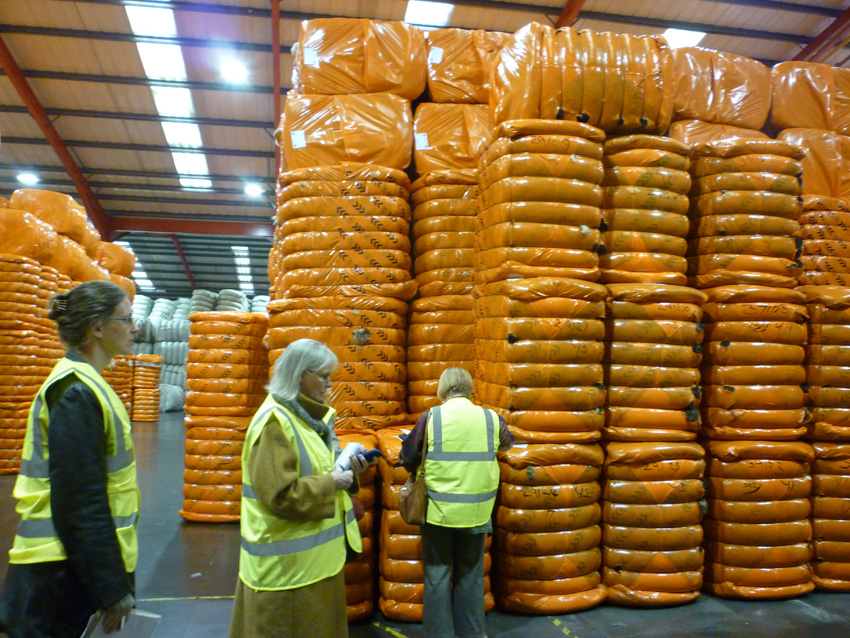
We walked between bales of UK fleece in orange wrappers, Irish fleece in yellow wrappers, fleece from the Mediterranean in sacking and from Norway in white plastic (fleece from overseas is certified free of disease before importation), all waiting for imminent processing. LOTS of fleece in the queue to be processed and a warehouse full of bales waiting their place in the queue. And this shows why The Campaign for Wool is an international campaign: many countries produce wool and many produce much more than the UK does. Even if a purely British campaign managed to increase the price paid for wool in Britain, the UK market would be flooded by wool from elsewhere. And, after all, most of the UK clip does go into carpets, not garments sold on the high street. So The Campaign for Wool is working to increase the profile of all wool, to publicise the value of all wool everywhere because (as someone said at Bradford) “A rising tide floats all boats”: raise the price everywhere and producers everywhere will benefit. Anyway, back to the tour. All the wool outside will come here:

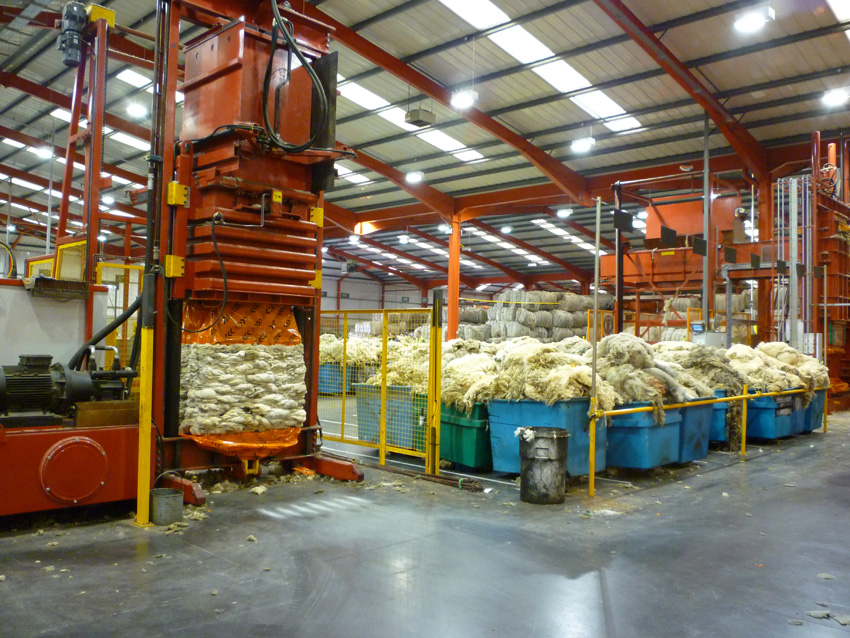
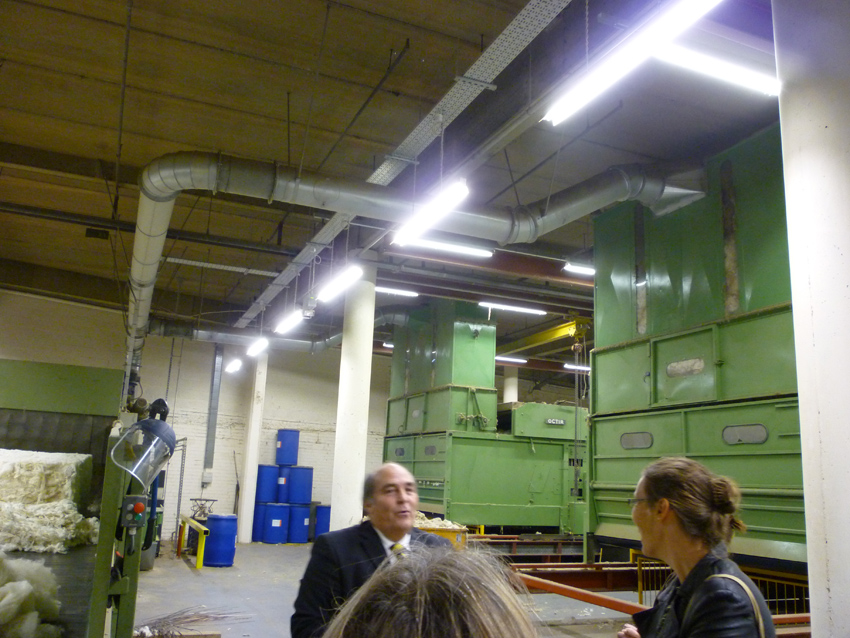
Strapping and wrapping is removed from the bale and it’s fed to the Big Green Machine on the left, which begins the process of opening the fleeces for processing. Cotted fleece (a separate grade at the Depot) goes first to the machine on the right, known as the Piranha, to be ripped open more… forcefully. The ducting from the Piranha feeds into the Green Machine, and from there all the fleece is blown through into the next room.

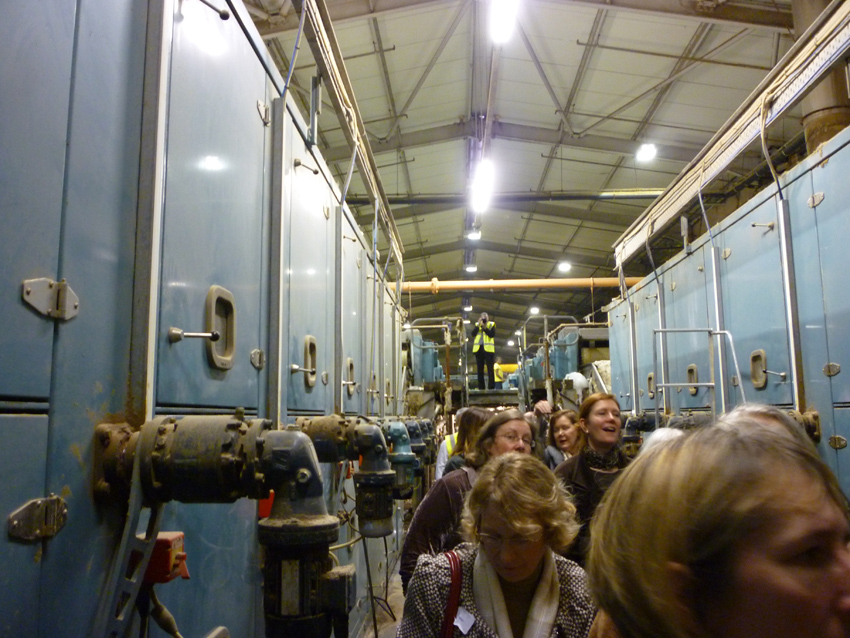
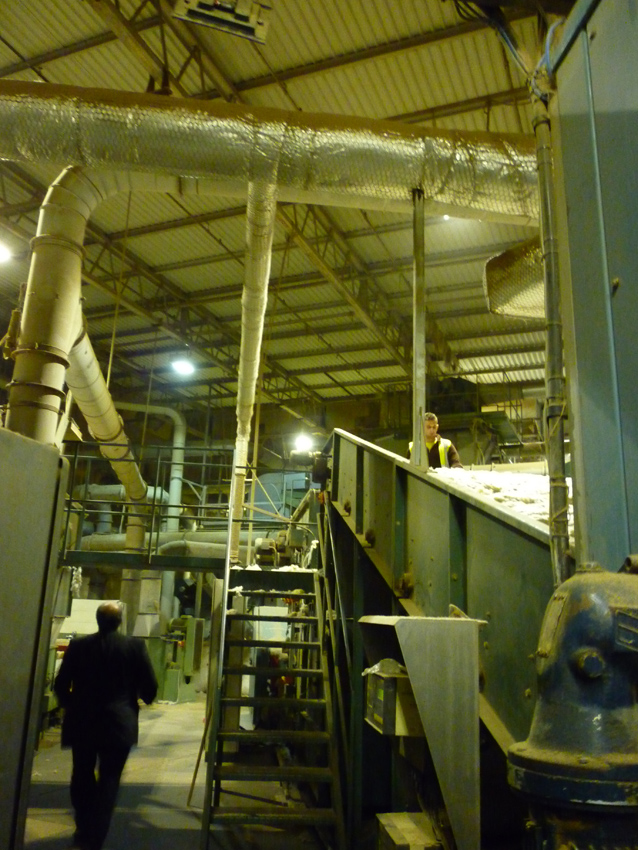
From this point my photos cannot do justice to the plant, let alone Martin’s enthusiasm as he showed us through it! Everything is just Too Big. There are two processing lines; the huge bins to each side of us as we walk into the works contain fleece being further opened as it moves toward the washing line. If you click for bigger on the photo above, you can see a set of steps; we climbed those and then a second set to get to the point where fleece emerges ready for washing. Now, in addition to the noise and the smell of industrial quantities of wet fleece (not as pleasant as my one fleece in my kitchen), we encounter steam and heat, which is why the camera lens is fogging. My camera does have a hard life, poor thing

Here the fleece is about to be fed into the first ‘bowl,’ as the washing containers are called. It’s a misleading name, they’re actually huge tanks. Water temperature and other aspects of the line are computer-controlled so that different types of fleece can be handled with varying degrees of delicacy. The first bowl is the hottest, running without detergent at 70°C at the time of our visit, which combined with my camera temperature to yield only wonderful pictures of lens fog.

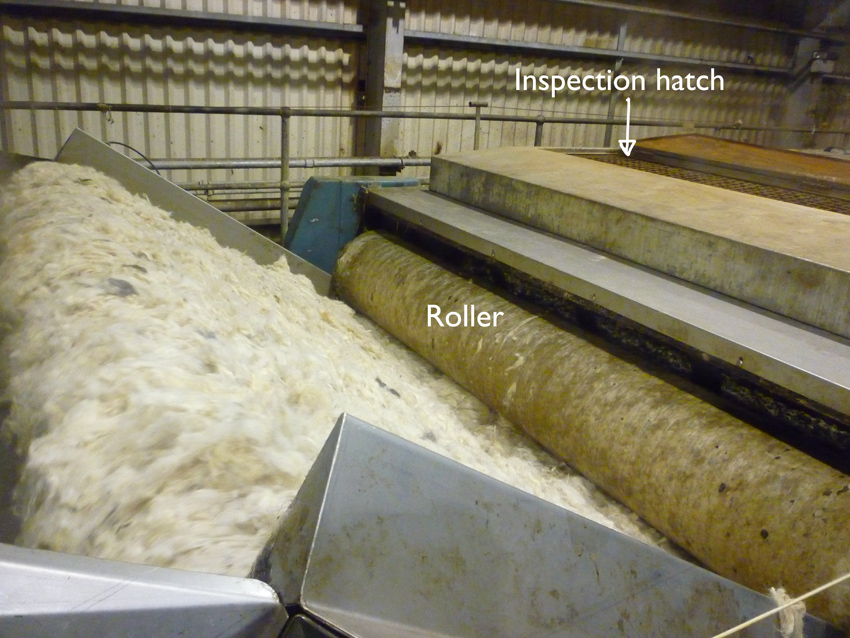
Above is one of the bowls a little further down the line (there are 8 in total); the line is moving from right to left. To give you some idea of scale, I’d guess the roller pressing excess moisture out of the fleece is 5–6′ wide. We peered into the inspection hatch and saw a mechanism that looked much like rows of wide-spaced fingers propelling the fleece through the water. I didn’t think to ask how much water the plant uses, but I did ask if they had difficulties meeting environmental quality regulations, and was told no, that Haworth has its own in-house water quality laboratory, bought lock, stock, barrel and specialist when another firm went under (we saw the lab later in the main building). Also, as later became clear, the dirt in the water is in fact money, so they want it out: there’s truth in the saying “Where there’s muck there’s brass.”

Here Martin is holding a handful of clean fleece. And it is clean: Haworth takes residual fatty matter down to 0.2–0.3% by weight, whereas some fleece processed in China is at 4%.

And then the driers. This perhaps gives the best idea of the length of the processing lines (there’s Tim Booth of the BWMB standing at the end of the washing area, taking a photo of me taking a photo).

After the driers, a visual inspection to remove anything untoward, followed by magnets to remove anything metallic that might damage the processing equipment.

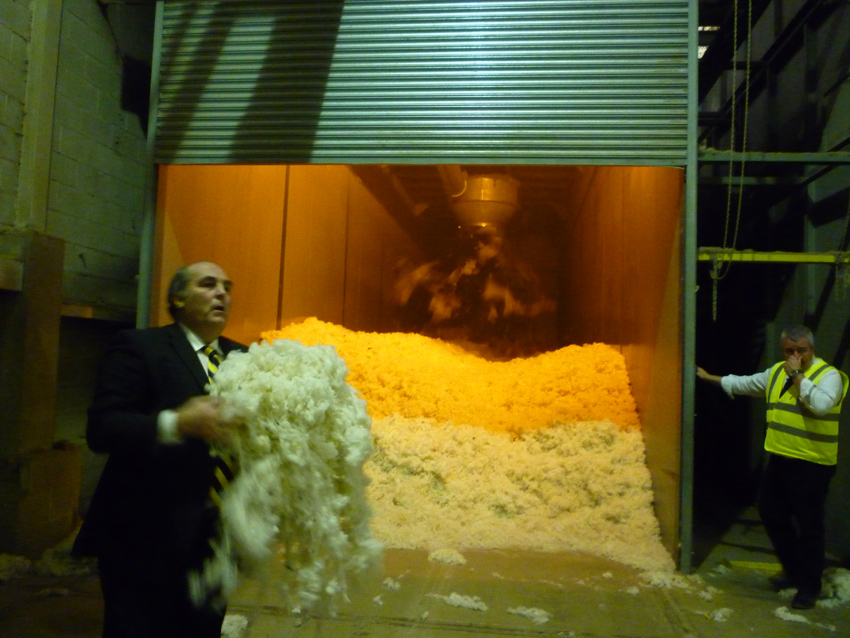
Now this was rather cool. Or rather warm, in fact. Haworth takes as much care as the BWMB to ensure uniformity in its bales. Here the dried fleece is blown in horizontal layers to fill a container roughly the size of a semi-trailer. Once it’s full they unload it from the front in vertical layers, blowing it to their own baling setup:

They’re very proud of their washing plant: these bales, which look just as clean as any other fleece we saw at this stage, are in fact sweepings off the road we walked down.

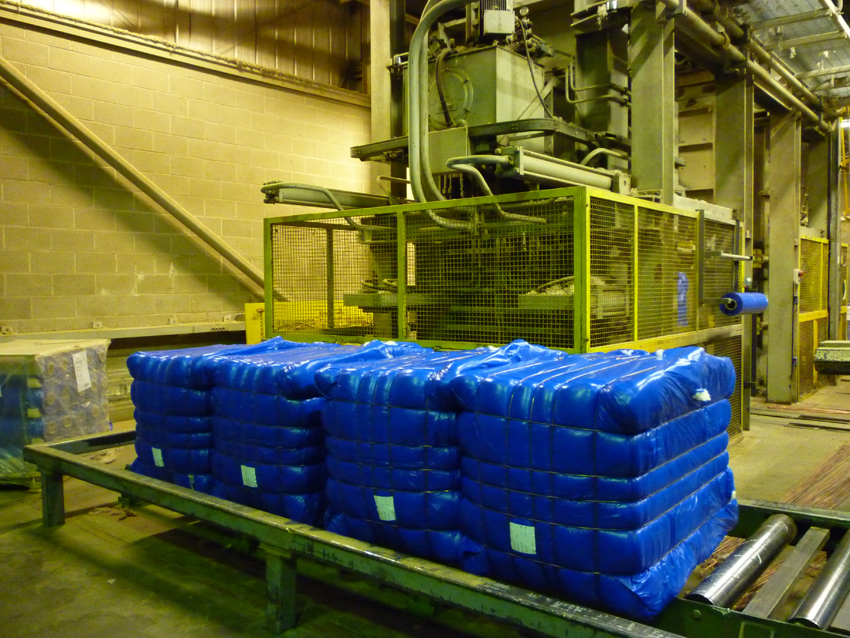
And here’s part of the store of clean fleece ready for further processing. The gold bales on the left are fleece from the best of British, which they hope to promote for the Olympics; the blue is their ‘ordinary’ and the unwrapped bales go straight to their own processing plant across the yard. So we walked across the yard

where we had a fine view of the set-up to reclaim lanolin and other waste products from the wash water. The lanolin is shipped out in those black ex-orange juice barrels for a variety of purposes. The soil/muck is used in soil reclamation projects, as it’s rich in plant nutrients.

Are you bored yet? We weren’t. We were excited!

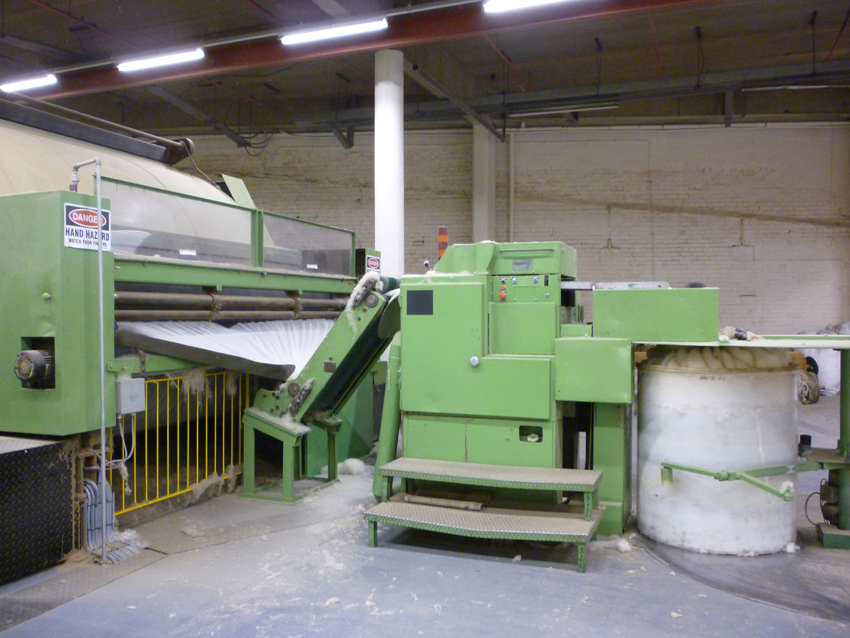
To the left you can just see part of the machine that opens the bales of washed fleece and anything else – tag ends of roving and so forth – ready for the drum carders. Those BIG green things on the right are industrial drum carders. Didn’t look like much at this end, but

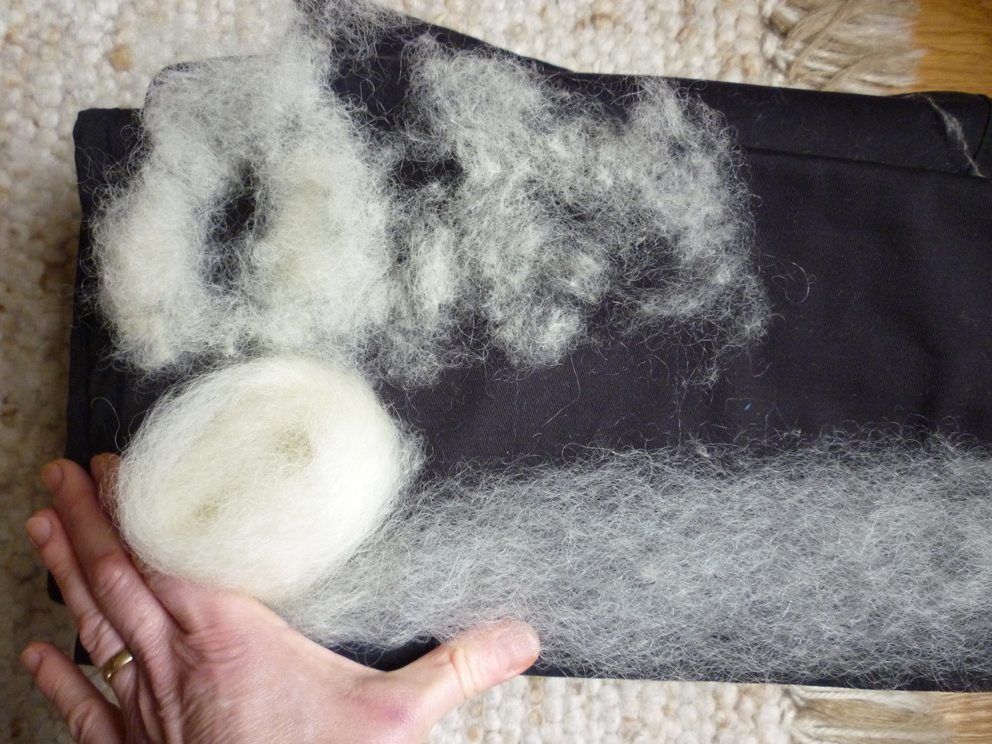
LOOK! spinning fibre! There was a swirl of excited laughter and everyone who spins tried to take meaningful pictures. Basically the sheet of fibre (it’s at least 6′ wide) is fed off the last drum and laid down into the big white bin. I couldn’t count the big bins of fibre visible in this space, and I was so overwhelmed I forgot to even try to take a picture of them. Basically it’s a giant space full of fibre like this:

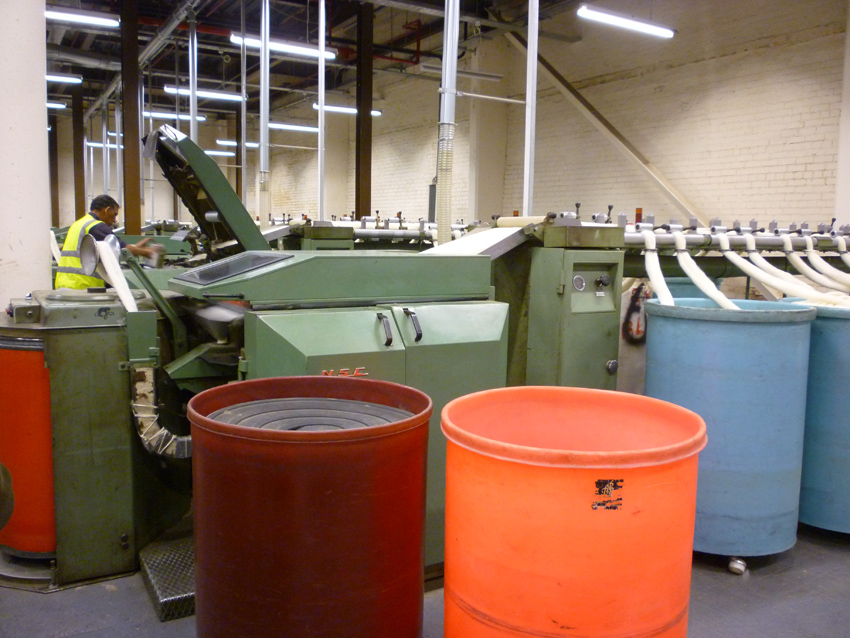
Some of the roving is fed into combing machines, like this one:

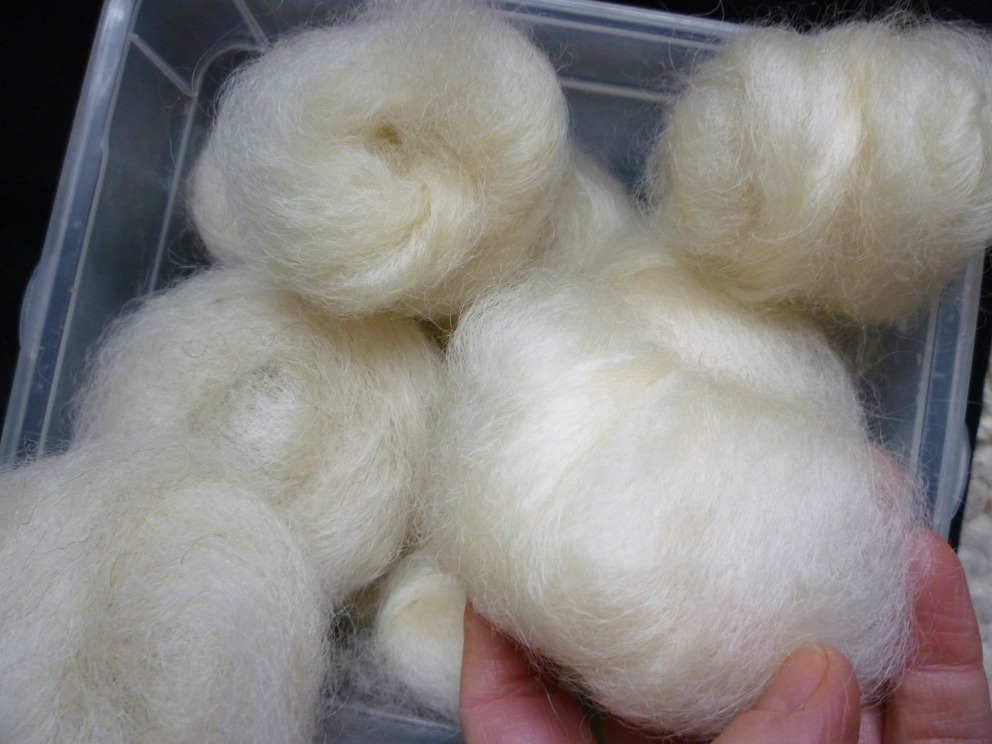
And the end result is fed into even more big bins, then weighed out into 10kg bumps.

And here’s the thing. Each of those bumps will cost you £4.50 – if you buy 10,000kg or more. That’s not a lot of money, really, for what they are. I look at that bump and imagine sheep cared for by farmers across the world, sheared and graded by a diversity of shearers, passed from hand to truck to be shipped to the UK and … here it is for us to admire and manufacturers to purchase: wool. It’s a wonder-ful fibre. Wear it with pride!

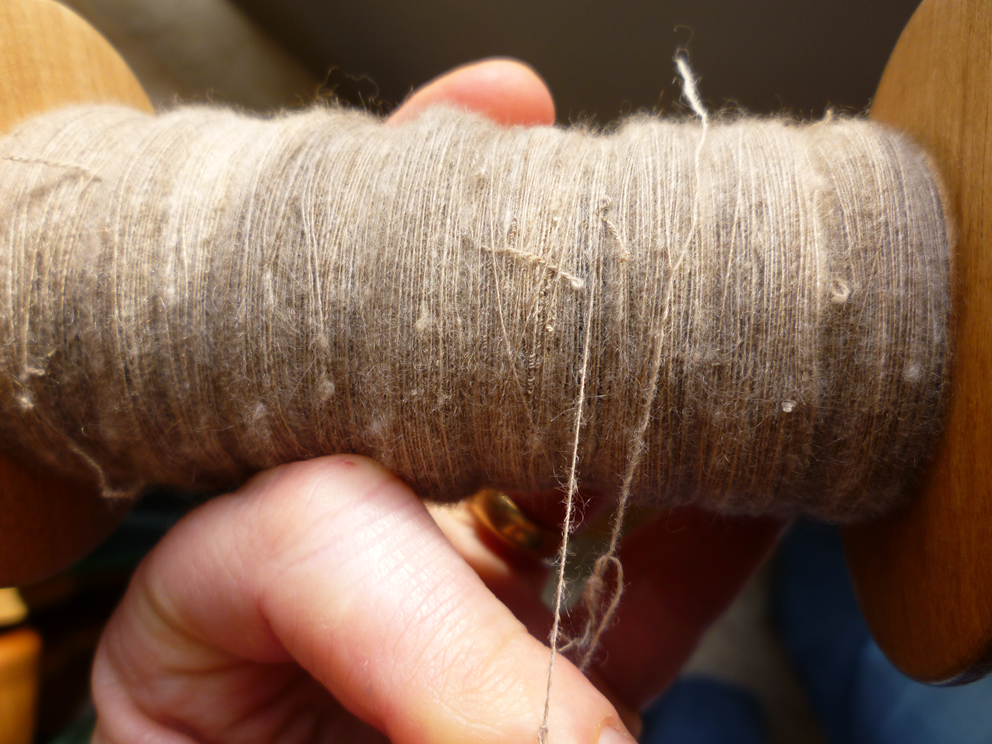
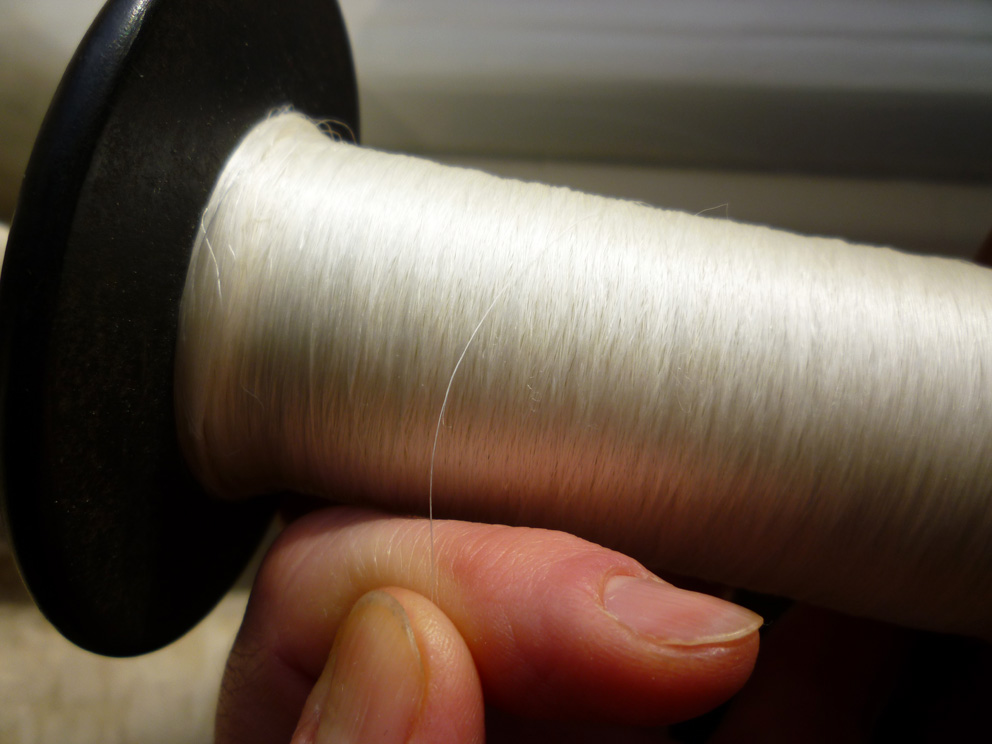
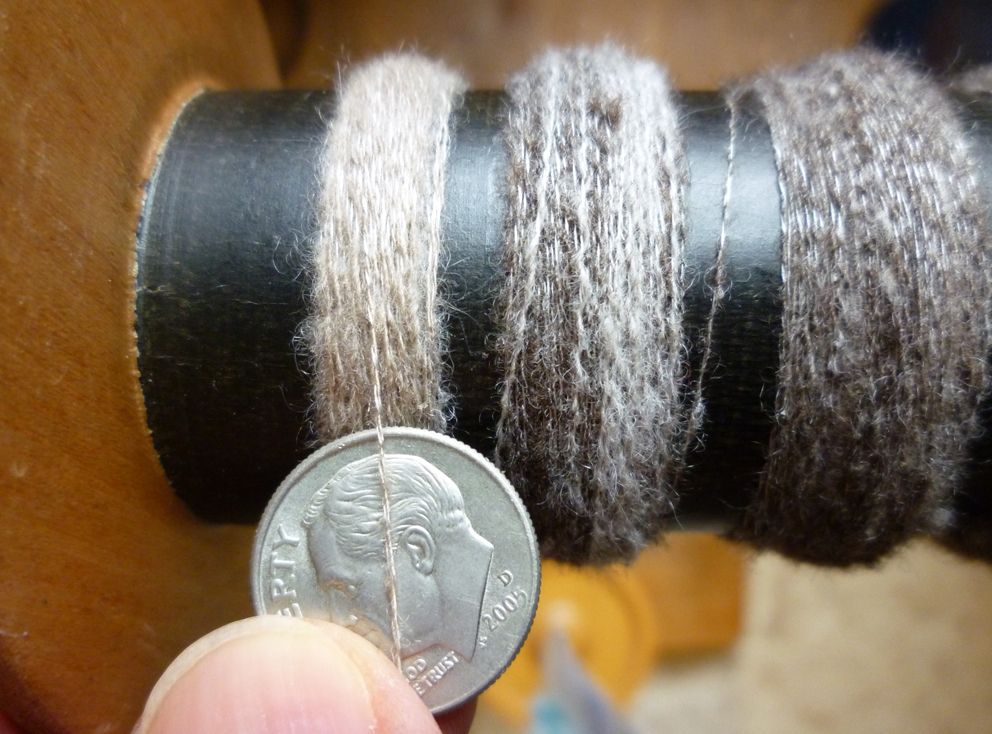
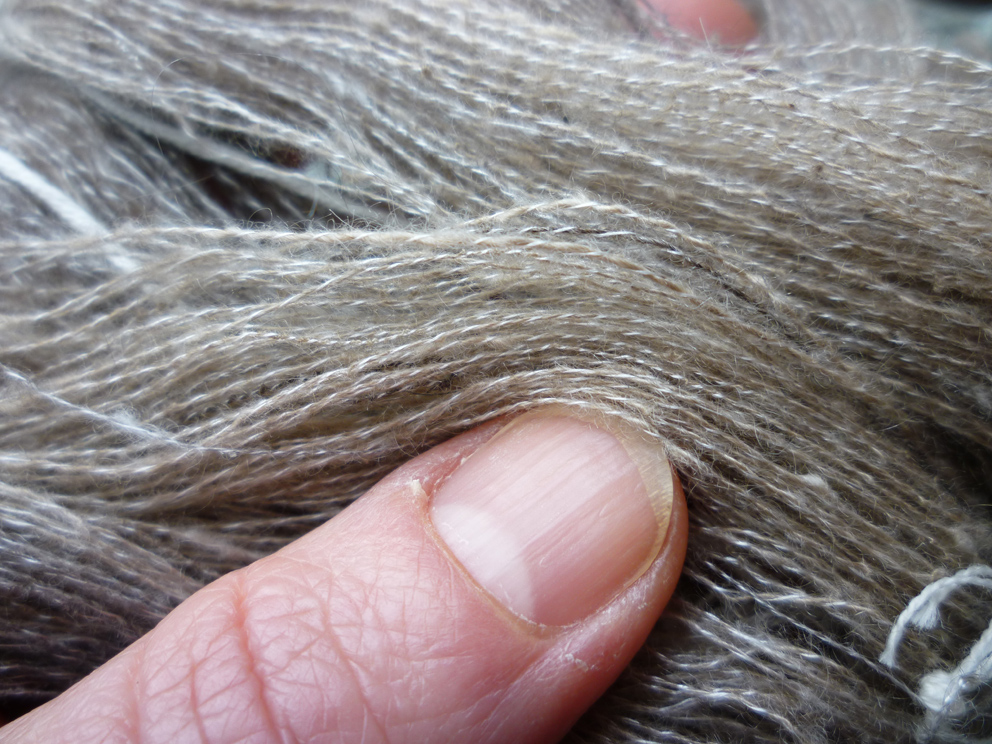
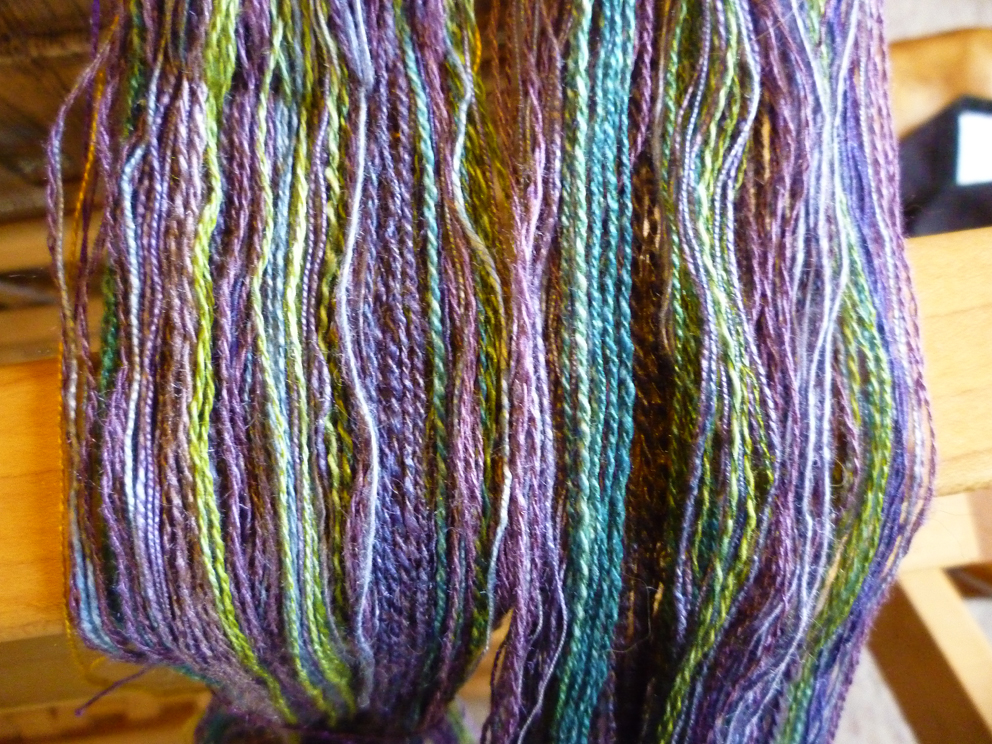
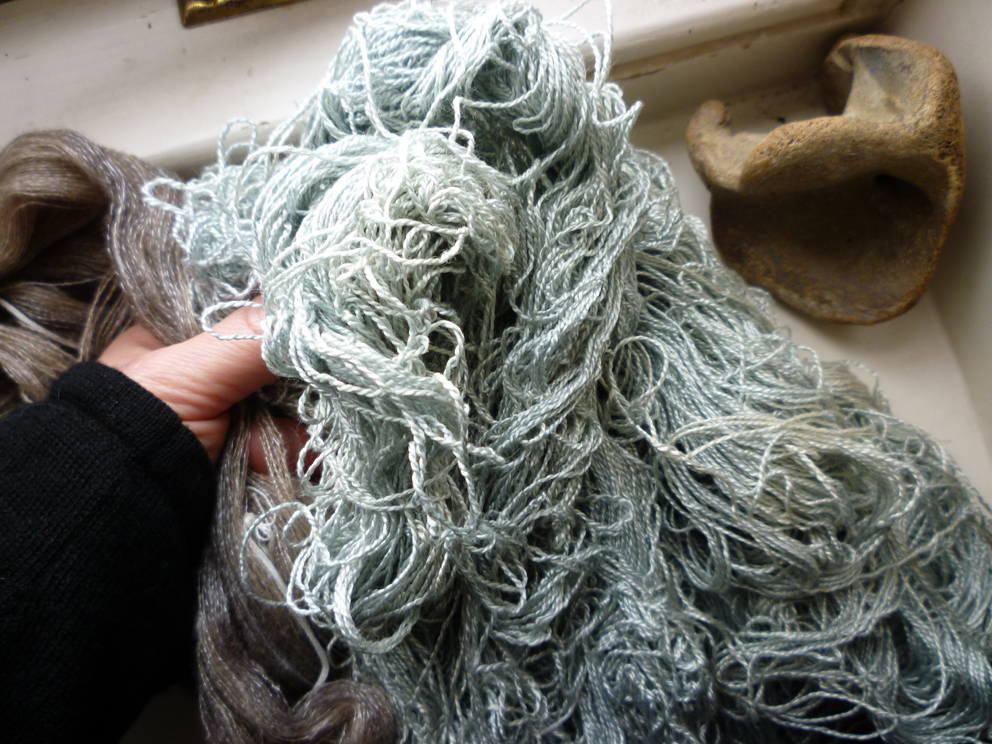
And finally, yet more fibre. Upstairs, above the offices, past the lab, we found a room of wool.

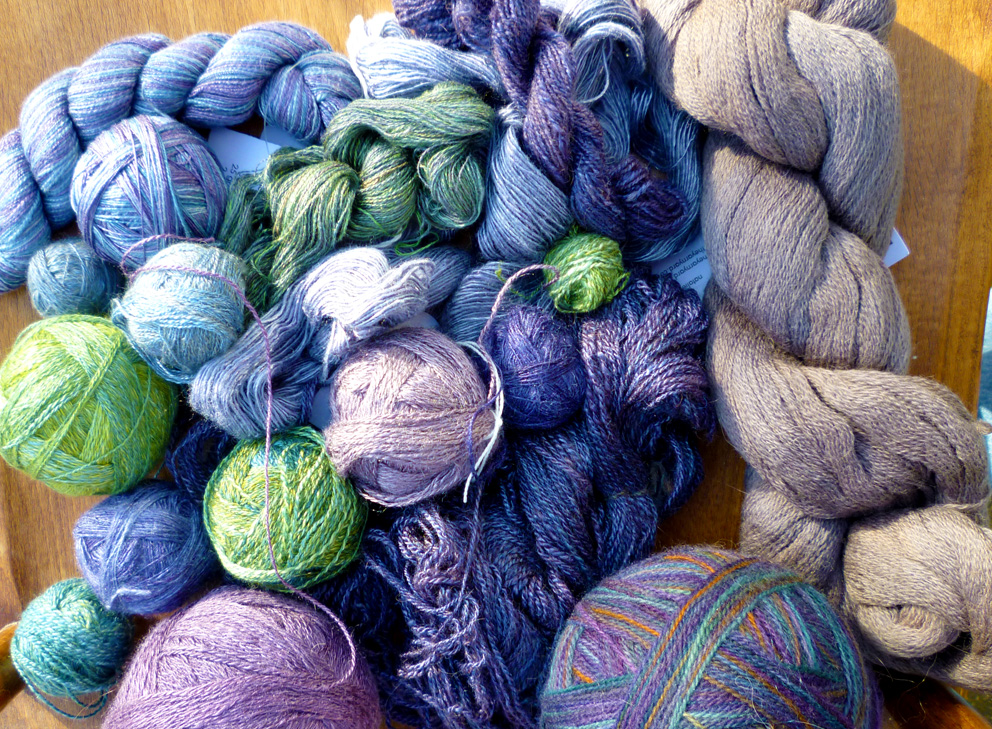
It’s the home of the Real Shetland Company! British breed fibres! Yarn! I wish we could have stayed longer… I didn’t really need to eat lunch.

If you enjoyed this, Lesley’s blog here gives an overview of our Big Day Out with some of the facts and figures I can’t read in my notes…

And now a different but related plea. You may have read about Wovember, the campaign to celebrate the fact that real wool comes from real sheep. If not, please take the time to read that link, and Kate’s ‘woolly thinking’ blog posts about how sloppy or actively misleading advertising may mean people buy not-wool when they thought they were buying wool. Take care to read the labels on garments you’re thinking of buying and, if you feel bold, mention your concerns to someone in the shop. Hand on heart, I have sworn to do this myself.

A Bradford Adventure I: the BWMB and the North of England Wools Depot

It’s been a long time. I have excuses and reasons, primarily that I began blogging to record my adventures in fibre, but it turned into a way to record walks and hikes and my interest in the history of the British landscape and the people who live in it. Sadly we’ve had fewer walks this year and so I spent my time outdoors enjoying being outdoors rather than documenting the experience. The same with SOAR this year: even if it’s a tiny digital camera lens, it distances the photographer from the experience and I wanted to live in the moment, rather than objectively recording it.

But.
I had such a good day out yesterday that I’ve been inspired to blog about it.  Wearing her Campaign For Wool hat, some months ago Lesley Prior asked for artisan wool-worker volunteers to train as speakers for the Campaign. I volunteered, and on Monday afternoon Alison of Yarnscape and I drove up to Bradford for the British Wool Marketing Board (hereafter BWMB)/Campaign for Wool Artisan Training Day. No photos of the journey, as I was driving and it was dark and I was navigating from memorised info to a place I’ve never been before. The Campanile Hotel on the Euroway Estate was clean and cheap, but I doubt anyone enjoyed the entertainment provided by a brief fire alarm at 0226 on Tuesday morning. Although the rather cheeky letter slipped under the door pointing out that we should be reassured, as it proved the alarm system was working properly made me chuckle. Very briefly.

Conveniently, the Campanile is virtually next door to the BWMB Wool House offices, where by 0930 roughly 13 of us had assembled for a brief coffee in a room displaying some of the best of British wool. OK, 70% of UK wool is used in carpets (and I can now tell you why, in possibly exhausting detail), but the yarns and woven goods were much more immediately interesting to handspinners and weavers. The swatches from Ardanalish Isle of Mull Weavers were lovely enough to make me wonder whether I could wear tweed with aplomb (I’ll probably settle for not looking silly). The BWMB website is full of information (if perhaps less than inviting to casual visitors), but the people are warm and welcoming, funny and absolutely passionate about British wool. We were well-met and well-matched!
Everyone piled into mini-vans and headed for the North of England Wools Depot. We didn’t have time to appreciate the size of the building until we were in it, donning our hi-vis vests. It’s immense. It has to be: 90% of the wool clip arrives between June and September, but it’s held, graded at the rate of 150,000kg/165 US tons per week and released to market gradually throughout the year to ensure the price remains relatively level, which benefits both producers and purchasers in the long term. If my scribbled notes are accurate, the Depot is currently holding 700-800,000kgs of wool (that’s 772-882 US tons), and the same again is stored at Carlisle waiting for grading. To put that in better perspective, total UK wool production in 2010 was 28 million kg, about 31,000 US tons… and that’s about 3% of world production. And THAT is why The Campaign For Wool is an international campaign… but more of that in another post.

The white mattress-like things at left are ‘sheets’ full of ungraded wool. The BWMB supply the sheets, producers fill them for collection or deliver them to intermediate centres, which compact them for efficient transport before the BWMB trucks bring them to the depot for grading. The orange plastic bales each contain c. 400kg of graded wool… but I’m getting ahead of myself.

Above, an overview of the grading area. To the right is a sheet of fleece hanging above the table on which the grader (chap in the white shirt) is working.

The grading area in more detail. You can see the frames holding individual wool sheets, the tables and the graders working. It takes 5 years to train as a grader: they grab a fleece, classify it by breed, assess it according to the grades for that breed (the grades vary from breed to breed), then throw it into the appropriate skep (bin), all in a lot less than 30 seconds/fleece. It’s important to note that they’re not looking for the same things as a handspinner, because industrial wool producers aren’t handspinners. Fineness, presence or absence of coloured fibres and kemp, dirt content (dirty fleece is termed ‘arable’ and worth much less than clean because it loses so much weight in processing) are much more significant than breed, for example. Skeps of graded fleece are weighed on the floor scale visible behind our guide, Chris, then wheeled into the queues for the bale compactors. Fearsome beasts these, and unsurprisingly noisy.

With apologies for the disembodied heads… Chris is very proud indeed of their new double compactor, which is faster and more efficient than the old single compactor. You may just be able to see that full skeps are being tipped onto a conveyor belt feeding them into a vertical shaft; when the shaft is full, a ram compresses the shaft-full to about 1/3 height, a relatively small package…

(This is a freshly-compacted bale on the single compactor), the plastic wrappers are pulled down, and wire links used to tie the bale. Then the ram rises and the fleeces exhibit the famous springiness of English wool as they try to rise to their original bulk! They’re then stacked with others of their grade.

Note the circular hole visible in some bales. This is the sign that they’ve been sampled:

This machine takes core samples (you can see a scatter of circular patches on the floor) from bales to assess uniformity of fibre quality, dirt content, grease content, and here my notes are indecipherable due to cramp – it’s a long, long time since I took notes by hand like this! The bales are stored here until they’re sold at auction, and can be held free of charge for up to four weeks after purchase; longer storage is chargeable. Over 70% of the wool goes overseas for processing and manufacture; currently demand is high in China, 15 container-loads per week, which is why wool prices are rising. Which is why the amount of wool produced each year in the UK is rising: good news after decades of decline. This year they’re expecting 29 million kgs and, if demand continues at this level, they hope for >30 million kgs in the near future.

Along with facts and figures we had time for many other questions. For example, they don’t have any problem with moth, probably because it’s too cold and the wool is passing through relatively quickly. The bales sit longer, but they are largely protected by plastic and are so dense that moth larvae could make little impact anywhere but the surface. In case you’re wondering, they’re very pleased with the quality of the finish of their new concrete floor, but by the end of the processing season the lanolin leaves it as slippery as a dance floor, so they have to have it thoroughly cleaned for safety reasons. The graders no longer succumb to Wool Sorters’ Disease aka anthrax, and a detailed medical study shows they’re in no danger from pesticides used on fleece.

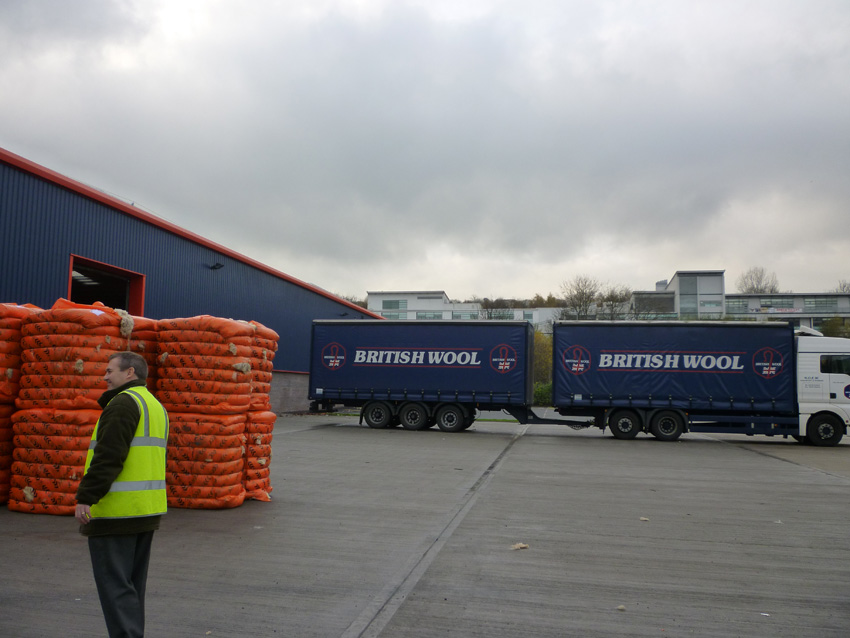
To finish, here’s a poor photo of a North of England Wools truck.

 Although it’s clearly promoting British Wool, the trucks are not always loaded with fleece – for maximum efficiency, they take haulage contracts for other goods when travelling to the depots to collect fleece. So when you see one of these trucks it might be full of tiles, but they’re still advertising British Wool. I like that.

Stay tuned for Part II, the delightful Martin Curtis and his Haworth Scouring Company!

The Workshop

Bast Fibres, sorry, Fibres. We were the noisy ones, so noisy that Jacey came to find out what we were doing. Several times. Sometimes we were pounding fibres – the flax strick needed only hackling to be ready to spin, but pounding the finished skeins with the beautiful wooden mallet on a chunk of the tree that fell on the studio softens and polishes the yarn.


Sometimes we were singing. But most of the time we were laughing. Monday and Tuesday AM were flax; on Tuesday we braved the storm (there was a tornado warning!) to boil our skeins. The Event Organisers were not completely happy allowing us to play with matches, but we did not burn the place down (we did borrow Jacey’s sign to use as a windbreak, though).


Tuesday pm was hemp, retted strick and decorticated top. Some of our handspun became rope: 12 singles became 3 strands became one thin but incredibly strong cord.
The singles are twisted into strands


The strands are twisted into rope


We spun on Balkan spindles, which have two whorls to contain the unruly flax singles; when the whorlsnare
removed ( they slide off), the spindle is used as a weaving shuttle.


We learned about other bast fibres: we spun ramie, we pounded soaked ganpi until what seemed was thick white fibre opened into the most amazing mesh


We showed our work at The Workshop Showcase on Wed evening; not the most packed or
most colourful table, but again we were noisy – we demonstrated pounded ganpi and flax ( as quietly as we could), and we, ah, encouraged people to come and watch our rope-making.

— Post From My iPhone

Monday is Flax Day One

And no photos on my phone, only on the camera and no way to transfer them here. In short: Stephenie summarised the characteristics of bast fibres as a group, talked about the cultivation of flax (including the story of an abortive DEA raid on one of her 4′ by 8′ flax plots (lush, green, what else could it be? Flax???). And then we learned about prep. Retting, rippling, breaking, scutching, hackling. Dressing a distaff or, in our case, broomstick (housekeeping was bemused). Spinning tow and line, dry and wet. My first attempt was Terrible, as I fought to overcome the longdraw habit. My second was marginally better. After dinner I returned to hackle and spin a third skein. Much better. Practice makes perfect and we’ve got flax again this morning. The rain and wind (tornado alert at 0630!) may delay the boiling of our skeins, but that gives us more time to spin.

— Post From My iPhone

Some of the fun

Lake Lawn is a maze of glassed-in corridors connecting residence blocks and various function centres. Having spent Friday learning the layout I knew where spinners were likely to congregate; I headed for the well-lit tables in the window alcoves by the deli (coffee and hot chocolate). And as if by magic, spinners appeared. Old friends and


new. We sat and spun and talked and knitted until the deli closed, then drifted away until we met again at Registration. Stetson is here! And diJeannene, and Jimbobspins, and, and. Sara Lamb and Deb Menzies exhibit awesome teamwork (did you know Sara is a grandmother? :-)

The afternoon passed in a blur of words and hugs and attempts to match real live people to Ravatars. After the Official Welcome, dinner. The Spin-In. My first Swill (that stuff is disgusting and yet strangely attractive. But pink, so I can resist).


The light in the Great Hall is poor for spinning, but Stetson was prepared :-)

— Post From My iPhone

SOAR 2010: fun begins…

The view from the balcony at 0730 this morning.


Breakfast was a cinnamon-pecan thing from Panera; while stuffing goody bags yesterday pm, someone mentioned there is a Walmart just ‘over there’, about 10 minutes walk. So I walked, out of curiosity. Never been to Walmart before: it was huge, full of stuff, but
not the fabric sweater (fibre) storage bags I was hoping for. I did buy a ‘Texas’ muffin tin, though: English muffin tins (actually English
muffins don’t need tins) are intended for fairy cakes, which are cupcakes by another name. There was also a Panera, smaller but stoked with much more desirable stuff :-)
Now, breakfasted, walked and wide awake (I crashed at 2000 last night), it’s time to see what everyone else is up to.

— Post From My iPhone

Saturday Morning

The long day may have been worth it: I woke at the usual 0500 this morning and faffed around for an hour (the upstairs(!) tv(!) doesn’t work) before essaying my morning constitutional. It was dark. Lake Lodge has a lake:


Eventually the paved path becomes a track through trees:

I found a sign:

Faced with the task of taking a photo in the dark, the iPhone does its best to emulate a flashy thing from MiB. I decided to stop torturing it.
Not far from that I found the boundary fence and a busy road. On the way back I wondered what trees I was walking under (I wish Lynn were here), spotted wildlife: grey squirrels, and what could be the Lake Lawn Monster sporting on the lake

Sadly, better light revealed not only waterfowl, but fishermen. Several boats-full. At 0700. What are they after?

Also large flocks of starling-equivalents grackling in the trees, then swirling across the sky


It’s as well I started with the lakeside path, as the other option isn’t

Now back to my room to scrub my hands. I bought what may have been the last orange at the deli, and the oil from the skin dissolved the black plastic disposable knife as I peeled it. I’m saving half to wars off scurvy later in the week, but it and I are smeared with black gunge.

— Post From My iPhone

The road to SOAR 2010 II

Sitting at the departure gate for the flight to MKE I turned the phone on to check my email and noted the time: 2240. Given I lay half-awake in bed from about 0400, this feels like a very long day.

GO Shuttle does what it says on the tin: after 15 minutes, just time to buy replacements for my lost-but-unmourned headphones, Amy and another UK SOAR attendee were assembled. Arrived at Lake Lawn 0030 UK time. *nice* shower. Lights out 2200 local. It WAS a very long day.

— Post From My iPhone

The road to SOAR 2010

Started at 0734 today, as the road from our house led to the M25

and that led to Heathrow. As usual, allowing 30 minutes for delays meant fewer delays than usual; I spent about 2 hours in the airport time warp before the gate was announced. I love liminal spaces, the desire to move made concrete. Now, after a movie and a hot meal – it was hot, but the bright yellow gravy was rather startling; I decided it was intended to cheer people whose holiday was over – I sit over the North Atlantic knitting, listening to Handel and inserting photos into a file to post on the Internet. And hoping 90 minutes is time enough to clear US customs in Toronto :-/ Isn’t technology amazing?

Technology or magic: which is more likely to be responsible for what seems to be a tortilla wrap filled with lamb in tomato sauce, served hot in a sealed cardboard box, having an expiry date of 06OCT2011? Frozen in bulk? Or a Spell of Preservation?

Let’s see if Toronto’s free wifi works…

— Post From My iPhone

Woolfest and A Glorious Day Out!

It’s a grey day in Flatland. I should be working, but my mind keeps drifting north and I remembered I did promise a post about Woolfest.

Oh, no they’re not. You can’t pull the wool over our eyes.
Seen just north of Blencathra.


I think Woolfest, which is held in Cockermouth, in the Lake District, was the first of the UK spinners’ gatherings. There aren’t many bricks-and-mortar shops selling spinning fibre here, so it’s a chance to see and handle a variety of fibres, meet indie dyers (and many, many other people) and buy fleece. There are sheep on the hoof and there’s a fleece sale. It’s the most fleece most spinners could ever hope to see under one roof.
There are classes and other things too (a Rav meeting point!), but a lot of spinners head straight for the corner with the fleeces. It was particularly poignant this year, as in 2009 Cockermouth was flooded very badly indeed. Some businesses are not yet trading, but the town has made a tremendous effort to get back on its feet and I daresay everyone at Woolfest was pleased to be putting money into the area.

We drove up on the Thursday, a leisurely journey that allowed us to shed various mental commitments by the roadside. We stayed in a very luxurious hotel – this was probably our only holiday this year, so we made the most of it – the name of which I won’t disclose because the obsequious staff blunted the edge of our enjoyment. But the shower was WONDERFUL. Anyway…

On Friday morning we arrived at the venue. The plan was for him to cycle the Lake District while I did Woolfest, my purchases limited by lack of a bearer to carry parcels. It was a good plan that failed :-)
Once in, I headed straight for the sheep and fleece, on a mission to buy an interesting fleece to share with friends on Ravelry. I wanted a good example of a UK breed that’s unusual in the US, and found a beautiful grey Ryeland gimmer aka shearling from Sue Trimmings. (I’ll do another post about sorting and grading it.)

Not one of Sue’s.

I also wanted to meet Caecilia (Ravname) from the Wool Clip to deliver a pile of printed leaflets about preparing and selling fleeces for handspinning. These are free to all; if you, Dear Reader, would like copies, please leave a comment here or PM sarahw on Ravelry with your email address. I fell in love with one of Chris Croft‘s rugs – yes, this IS possible, at least for me – and visited it several times. And I fretted gently, worrying about him on his bike on narrow, unfamiliar roads and steep, steep hills. I bought some fibre. I tried to ring him, but the call could not be connected: wherever he was, he had no phone signal. I bought the rug (‘A Yorkshire Abbey’, Herdwick wools, 5′ x 3′). I fretted… and then the phone rang! He’d been delayed by a tyre exploding coming down Honister Pass.
I relaxed a bit, went around the stalls again in search of Exmoor Horn fleece samples, something nice for me to spin, anything interesting. I bought a double handful of Herdwick fleece just to see how it spun, and a Shetland lamb fleece because, well, because it was there. These last two are shown in the previous blog entry. I sat and watched some of the sheep showing.
I admired Galina Khmeleva’s lace, had a brief Russian Spindle lesson and bought one, plus a bowl. I went out to the car (which by now smelt strongly of sheep thanks to two-and-a-bit fleeces), got my wheel and prepared to spin… and the phone rang again. He needed collecting, somewhere on the road from Ambleside to the coast. So I packed everything in the car and headed off to experience Hardknott and Wrynose passes for the first time. I confess I used a lot of words as I drove hard up those hairpins, and many more as the smell of overheating clutch permeated the air; ‘unnerving’ was not one of them. Fortunately it was nothing more than hot and despite my fears I did no damage to the car. He was alright, too. Sighs of relief all round.

Saturday was to be a Hill Day. Blencathra seemed a likely candidate, especially as it offered so many routes up and down. Sharp Edge was a possible ascent that would test my fear of heights… possibly too far. We discussed it as we parked in Threlkeld and began walking along the base of the hill. It was a glorious, delightful, beautiful, couldn’t-be-bettered morning.
There was wool on – and off – the sheep…
I think these are Swaledale, but they might be Rough Fell. Whatever they are, they are shedding their fleece naturally as it snaps at a weak point where the new growth meets the old. This is a ‘primitive’ trait: modern breeds such as the Merino have been selected to keep their fleece, allowing it to grow until the sheep is sheared. Shrek‘s story is amusing, but eventually that fleece would have killed him: if he’d fallen and rolled, he’d probably have been unable to regain his feet, and sooner or later it would have completely obscured his vision. Not to mention the effort needed to carry the weight!
This shows how walkers get over stone walls and sheep go through them: the gap (which is closed by a piece of chicken wire) is a creep. After some discussion I decided discretion would have the better of valour this time, and voted for Hall’s Fell as the route up. Some scrambling and a little less exposure seemed a safer option, given that I have been almost physically sick from vertigo at times. It makes me incredibly angry that my body can do this to me, and I am determined to train myself past it. Mind over mind over matter. But it’s easy to say that on the flat.
That’s the view south part-way up Hall’s Fell, showing the point where civilised, walled, fertilised pasture meets the fellside. The lower part of the fell is also green with grass (and bracken), and probably gets a little fertiliser from time to time (or did in the past, before nature conservation came to the fore). Higher up the slope the green-brown of heather is broken by the first rock outcrops.
And that’s the last photo you have of this ascent, because soon after this the ridge began to fall away to either side and the path began to run across rock. Scrambling. Not difficult at first, but as we climbed higher, onto rock polished by the passage of thousands of feet, I realised I was forcing myself up and forward by willpower as much as muscle: my hindbrain, the remnant of lizard where my sense of self-preservation lives, was increasingly afraid of falling, and my legs were responding to that fear. Rebelling, slowing, faltering. Which was silly: I’d have had to be both stupid and unlucky to fall any distance, but still. I felt as though my body was made of lead and I was forcing it up by mental effort alone. It was exhausting. I narrowed my focus: I didn’t look at the drop, I didn’t look at the view. I looked at the path no more than 3 feet ahead, I looked at the (firm, secure, good, friendly) rock I was grasping. And kept going. And we reaped our reward. It’s not a big hill, not a high hill. The Lake District is a (whisper it) bijou landscape by comparison with Scotland. If we’d taken the broad motorway worn into the hillside from Threlkeld, it would have been nothing more than a slog uphill. But this, for me, was a triumph.
The top of Blencathra is broad and long, sloping away to the west. People were picnicking everywhere.

Looking westish, towards Skiddaw

We wandered from one end to the other discussing various options for the descent.

The view northeast, away from the Lake District to Scotland. Eventually.

North of the summit a cross of white quartzite is laid out on the turf. The Internet doesn’t seem to know why it’s there, but that quartzite is not found on the mountaintop: each one has been carried there.

The remnants of a small Armistice Day cross was tucked under one of the stones and that, for me, made the quartzite cross a reminder of all the mountaineers, mountain-lovers, shepherds and walkers who died in both the Wars.
Lest We Forget.

The southern summit. Yes, we walked all the way there, too. And back again.

Eventually we decided to head down the hillside to Scales Tarn, which looked quite attractive from up here.
The steep bare rock ridge above it is Sharp Edge. As we descended the hillside we could see a steady trickle of walkers head up the path and slow dramatically as they moved onto the rock. Most continued, but a few eventually turned around and came back down the path. I think… I don’t know. The memory of fear had already faded, an hour or so later. I think… I could do it. In good weather with no wind. But I know I wouldn’t enjoy it. That’s no reason not to do it, though. And he wants to, I think.
Picnickers were wading in the tarn, and the hillside above it was dotted with sheep. Count the sheep… there are at least 23 (I counted in Pshop). Further down it felt like Scotland in miniature.
Briefly. The Northwest Highlands are not so green, so pastoral:
The path loses height constantly as it curves south around the base of Blencathra. Into fresh, green bracken.
A place to consider our Western change in attitude to beauty in the landscape. In the distant past, when life was hard, the friendly green valley, covered in tame, fertile fields would have been regarded as a beautiful landscape. The wind-lashed peaks, the harsh stony hillsides were frightening, lonely, inhuman places. Only relatively recently, in the last two centuries or so did we (or at least some of us) begin to see the wild places as romantic, even attractive. The Lake District is one of the places where that link between wild and beautiful was forged, with the works of the Lake District Poets and their descendants.

The online guides to the route mentioned a brief scramble on the path at Gategill. Brief it was and, with no drop to speak of, it was fun.
But what we REALLY wanted at this point was ice cream. And, eventually, we found some. Our joy was complete: a Glorious Day Out indeed.