
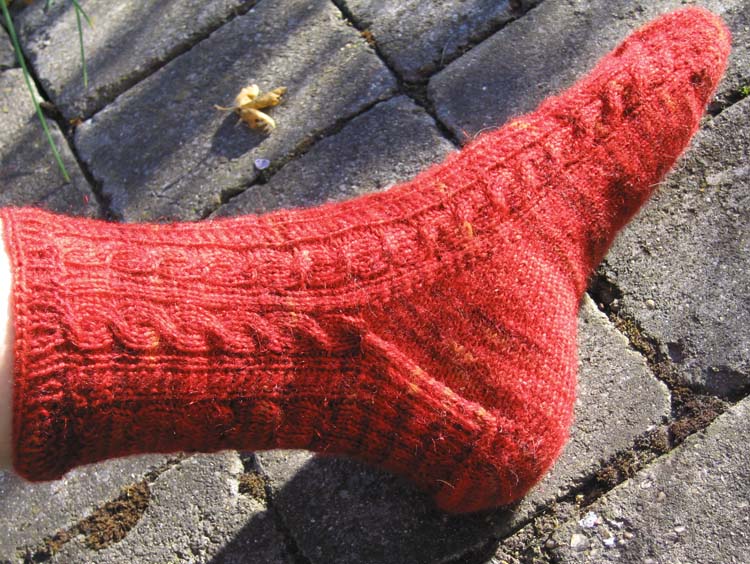
But not yet in with the new, although I’m knitting as fast as I can. I’d been putting off knitting socks for A: his feet, although not immense, are much bigger than mine and I was intimidated by the thought of all those stitches. Also a bit worried that the reality (his first pair of hand-knit socks) wouldn’t live up to expectations, his or mine. He’s got arches so high I’m surprised he doesn’t have vertigo (he has orthotics to correct some of the problems they cause). After Mim’s explanation of toe-up gussets I’d begun to think I knew how to handle this, which is just as well. Late last week, as I was gleefully contemplating choosing between my Blue Heron Beaded Rayon and Piece of Beauty sock yarn, he came home from work, took his shoes off, and stood in front of the fire. “Please,” he said sadly, “may I have a pair of hand-knit socks?” And wiggled his big toe through a hole in the (boughten) pair he was wearing. So. Here we are, then. 72st on the needles (it would be more, but the instep’s on a 2.5mm needle), heading for c.8″ where I’ll start an extra-big gusset. Turn the heel at 10.5″ and head on up the leg. I’d really like to finish them for Christmas, so I’m knitting when I get in from the gym, before I start work (2 rows while collapsed on couch). I’m knitting after a hurried lunch (4 rows). I’ll be knitting before Pilates this evening, and any other time/place I can until I finish them.
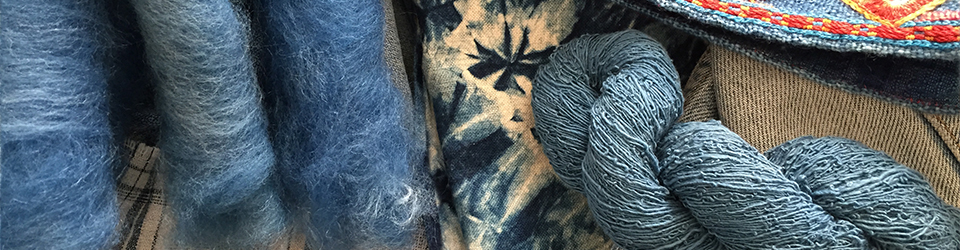
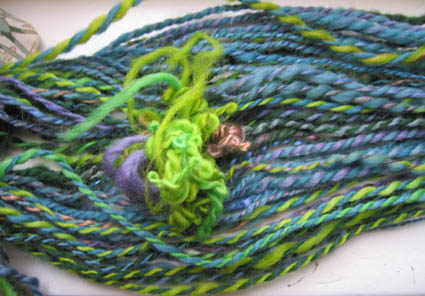
 The yarn is Cherry Tree Hill ‘Blueberry Hill’, straight from the stash. It feels good, lovely and springy. Much livelier than the Lorna’s Laces which, incidentally, bled pink rather badly when I washed them. I think the springy-ness has something to do with the amount of twist in the yarn; I plan to investigate this when I’ve time. I must think more about spinning — I’ve signed up for a 1-day course with Nancy at Handweaver’s Studio in January. I’ve also assembled a binder of record cards to keep samples of yarn I’ve spun as Knitterguy Ted suggested. My very, very first is in there already :-) Now that’s amusing. I don’t have a complete bookmark file in Firefox, which is what I use for Blogger, so I googled ‘knitterguy’ to find Ted’s URL. And found this. Which is, of course, completely true. Just look at his spinning, and his lacework.
Joanne, I don’t know of any crack houses in this neighbourhood… but here’s the church :-)
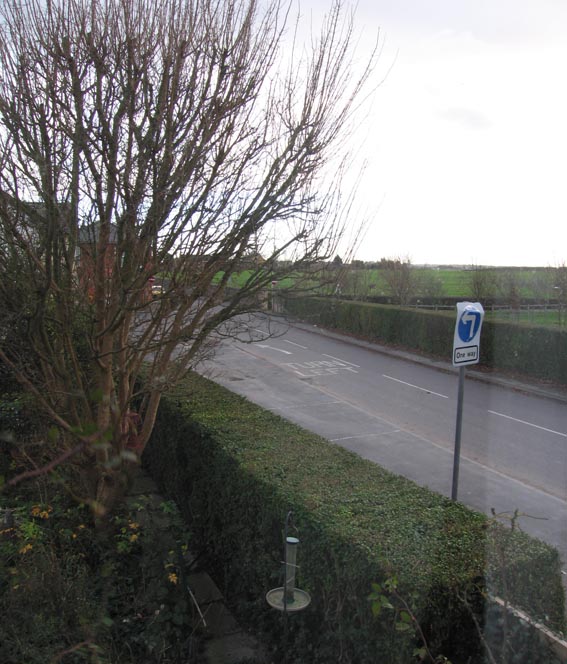
 The view from our upstairs back window (we only have two windows on the back/north wall of the house. Remind me to tell you about that some time). First, the blurry thing at bottom right is a cut-crystal octagon that in summer sends rainbow sparks dancing along the white walls of the hall and stairs. There’s also one of the last roses, a climbing Iceberg. A martyr to blackspot, but very reliable :-)
On the left, beyond the hedges, the brick building with the red roof was once something to do with the school caretaker; the cream (painted brick) building with the ugly, fake slate roof was the school, which was declared ‘unviable’ and closed in (I think) the 1980s. The buildings then became a sort of mini-industrial estate which was sold to a developer when the owner retired. Now the buildings are being re-shaped into houses, and another 6 or more large houses have been built in the yard to the rear.
Britain is a small island inhabited by a lot of people, all of whom want to live in their own house (I am intrigued by this, and the possible reasons for it.) Development is restricted by laws protecting scenic or historic landscapes, historic townscapes, and other binding classifications of land. Land adjacent to a village may not be built on unless Planning Permission is granted, and often it’s not. Especially as those who’ve already got their houses usually campaign to prevent further development ‘damaging’ ‘their’ landscape. That means there’s a housing shortage here, which in turn means houses are seriously expensive. People born and raised in villages like this and working in local industry often can’t afford houses in their villages. Of course smaller, cheaper houses could be built, but developers have to be forced to do this as the profits are (of course) smaller. We incomers just add to the problem: demand drives the prices higher and, with two incomes or a London salary, we can afford them where the locals can’t. Yes, I feel guilty. But at least I not only didn’t campaign against this development, I actively argued against the campaigners on the grounds that there are some low-cost homes included. And it’s grossly unfair that those who already have their homes should work so hard to deny homes to others.
In the distance, the village church. The stone pillar near the street is the village war memorial. France seems very, very far away. The walls of the chancel (the bit of the church closest to us, with the window) date from the 12th C and most of the rest is 13-14th C. Not unusual in Britain :-) It’s largely built of roughly-coursed flint held together with lime mortar. The tower houses a ring of 6 bells, which are rather fine; although the local ringers aren’t, um, brilliant, we do regularly have the pleasure of hearing the bells rung really well by groups from elsewhere. You may be able to see some black plywood figures standing in front of the Chancel; I couldn’t work out what these were until the other night, when I realised their shadows (an angel, and others less identifiable) are projected onto the Chancel by a floodlight. I wish the Church wasn’t lit like that: I’d rather see the stars.
Sorry, Debby, no pink or cats yet, but I’ve got to get back to the maps. I’ve done 75 as first drafts and more have just arrived!









 carpe diem!