Travel Chaos

It’s so frustrating. I’ve been thinking, I have so many ideas I need to crystallise as words on… whatever this is. It’s not paper, it’s better (for this) because I can add pictures so easily. I have a duff toe (it’s getting better) and a skein of Colinette sock yarn and a copy of Norsk Strikkedesign and a fabulous summer top knitted in cotton from Liberty as souvenirs of Saturday in London. I want to examine that top and see how it was made so I can work out how to make something similar. I’m 1.25 sleeves away from finishing ‘the sweater that fits’; it looks as though it does, but he’s asked for socks before he goes away in March so I’ve cast on sock yarn on 2mm needles. Oh, the relief to have socks on the go again! But I’ve got a cast-iron dyed-in-the-wool project deadline on Friday, so I must be strong. And hold all the words and ideas pent up until they tumble out through the penstock to drive my creativity. Ha. Here’s what I wrote on Friday, before the deadline arrived.

That was the view from our kitchen door at 0630 on Thursday. I’ve been unkind to my little Canon S70 — it’s not a big-ass Nikon, but then I’m not a big-ass photographer. Did I really say that? Anyway, I found the book of words and investigated changing shutter speeds before trying a handheld (braced against the wall) 1 second exposure. By rottweiler light (as the infra-red sensor security lights are sometimes known). Alas, the snow falling gently from the sky looks more like rain sheeting down. The things on poles are birdfeeders; the big one holds about 4litres of seed.

After he’d left for work (dedication or stupidity? Place your bets now), I took this, a 30 second exposure with flash to try to ‘freeze’ some of the falling snow. Which it did, but not in a good way. It could be a really bad case of dandruff. It has just occurred to me that the snow was not incredibly deep, perhaps 2-3cm, so it can’t have been snowing for longer than an hour or so.

And this was the view from my window at about 0845. It’s still snowing. It didn’t stop snowing until about 1500, although for the last two hours it was melting faster than it fell. Looking at this I am reminded that I shouldn’t sneer quite so strongly at the travel chaos. Remember, all you northerners, that most British people are driving on ‘summer tires’. Snow tires are extraordinarily rare. The usual winter hazard is ice, which is dealt with by sending out trucks to spread gritty salt on the roads whenever frost is forecast.

Today? Rain. Grey, green, brown. The magic carpet that covered the trash, the dirt, the broken dreams to create a brief-lived wonderland has melted.

Never mind, I have bags of yarn and roving. I can make dreams reality.

One of these things is not like the others,
One of these things just doesn’t belong,

Can you tell which thing is not like the others
By the time I finish my song?

I didn’t watch Sesame Street, honest, my sister did. I was 17, she was 2. So why can I remember all the songs? There are actually several differences, so think like a non-knitter. I noticed this yesterday evening. He kindly offered to finish winding my ball of yarn while I made dinner. Does the difference mean something? How do you wind your yarn?

Thank you


For your compliments. Honestly. You’ve all got remarkably good timing, too… it’s been a difficult week so far. First, we’ve had an outbreak of electricians which, with unerring lack of intelligence (see? My fairy godmother gave me a bust. When there are so many other more useful things I could have.) I’d arranged for the beginning of February because that’s the time of year when having no power/heat in the house all day is so, what’s the word, refreshing. That’s it. Refreshing. It’s cold here, winter is fighting back. There’s a lovely clear glass marble with an iridescent surface looking even more beautiful obscured by frost. It might be hidden by snow soon if the forecasts are accurate. A weather emergency, seven inches of snow and Complete Travel Chaos is on the cards for tomorrow. Anyway. The electricians finished Phase One yesterday (nice lads, seemed far too young to be playing with powerdrills and electricity. I wonder if their parents know where they are?), but the house had not yet warmed up when I discovered that one particular client has decided to dispense with my services on a project I’ve been hassling with since September. I’m not grief-stricken, just frustrated and embarrassed with an thin overlay of relieved. It’s the first time in 18 years I’ve been unable to find a satisfactory compromise solution to a problem, which (I tell myself) means this one’s probably not my fault. But still. It’s a failure.

I was truly intrigued by your wishes. Most of them* seem in some way to be about wanting confidence. I wonder if that’s got something to do with how much we expect of ourselves these days? So many skills are needed, and every new thing we try leaves us open to criticism as we learn. Criticism from others hurts (me) more, but I think self-criticism is far more dangerous. I set myself unreasonably high goals (based on what I see others have achieved, not thinking that they actually know how to do [whatever] perfectly). Failure is almost inevitable, and there’s another blow to my battered confidence. Or yours, if you do the same. So… I wish us all self-confidence. More than that, I wish us a firm belief in our ability to do anything at all if it’s within our capability, provided we take time to learn how to do it well. Oh, and the ability to remember to think of the things we CAN do well, not just the things we can’t. Anyone else who wakes up at 3am to find their ‘Life List of Failures’ scrolling endlessly before their eyes? I hate that. I feel so small, so stupid. We can’t change the past, I can’t undo those mistakes, only try not to repeat them.

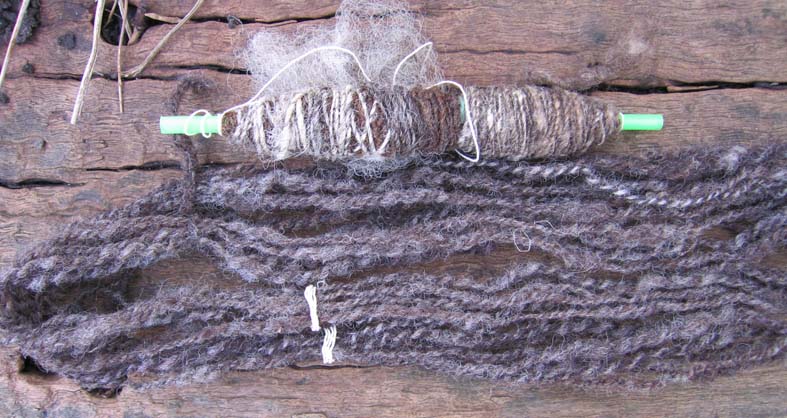
Anyway, have some knitting AND some spinning. My alpaca/silk handspun is not wiry! From bottom to top: my little Bosworth spindle and the alpaca/silk roving; 45-ish metres (a spindle-full) of light fingering weight singles (weighs c. 10gms); a sample knitted from a 2-ply made from similar singles. It’s wonderful. I love it. Soft, warm, and I’m particularly taken by the way that plying followed by knitting evens out all the unevennesses in my handspun :-) He looked at it and said “You could knit me socks out of that”. Which is true, but extremely unlikely.
I feel better already. There’s something I couldn’t do, wouldn’t have dreamt of trying six months ago, and the end product is really not too bad. If we grant ourselves confidence, we can move mountains. Believe it.

* Alice, stop worrying! The world needs people with intermittently red hair and mildly evil thoughts who look fabulous in their handknits :-)

What would you have wished for?

You know. When the fairy godmothers were giving gifts.* Lips as red as rubies, hair that curled without benefit of breadcrusts**, effortless elegance, the inability to get a foot anywhere near your mouth (let alone insert both of them and still be able to speak). Intelligence and the ability to act on it would be nice. As in never opening the door that the monster is hiding behind: it’s so obvious, dammit. Wit would be good, especially if not combined with crushing shyness. A decent sense of intuition and willingness to pay attention to it. The ability to remember the lessons learned from experience. Patience would be marvellous. I mean, who’d want to be able to get things right first time, every time? The entire world would hate you, even if you were always the first one picked for anyone’s sports team. But patience would mean you’d get it right eventually and still have a friend or two.

Patience means taking time to learn how to swim before jumping into the deep end of the pool. Researching the picking-up of stitches for button bands before beginning my first-ever button band. The instructions might say ‘200’, but the books say it’s permissible to pick up the number that’s right for me, which is more than that because my row gauge was off (but still an even number to make the 2×2 rib work. I’m not stupid. At least not today.) Patience means spending all my knitting time this morning ripping out the button band I knitted during my knitting time last knight (that’s a real typo :-) for another attempt at a smooth curve rather than a 135° angle across the collarbones. If this one doesn’t work I might try duplicate stitch on the offending corner. Does that still count as patience? If so, I’m glad I was given the ability to learn from experience. It’s much more useful than effortless elegance.

Really, it is.


Look! Spring!

* Leaving aside those that fate you to fall asleep for ages to be woken by a kiss/the consequences of something much less pleasant

** Didn’t your mother tell you to eat your crusts, they’d make your hair curl? I not only didn’t like breadcrusts, I wanted a shimmering waterfall of straight hair, like Whatshername in Grade Eight. I found the secret – you had to iron it – but my mother wouldn’t let me try.

Snow!

In the view from my workroom window I posted a month or two ago, you might just have been able to make out the faint blur that was the chalk escarpment, about two miles south of the village. This is a closer view. Look, it’s REALLY winter, or it was last week! Travel Chaos!* The low mounds silhouetted on the skyline are barrows, mounds raised over burial sites. Most of these are Bronze Age (5,000-3,000 years ago), but one is Neolithic (over 5,000 years old). If you look closely, you can see people walking past the mounds, which gives a sense of scale. They’re big, even after 5,000-odd years of erosion. Barrows were often built on the highest ground visible from local settlements; no one today knows why. Perhaps people were comforted by the thought that their ancestors were keeping watch, or it may have been a territorial statement. Today the mounds are obstacles on a golf course.
The trees to the right are beeches, often planted on chalk hillsides: their shallow root system copes reasonably well in the shallow soil that develops over chalk. Beech wood is lovely, often used for wood-turning, also known as ‘bodging’. Many Chiltern oakwoods were felled and re-planted with beech to support the chair-making industry… I was going to continue to describe the history and archaeology of the chalk, but I must get some work done!

Some knitting content: I’m making progress on ‘Something Red’ in Sundara’s aran silky merino. It’s so soft!
I’m not yawning, I’m trying not to laugh too hard. I feel ridiculous holding the two sides of the cardigan together (it looks as though I’m bursting out of it already) while staring into a camera balanced on the mantleshelf. Anyway. I am a bit worried about the fit under the arms. My 38 is actually a 32F. The armholes seem a bit large to me. I’m debating ripping back a bit. Although I can see the sense in continuing, just to see how the pattern as written ends up fitting me. If I’m right, I should have increased the rate of increase across the fronts from the beginning (increasing every 7 rows instead of every 8 would have given me another inch or so on each side to cover the bust) and called it quits on the sleeve raglans about a half-inch above the current join. On the gripping hand, the yarn is very… malleable. Sundara advised knitting slightly tighter than specified, as it will stretch. I simply knitted to my usual tense tension :-)
So perhaps it will block to an appropriate shape, and I hate tight sleeves anyway. The only way to find out what works is by finding out what doesn’t work. Which means knitting a few (if I’m lucky) tops that don’t quite fit. Oh, well.

Doesn’t that sofa look inviting? The bit with the sun on it is my knitting seat; my ‘current’ knitting bag is just out of shot. I could wander back downstairs, settle in, and see what happens with that top. Or I could persevere with Seraphim^2. At the moment it looks like a giant woolly jellyfish, with c. 130st/quadrant, just about time to start the first pattern chart (I’m doing extra repeats to compensate for dropping needle size). Or I could cast on a pair of socks. It truly must be an addiction, because I desperately crave sock-knitting. I thought I’d love the speed with which aran yarn makes fabric; instead I miss the rows and rows and rows of tiny stitches on 2mm needles. I miss the changing colours, the developing patterns *sniff*. If I’m honest, I also miss the confidence I’ve developed. I can now knit socks that fit, but sweaters are a different matter. Of course this WILL change, once I’ve learned from a few mistakes. I just hope they’re not completely unwearable.

Back to work!

*Only on the roads. This was ‘normal’ British snow, which falls from the sky in soggy lumps. A few years ago we had proper cold weather, complete with proper snow drifting on a knife-edged easterly wind. Complete Travel Chaos. A Network Rail spokesperson explained that this was ‘the wrong kind of snow’: the diesel train engines suffered from indigestion when the fine crystals were sucked into their air intakes.

Of sweaters and sizing,


Of cabbages and kings. I could say quite a lot about cabbages, as we’re two years into our/my attempt to seriously reduce food miles. Alas, there are not many winter vegetables grown in the UK. Well, there are, but most of them seem to be cabbage or its relatives (brussels sprouts). But I digress… I wanted to say something about sweaters. Specifically my attempt to make a sweater that will fit, as in not hang about me like a very large tent. Late last year I was unventing a top-down v-neck raglan in a lovely butter-soft black-over-blue silk/wool aran singles hand-dyed by Sundara. Given that I’d never knitted a raglan, let alone a v-neck, top-down, bottom-up or sideways, I was relying on brute force: mathematics and luck, plus advice from Joanne and anyone else who happened to pass by. Note the past tense? I got to a point halfway down the shoulder where I worked out that I needed to change the frequency of the raglan increases or gain a lot of weight, and just stopped. I love the yarn, I need a warm sweater, but I just left the shoulders coiled miserably about the yarn on the table by the couch, half-buried under sock yarn and books. For weeks I looked past it until a few days ago I had the sense to ask myself why I was ignoring it. Answer? I wasn’t enjoying the knit. It’s not the yarn or the needles, it’s the fear, no, fear’s too strong. The nagging uncertainty about whether or not I was going to create something I could wear. All those stitches, hours of my time. The sheen worn off the fabulous yarn. All possibly? probably? wasted because I really did not know what I was doing. The solution was obvious. Earlier this week I frogged the shoulders. Sighs of relief from me and the yarn, which thought I hated it. Then, by sheer chance, I came across Wendy’s pattern for Something Red. Despite being a cardigan this looks a lot like the sweater I was hoping for, and my washed (yes, I actually washed it and everything. I want to do this right) swatch is *precisely* on gauge. Row and Stitch. Crumbs. I assume this will change completely once I start knitting but, well, it’s encouraging.

While clearing the bedroom for decorating, I found this sweater, knit c. 1980 just after we arrived in the UK. Ah, the memories. I remember agonizing over the cost of the yarn. Really: we had very little money, living on my wages as a trainee accounts clerk. We were living in ‘Married Students’ Accommodation’, a bedsit the likes of which I, a coddled middle-class Canadian, had never imagined. A large room (perhaps 20′ x 20′, with 12′ ceiling) with immense bay window (single glazed, draughty sash windows) in a large Victorian house. No insulation anywhere. Heated only by a 3-bar gas fire.* Winter 1981/2 was bitterly cold, with deep snow even in Surrey. I wore this sweater constantly. It didn’t keep my legs warm, though; I developed chilblains on my shins after huddling too close to the fire.

I wasn’t going to wear the sweater again (we’ve got central heating!) and it was too worn and mis-shapen to pass on to someone else. So I cut the sleeves off, slit it up one side, then unravelled a sleeve to get yarn to stitch a freeform cat bed, as seen below. Left: empty; right: as seen from my corner of the couch. Clearly three thicknesses are needed to make bits stand up. I may fold and stitch some structural uprights now, just to see how that works. It’s appreciated even when flabby. Incidentally, the cat tree is as large as it looks, and the solid wood construction means it doesn’t move as two Maine Coons thunder about on it. Much better value than those things made of cardboard tubels available from any pet store we’ve visited. From ZooPlus.

Some alpaca/silk from Handweavers. 15g for 80p (about $1.60). It’s incredibly soft, steel grey, and as slippery as a wet bar of soap (the least offensive comparison that came to mind). I’ve been spinning it, very carefully, trying to create a reasonably even singles to ply. I’d spun about half the bag when I thought of looking online for advice on spinning alpaca, and found the comment that if spun too tightly it resembles wire. Already suspecting that I spin too tightly on principle (tense? moi?), I immediately stopped, hung the spindle from the ceiling light fitting (don’t worry, it’s safe), wound the yarn off the spindle into a center-pull ball on the fingers of my left hand, then plyed it from both ends back onto the spindle. This worked so well I was so thrilled that I wandered downstairs to show him. He was not enthralled. ‘It’s just string,’ he said as he stared into the bottomless depths of his laptop screen. Pah. Philistine. The washed skein looks like it was spun from dead rat, but not strongly twisted dead rat, so I’m hopeful. Spinning has got to be one of the cheapest hobbies going… 40p of fibre has kept me excited and interested for about 2 hours (not counting time spent gloating before I started), and I’ve yet to knit it. Or perhaps I’m just a bit sad :-)

Please forgive me if posts and email messages become erratic over the next few weeks. This is the season when many organisations granted funding for various projects last spring realise they’ve done absolutely nothing to date, but if invoices for the finished items aren’t submitted before April, they’ll lose the money. So hard work and real deadlines are piling up apace. Tense? Moi?

* The bathroom/loo was worse. Same ceiling height, heated only by a tiny radiant heater mounted about 9′ up the wall so we wouldn’t electrocute ourselves. And shared with three other couples (as was the kitchen). It took us three years to find affordable private accommodation: in a tiny converted Portakabin at the bottom of someone’s garden. Even colder. Every time I think life is too good these days I remember those days.

Handweaver’s Studio handspinning course

Sorry, this is a long post with almost no pictures (there’s another one at the end). It’s intended to remind me of what I learned, or at least should remember! There’s a lot – it’s a fabulously useful course – for only one day (10am – 5pm).

I started by arriving early to assemble the weaving yarns I wanted.
Nancy started by pulling a rolled raw fleece from Pongo, a Jacob x Texel onto the table. We handled/hefted the roll, assessing its smell (sheepy!), lanolin content (too much is unpleasant, too little may not spin well), the feel of the wool, and the weight of the roll (too heavy may mean a wet or particularly dirty fleece, an off-centre weight may mean someone’s thrown in a few handfuls of sheepshit). Most sellers will not object to the removal of a small lock from the fleece: holding each end firmly, tug on the lock to see what the wool does: if the fibres snap, this indicates a weakness that makes it unsuitable for spinning (and thus unsaleable to the Wool Marketing Board: handspinners beware, some farmers may be selling reject wool). Then assess the fibre quality, the lustre and fineness. We opened the fleece up (it was huge, spreading to completely cover a 5′ long table, draping to the floor on either side), and explaining the anatomy of a fleece to us: at one end (usually) is the head and neck, where the seeds and grass are most abundant. Moving back down, the shoulders are next: slightly cleaner, fleece softer than anywhere else. own the middle is the back, more densely packed, drier (less lanolin), more sun-bleached, often with some vegetable matter. To each side the flanks, with locks of good fleece hanging in rows like shingles on a roof. Below that, on each side, the skirt, dirty, often slightly felted, could be best as compost. Behind the back is the rump/tail, which is the coarsest wool, often with lots of hair and relatively dirty. I liked the grizzled appearance of the dark wool and paler hair. Wool categories: Mountain and Hill (coarser, good for mattresses, rugs, loft insulation), Lustre Longwool (finer, softer fibres, glossy, often with curl), everything else (I didn’t write this down!). Different parts of the same fleece may look like fleece from different breeds.

Put Pongo away, look at fleece from a variety of hybrids. See how different breeds produce yarns that feel different and behave differently when washed (a sample scarf, varying in width, also provided a good lesson on how to diagnose moth and what to do when you find it. The cocoons are very nearly invisible). Then a relatively brief description of what can happen to wool during processing. Dyed in the wool (a sample of lovely tweedy yarn, together with a bag of the bits from which it was spun, which looked like scraps of stuff that no one wanted to spin, short, slightly felted, some bright blue, some black, a lot of white from many breeds), vs dyed yarn, vs dyed in the piece garments. Machine-spun perfect yarn, and yarn machine-spun to look like handspun, suspiciously even with a kink every 2 inches.

Out came a bag of fibre, again texel x jacob, and we were shown how to use drop spindles to spin in the grease, completely unprocessed fibre. Just pick a lock from the fleece, loosen the fibres by spread it carefully and evenly (which allows the dirt to fall away), feed a bit onto the leader yarn, and spin. It felt sticky and wiry – very different to my lovely smooth Blue-Face Leicester roving – a good and interesting experience. After lunch, introduction to carding. Place the fibre in the middle of the surface, leaving a 1″ margin all round and being particularly careful to stay away at all times from the handle side, as looping fibres around the pins here will create a ridge in the rolag. Avoid carpal tunnel syndrome: hold the handles in fists, without extending fingers. I need to practice carding. Do it to create an even, uniform fibre mass. If you want to retain the character of the locks, especially the bleached ends, spin from uncarded locks… example, a beautiful lap rug woven from hand-spun wool sheared after the summer of ’76 (one of the hottest, sunniest on record in the UK). The warp was spun from the coarsest wool on the fleeces, yielding a beautiful, grizzled hairy yarn. The weft was the softer shoulders and flanks, softer, with the colours of the sun-bleached tips preserved by spinning from individual locks. Much of the brittle, bleached wool will break away during the first wash, but enough remains to make the colour variation visible. Woolen vs worsted, and a demonstration of the principles of worsted combing on a carder.

When we’d carded enough to at least understand the principles, a bag of rolags appeared, and we were introduced to spinning in the grease on a spinning wheel. The mechanism is far simpler than I’d imagined, but the co-ordination is a bit more difficult… and it just eats wool. Even treadling as slowly as I could. The feel is feeding the yarn to the bobbin rather than let the bobbin pull it. With incipient yarn held gently between finger and thumb, slide the finger and thumb up the yarn allowing the twist to follow. The wonky skein in the photo is my first wheel-spun handspun. It looked very different before it was washed – lanolin makes everything a dark golden brown. Principle is like handspun, clockwise rotation on singles, anti-clockwise to ply. We plyed by winding the singles into a centre-pull ball (Memo to self: BUY BALL-WINDER, it’s magic), then plying both ends. Count the treadles needed to put twist in an arm’s width, assess the twist (it should just gently twist back on itself), when satisfied, allow the 2-ply onto the bobbin. Continue to ply length by length. How to wind a skein, tie it. If for knitting, wash it. Hang very lightly weighted. If for weaving, leave to be washed in the fulling process.

Bags of exotic fibre appeared, and we were encouraged to change the character of our original wool by carding in camel down, silk, tussah silk… and shown, quickly, the principles of spinning plant fibres such as flax and linen, and how to manage the long, smooth silk roving (I’d guessed right with mine, hurrah!).

hey, when did the sun go down? It’s dark outside! Run around frantically grabbing stuff, small carders for luxury fibres and sample bags of fibre to play with… camel down, silk noil, grey alpaca, a steel-grey alpaca/silk blend, grey-brown BFL, manx/silk (it felt soft and it’s soft pale grey-brown). I haven’t got photos of these yet, and I’ve got to go make the pizza dough. If something important about spinning isn’t mentioned here, chances are I jsut forgot to mention it.

Here’s a close-up of the yarn I spun. The rightmost stuff on the straw is TxJ carded with silk and with camel down, spun on the drop spindle. There’s so little of it, I’ve no idea what to do… knit a tiny box or something, perhaps. I want to feel it, but it must be washed thoroughly. By the end of the class I no longer noticed the sheep smell, but when I arrived home the cats followed me everywhere, sniffing eagerly. Incidentally, cat ‘wool’ felts ferociously. Apparently it must be blended with wool, preferable merino, to make a very soft yarn.

FO: Mountain Fruit Socks

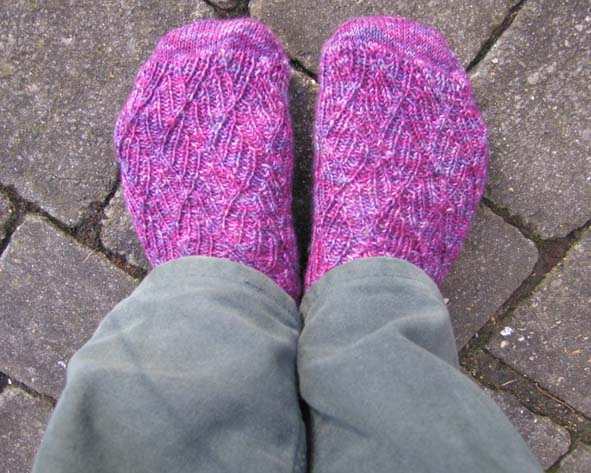
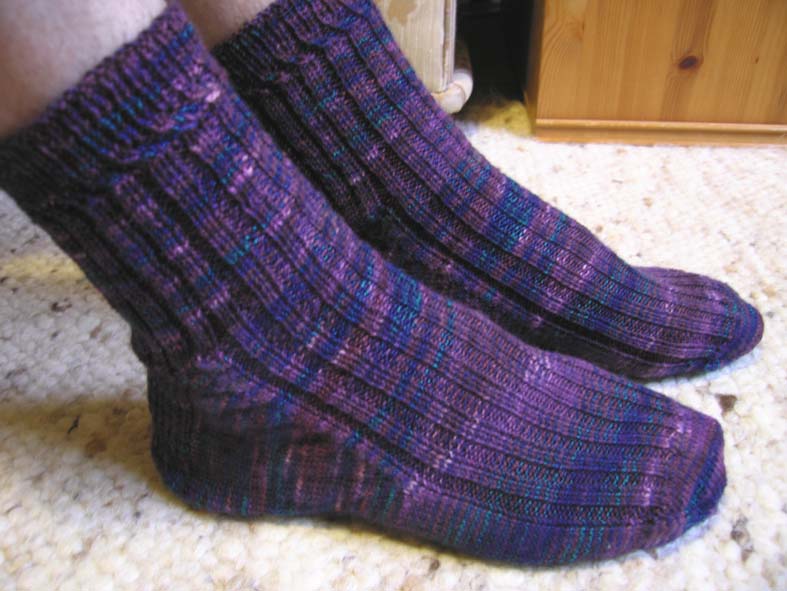
I think I’m knitting faster. Or perhaps speed is a function of yarn quality: if I like it, the stitches fall effortlessly OK, almost effortlessly from the needles. I not only like this woolly, springy yarn (Piece of Beauty in ‘Mountain Fruit’), I like the stitch pattern, I like the way the ribbed lace grips my feet, I like the way it and Kirsty’s mottled dye technique work together. I think I’ve used ‘like’ altogether too much. Summed up, the above means ‘I love these socks’. Thank you, Kirsty!
Socks 64st in total, which is a little small for me. So the instep is on a 2.5mm circular while
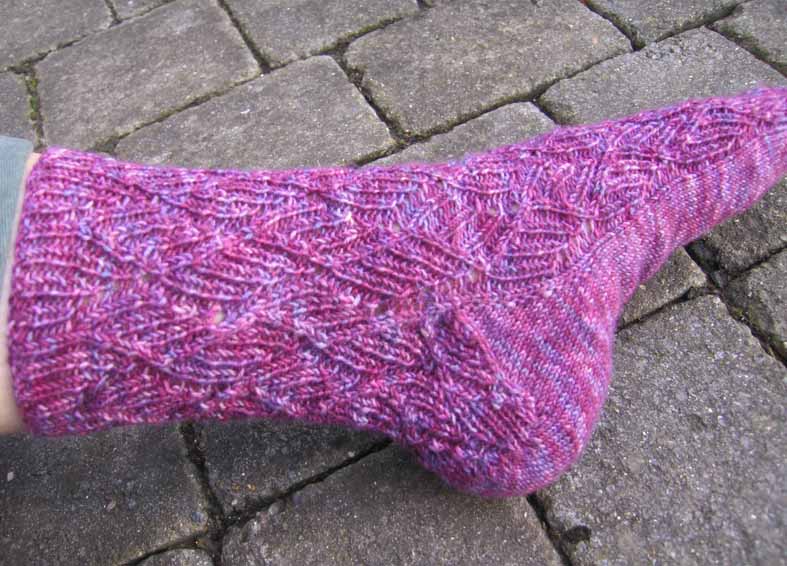
the sole and heelflap were on 2mm, switching to 2.5mm at the top of the heelflap. This has worked really, really well: the socks are not tight, and stretch nicely to reveal the stitch pattern. I want to do these again in green/blue, like scales. I also tested a theory with these, namely that to fit properly, socks should be about a half-inch shorter than the measured footlength. Seems to work. Also, I must remember that the heel from end of gusset to flap takes about an inch, or at least my heel does. These were short-rowed from 32st down to 12, I think.

Note the heelflap. Please note the PATTERNED HEELFLAP. Most heelflaps done in pattern that I’ve seen are worked on top-down socks. There is a reason for this, and now I know what it is. Math. Simple math, but math. To do a toe-up heelflap in pattern, you must work out how many heelflap rows there will be (which equals the total number of gusset stitches, because you pick up one per row). Given the number of rows, you then start from what will be the next row on the instep and subtract the number of heelflap rows from the rows of the pattern. For example, this was a 24-row pattern. I stopped the instep on R23, so R24 was next. I just happened to have 24 rows in the heelflap, so started the flap on R1 of the pattern. Serendipity reigns only so long; I had to re-work the corners of the gusset several times to get the stitches to do what I wanted.

Next socks: for him. I was most unfair, spread all the sock yarn out on the sofa and persuaded him to choose the colour he wanted. He chose my last remaining Lorna’s Laces, in ‘Forest’ (just in case anyone wonders what a man will choose if made to choose :-)

Socks, glorious socks

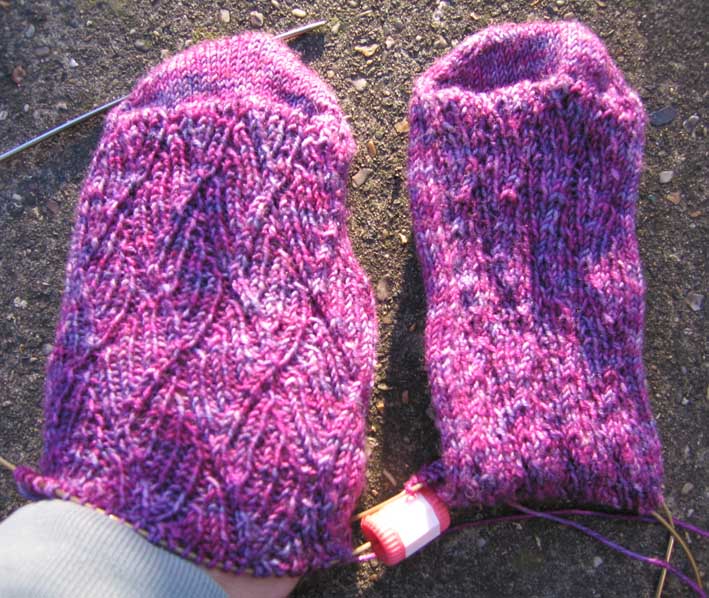
Well, I think they are. That’s Piece of Beauty ‘Mountain Fruit’, in the Ribbed Lace pattern from Sensational Knitted Socks. I think Kirsty’s not only successfully dealt with the ‘spicy’ issue of pooling, she’s produced a truly lovely patterned yarn that works beautifully for moderately lacy knitting. I also really like the way the Ribbed Lace is producing a remarkably stretchy fabric, as demonstrated by my left hand. Having written all that I realise just how poorly I must have felt earlier in the week when he and I couldn’t do more than sit on the couch staring into the distance and waiting to feel better. The concentration required for a 24-row repeat was completely beyond me. Ah, the joys of ‘flu or a 24-hour virus or whatever it was, our reward for being sociable on New Year’s Eve. Never mind, it’s over. I hope. Until the next time…

I do wonder whether our (in the general western civilisation sense) memories are less effective now than they could be. I’d be lost without my PDA and the little red book in which I note date, time and content of business telephone calls. But in the past people not only invented 24-row, multi-stitch knitting patterns (and far more complex weaving structures), they remembered them. Lots of them. OK, they probably kept samples to refer to, but I lay odds they remembered more than we do. Bards and others with trained memories could recite histories and genealogies for hours? on end. My memory is crammed so full of telephone numbers, card numbers, account numbers and the security codes, passwords and PINs I need to access ‘stuff’ that I can feel things dribbling out of the cracks. Perhaps this is another reason to have less stuff. We culled clothing before we put it back in the closet, so there’s a stack of ancient t-shirts for rags and another of decent clothing for recycling. Stuff I’ve grown out of, mentally and physically. (Some I never grew into: shirts far, far too large, a legacy of my days of thinking I was fat. I’m working on that.) That felt good, really good, so we attacked the main storage cupboard. We threw out all the paint tins we’d kept for a decade or more (why did we do this? most colours are unavailable within a year or two, the paint dries out, our tastes change). The SLR cameras we haven’t touched for 7 years, the air mattresses, the fabric that once concealed the ugly hand-me-down chairs that were our only furniture, any stuff worth having that I didn’t even remember possessing* was offered on Freecycle. It’s gone, with luck to people who actually need it. Not only do I feel lighter mentally, we can walk into the cupboard on the floor instead of clambering over stuff we didn’t use. A good start to 2007.

Another measure of my viral misery was my inability to be more than moderately excited when this arrived, part of the ‘yarn for needles’ swap I’ve got going with my inlaws. Hand-painted yarns first fired my enthusiasm for sock-knitting – I was desperate to see what the colours DID – but I’m now developing a greater interest in the feel of the yarn itself, perhaps because I’m thinking about spinning. Cherry Tree Hill seems so tightly spun it almost bounces, although after its first machine wash it softened considerably. And lost more colour than I expected. I didn’t like Lorna’s Laces, it felt thin. Ungenerous. Mountain Colours, sorry, Colors ‘Bearfoot’ is thick, warm and glossy with mohair. Fleece Artist Merino is inoffensive in every regard, save that the ‘Jester’ bright reds faded to pinks after only two machine washes, and it’s still shedding dye in every handwash with wool detergent. The STR yarn feels promising, soft and very, very woolly. Perhaps the ‘Rooster Rock’ will be his second pair of socks.

Guess what? More yarn. This was a sort of birthday present to myself: membership in Sundara’s Sock Club. The first installment has arrived! The colour is off in that photo, but I assure you that it reminded me of all the beautiful dark hellebores that fail to survive in my garden. Only white with purple spots seem to like it here. Is that significant? I don’t know, but I do like the fact that I have no inclination whatsoever to buy yarn. Everything I want to knit (there is a list) can be made from stash yarns, or by spinning the small stash of roving I haven’t confessed to possessing :-)

* with one exception. I found a small stash of Phildar yarns and a Phildar baby knit pattern book. I don’t do new years resolutions, but I am going to knit that yarn into baby clothing and find a local charity that wants it.

Happy Feet, er, New Year…

Actually completed on Christmas Eve eve. I did a twiddle at the beginning of the ribbing, using M1s and P2tog to split the K2P2 ribbing evenly into K1P1, then cabled the resulting single ribs to make a band a little tighter than the ribbing, just to hold it more firmly. I like the look, but the jury is still deciding whether or not it has any effect on the fit. The majority verdict on the socks overall is ‘good, but could be better’. They’re a fraction too big in the foot, but all the others I’ve knitted tightened up in the first machine wash, so I think that will be ok (I can’t do anything about the fact that his left foot is 1/2″ shorter than his right, or rather I can, but it’s not worth the pain). He’s not sure about the way the thick heelflap catches as he puts his shoes on, but that might just be the novelty. I’ll have to do a standard short-row heel with added gusset next for comparison. I do like the way the large gusset (22st/side) has prevented any hint of tightness in the instep: just look at the even expansion of the ribbing as it climbs the slope to the leg.

Sometimes our age shows itself in peculiar ways. One is that we reserve long-distance phone calls for Christmas and birthdays, a reminder of the days when international calls cost seriously large sums of money. It’s always pleasant to hear familiar voices (in one or two cases, the distance adds to the pleasure), but this year I particularly enjoyed a conversation with my niece that began “It’s all YOUR fault!” What had I done? Well, she’d been a bit taken aback to find that the soundtrack for the Christmas family get-together was the sound of clicking knitting needles. My mother-in-law is not only still knitting, she’s just finishing her first pair of toe-up socks. My sister-in-law was knitting something else, but was so impressed by MiL’s work that she’s going to start sock-knitting in the New Year. I’m sending them each a set of Addis for socking on two circulars and in return I’m getting Socks That Rock sockyarn! Sounds good to me… and I’m sure my niece can learn to live with it. Perhaps the gift of a shawl would help. She was absolutely adamant that I wasn’t going to start her knitting (she’s quite happy quilting, thanks).

Another FO: our bedroom floor. This means he’s hand-sanded every inch of the upstairs floor at least twice, scouring away the dirt and old paint with coarse and fine paper, but leaving the worn shape of the boards intact. Room by room the floors have been sanded, oiled twice, and then I apply a hand-made wax (beeswax, carnauba and turpentine) which is then polished to a satin finish. It’s been a bit of a knee- and back-killer, but the finished rooms are lovely: white walls, white woodwork, all warmed by the golden glow from the floors.

That was Boxing Day. Alas, things went downhill from there. Fast. After waking early to go to the gym on Wednesday we stumbled bleary-eyed into the kitchen and found a small flood, complete with water dripping through the ceiling. The valve to the coldwater tank in the loft/attic had failed, and a leak in the overflow pipe allowed water to sheet down the inside of the airing cupboard in the bathroom (luckily behind the lining of polystyrene panels, so the linens were untouched) to the floor below. We shut off the water, mopped up, placed towels to catch the remaining drips, breakfasted, gymmed, and returned. He went to buy the necessary bits (just think how bad it would have been on Christmas Eve, perhaps, or if we’d had to find a plumber). I started clearing up properly and found a second flood under the sink: the washing machine feed had been leaking for ages, soaking the frame of the cupboard. So I shut the inline valve on the supply (I can’t put enough pressure on the joint to tighten it) and emptied the cupboard. To summarise, at lunchtime Wednesday the contents of our largest kitchen cupboard were stacked in the middle of the kitchen floor. The entire contents of our bedroom (decorating in progress) filled the dining room and any spare space in my office/the spare bedroom (in which we are sleeping on my desk, sorry, the spare room bed). The kingsize mattress leans against the upstairs hall wall, which wasn’t a problem until the contents of the airing cupboard added a chicane for traffic into the bathroom. The cats are having field days, especially enjoying mountaineering up the mattress and glissading back down. Talking constantly while they do so, day and night. To think I’d hoped to have some friends round…
Anyway, the floods have been cured, and he’s back to decorating. Did I mention the bit where my mad dash to town to buy the paint ended in the discovery that our favourite supplier closed early for Christmas? Never mind, the room looks wonderful now and will look even better when seen from clean sheets on a real bed.

I was going to cast on for Eunny’s intricate Endpaper Mitts for me when I finished his socks. I’d even bought some Jamieson’s Shetland 2-ply for that very purpose. In fact I did cast on, twice, and the Italian tubular cast-on defeated me twice. I’ll practice it with something smoother, more inclined to co-operate when I try to pull it out from the middle of the tube. Mind you, even the bits from which I’d extracted it didn’t look smooth and tubular. Feeling disgruntled, I looked for another gruntle in the stash and found some Manos I’d bought in Canada for a Cat Bordhi moebius bag to replace the one my Pilates friend bought off my back earlier this year. Cast on, knitted like mad, felted this afternoon: I have a new gruntle. Much better. Now I can honestly wish all of you – the entire multiverse – a very happy New Year, this year and always.

Of love and socks

I’ve read other blogs wherein knitters describe knitting ‘love’ into every stitch knitted for a significant other. I’ve been trying but, my word, at this stage ‘love’ is getting every third stitch. ‘Disbelief’ and ‘incredulity’ get the other two. There is NO WAY that the single skein of CTH supersock is enough to finish these socks. Admittedly, it was the very first sock yarn I ever bought, and I used a very little to make my very first circular swatch, but that’s only about 5cm in a very narrow tube. The rate at which the balls are shrinking suggests I’ll run out about an inch after finishing the heel. I have another skein of the colourway, but it’s a different batch and quite noticeably darker. I’ll do the heelflap in the new skein and then I think I’ll stripe the old and new Fibonacci-style. If I live that long. That’s a metric tape measure and one of the socks on his foot last night, by the way. His first appearance on the internet: a star is born!
I was puzzled by the rate at which these socks were eating yarn. I mean, I get a decent pair with yarn left over (log cabin something in the distant future) out of skeins shorter than this. So I did some calculations:
His basic sockfoot is a 72-stitch tube. At 12 rows/inch, that’s 864 stitches/inch. I did about 8″ of that, which is 6912 stitches. Each gusset builds over 4″ to shakes head in disbelief 24 stitches. So at this stage (the heel starts when I go back downstairs) the tube is 120 stitches. A fair guessimate of stitch numbers would be half the gusset stitches over the length, which is … 4608 stitches. So that’s 11500 stitches in the foot. Stitches in the heelflap? It’ll be about 30x12x2, a paltry 720, add the short-row heel and call it 1000. That’s 12,500 stitches plus the leg… 72x12x7ish, call it 6000 minimum. So each sock each sock! is at least 18,500 stitches. I’ll be knitting ‘desperation’ into them before the end. But he likes the fit, he really does. He says his gran used to gift them handknits, including socks, when he was little. He remembers ‘crunchy, hard’ socks (what did she knit them from? entire sheep?), whereas these are soft and warm and fit perfectly. Perhaps there’s more love in there than I thought.

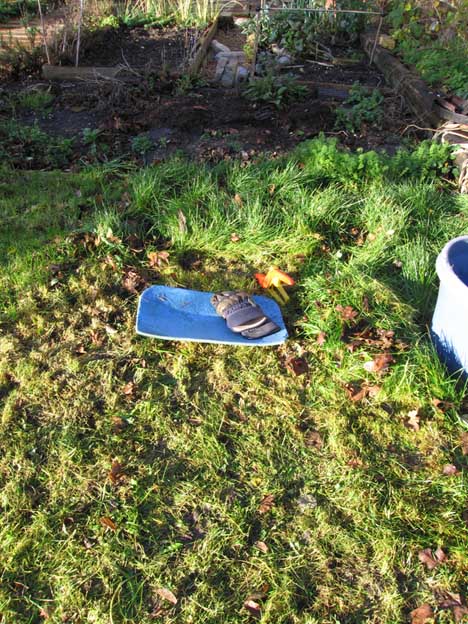
When I’m not knitting or working, I’m trying to strike a fine balance in the garden between untidy (for wildlife) and tidier (for the garden design, which demands clean lines). We’ve got two tiny patches of lawn, one of which is shaded for much of the day, so remained reasonably green during the drought last summer (watering is not allowed). The other is in full sun, all day. By September dandelions were the only green things in it. So I devised a cunning plan: I would allow the grass to grow longer on this side, plant wildflower plugs, and turn it into a tiny haymeadow. Ha. It started raining in October, and only recently stopped. The tiny meadow cut for (an armful) of hay in September was a tiny sea, a torrent of green in November. It looked dreadful. The grass had to be cut, but it was far past the stage where our little push-mower (that’s actually our mower model. Astonishing) could tackle it. Desperate times demand desperate measures: I resorted to my garden ‘scissors’. It’s taken me two days, but that (12m^2) lawn has been, er, cut down to size. Now I have access to the rotting railway sleepers that edge a raised bed (on the right, below), so I can replace them with new equivalents, and re-lay the ‘temporary’ brick edging where the vegetable patch meets the lawn. ‘Things put off don’t happen’, as my mother used to say. How right she was :-(