Category Archives: Uncategorized

Some of the fun

Lake Lawn is a maze of glassed-in corridors connecting residence blocks and various function centres. Having spent Friday learning the layout I knew where spinners were likely to congregate; I headed for the well-lit tables in the window alcoves by the deli (coffee and hot chocolate). And as if by magic, spinners appeared. Old friends and


new. We sat and spun and talked and knitted until the deli closed, then drifted away until we met again at Registration. Stetson is here! And diJeannene, and Jimbobspins, and, and. Sara Lamb and Deb Menzies exhibit awesome teamwork (did you know Sara is a grandmother? :-)

The afternoon passed in a blur of words and hugs and attempts to match real live people to Ravatars. After the Official Welcome, dinner. The Spin-In. My first Swill (that stuff is disgusting and yet strangely attractive. But pink, so I can resist).


The light in the Great Hall is poor for spinning, but Stetson was prepared :-)

— Post From My iPhone

SOAR 2010: fun begins…

The view from the balcony at 0730 this morning.


Breakfast was a cinnamon-pecan thing from Panera; while stuffing goody bags yesterday pm, someone mentioned there is a Walmart just ‘over there’, about 10 minutes walk. So I walked, out of curiosity. Never been to Walmart before: it was huge, full of stuff, but
not the fabric sweater (fibre) storage bags I was hoping for. I did buy a ‘Texas’ muffin tin, though: English muffin tins (actually English
muffins don’t need tins) are intended for fairy cakes, which are cupcakes by another name. There was also a Panera, smaller but stoked with much more desirable stuff :-)
Now, breakfasted, walked and wide awake (I crashed at 2000 last night), it’s time to see what everyone else is up to.

— Post From My iPhone

Saturday Morning

The long day may have been worth it: I woke at the usual 0500 this morning and faffed around for an hour (the upstairs(!) tv(!) doesn’t work) before essaying my morning constitutional. It was dark. Lake Lodge has a lake:


Eventually the paved path becomes a track through trees:

I found a sign:

Faced with the task of taking a photo in the dark, the iPhone does its best to emulate a flashy thing from MiB. I decided to stop torturing it.
Not far from that I found the boundary fence and a busy road. On the way back I wondered what trees I was walking under (I wish Lynn were here), spotted wildlife: grey squirrels, and what could be the Lake Lawn Monster sporting on the lake

Sadly, better light revealed not only waterfowl, but fishermen. Several boats-full. At 0700. What are they after?

Also large flocks of starling-equivalents grackling in the trees, then swirling across the sky


It’s as well I started with the lakeside path, as the other option isn’t

Now back to my room to scrub my hands. I bought what may have been the last orange at the deli, and the oil from the skin dissolved the black plastic disposable knife as I peeled it. I’m saving half to wars off scurvy later in the week, but it and I are smeared with black gunge.

— Post From My iPhone

The road to SOAR 2010 II

Sitting at the departure gate for the flight to MKE I turned the phone on to check my email and noted the time: 2240. Given I lay half-awake in bed from about 0400, this feels like a very long day.

GO Shuttle does what it says on the tin: after 15 minutes, just time to buy replacements for my lost-but-unmourned headphones, Amy and another UK SOAR attendee were assembled. Arrived at Lake Lawn 0030 UK time. *nice* shower. Lights out 2200 local. It WAS a very long day.

— Post From My iPhone

The road to SOAR 2010

Started at 0734 today, as the road from our house led to the M25

and that led to Heathrow. As usual, allowing 30 minutes for delays meant fewer delays than usual; I spent about 2 hours in the airport time warp before the gate was announced. I love liminal spaces, the desire to move made concrete. Now, after a movie and a hot meal – it was hot, but the bright yellow gravy was rather startling; I decided it was intended to cheer people whose holiday was over – I sit over the North Atlantic knitting, listening to Handel and inserting photos into a file to post on the Internet. And hoping 90 minutes is time enough to clear US customs in Toronto :-/ Isn’t technology amazing?

Technology or magic: which is more likely to be responsible for what seems to be a tortilla wrap filled with lamb in tomato sauce, served hot in a sealed cardboard box, having an expiry date of 06OCT2011? Frozen in bulk? Or a Spell of Preservation?

Let’s see if Toronto’s free wifi works…

— Post From My iPhone

Woolfest and A Glorious Day Out!

It’s a grey day in Flatland. I should be working, but my mind keeps drifting north and I remembered I did promise a post about Woolfest.

Oh, no they’re not. You can’t pull the wool over our eyes.
Seen just north of Blencathra.


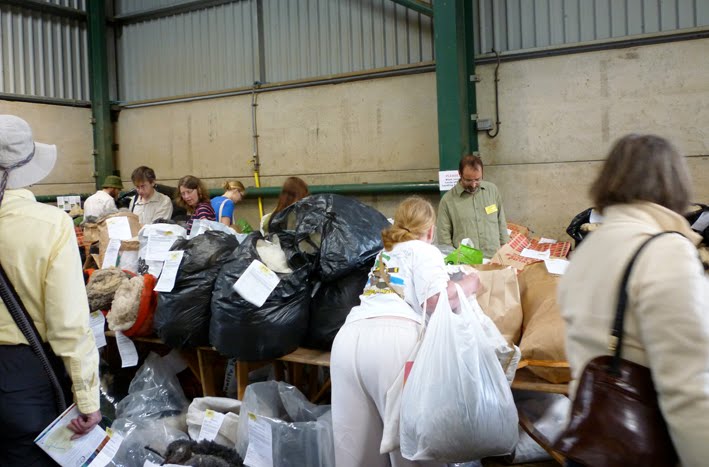
I think Woolfest, which is held in Cockermouth, in the Lake District, was the first of the UK spinners’ gatherings. There aren’t many bricks-and-mortar shops selling spinning fibre here, so it’s a chance to see and handle a variety of fibres, meet indie dyers (and many, many other people) and buy fleece. There are sheep on the hoof and there’s a fleece sale. It’s the most fleece most spinners could ever hope to see under one roof.
There are classes and other things too (a Rav meeting point!), but a lot of spinners head straight for the corner with the fleeces. It was particularly poignant this year, as in 2009 Cockermouth was flooded very badly indeed. Some businesses are not yet trading, but the town has made a tremendous effort to get back on its feet and I daresay everyone at Woolfest was pleased to be putting money into the area.

We drove up on the Thursday, a leisurely journey that allowed us to shed various mental commitments by the roadside. We stayed in a very luxurious hotel – this was probably our only holiday this year, so we made the most of it – the name of which I won’t disclose because the obsequious staff blunted the edge of our enjoyment. But the shower was WONDERFUL. Anyway…

On Friday morning we arrived at the venue. The plan was for him to cycle the Lake District while I did Woolfest, my purchases limited by lack of a bearer to carry parcels. It was a good plan that failed :-)
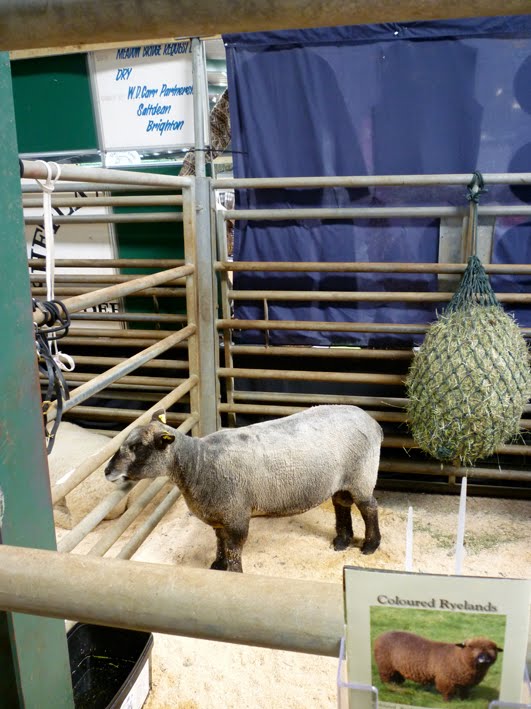
Once in, I headed straight for the sheep and fleece, on a mission to buy an interesting fleece to share with friends on Ravelry. I wanted a good example of a UK breed that’s unusual in the US, and found a beautiful grey Ryeland gimmer aka shearling from Sue Trimmings. (I’ll do another post about sorting and grading it.)

Not one of Sue’s.

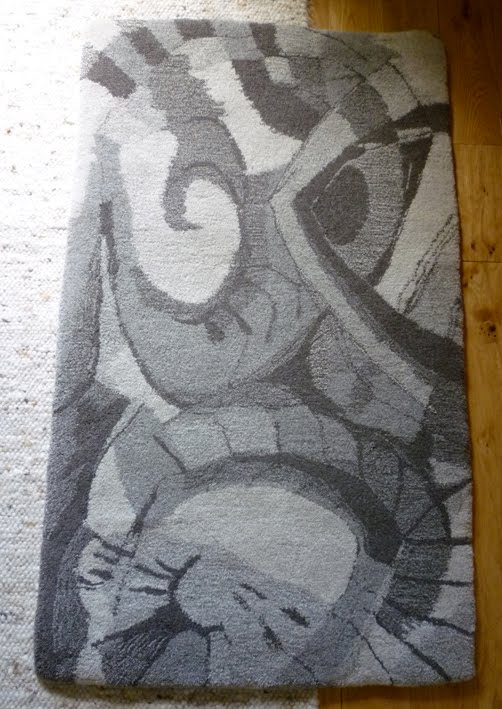
I also wanted to meet Caecilia (Ravname) from the Wool Clip to deliver a pile of printed leaflets about preparing and selling fleeces for handspinning. These are free to all; if you, Dear Reader, would like copies, please leave a comment here or PM sarahw on Ravelry with your email address. I fell in love with one of Chris Croft‘s rugs – yes, this IS possible, at least for me – and visited it several times. And I fretted gently, worrying about him on his bike on narrow, unfamiliar roads and steep, steep hills. I bought some fibre. I tried to ring him, but the call could not be connected: wherever he was, he had no phone signal. I bought the rug (‘A Yorkshire Abbey’, Herdwick wools, 5′ x 3′). I fretted… and then the phone rang! He’d been delayed by a tyre exploding coming down Honister Pass.
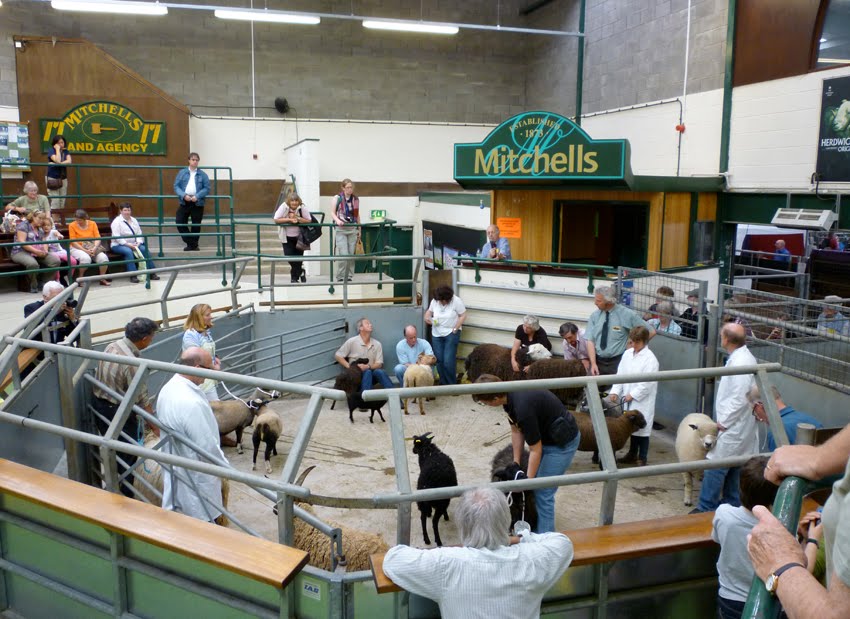
I relaxed a bit, went around the stalls again in search of Exmoor Horn fleece samples, something nice for me to spin, anything interesting. I bought a double handful of Herdwick fleece just to see how it spun, and a Shetland lamb fleece because, well, because it was there. These last two are shown in the previous blog entry. I sat and watched some of the sheep showing.
I admired Galina Khmeleva’s lace, had a brief Russian Spindle lesson and bought one, plus a bowl. I went out to the car (which by now smelt strongly of sheep thanks to two-and-a-bit fleeces), got my wheel and prepared to spin… and the phone rang again. He needed collecting, somewhere on the road from Ambleside to the coast. So I packed everything in the car and headed off to experience Hardknott and Wrynose passes for the first time. I confess I used a lot of words as I drove hard up those hairpins, and many more as the smell of overheating clutch permeated the air; ‘unnerving’ was not one of them. Fortunately it was nothing more than hot and despite my fears I did no damage to the car. He was alright, too. Sighs of relief all round.

Saturday was to be a Hill Day. Blencathra seemed a likely candidate, especially as it offered so many routes up and down. Sharp Edge was a possible ascent that would test my fear of heights… possibly too far. We discussed it as we parked in Threlkeld and began walking along the base of the hill. It was a glorious, delightful, beautiful, couldn’t-be-bettered morning.
There was wool on – and off – the sheep…
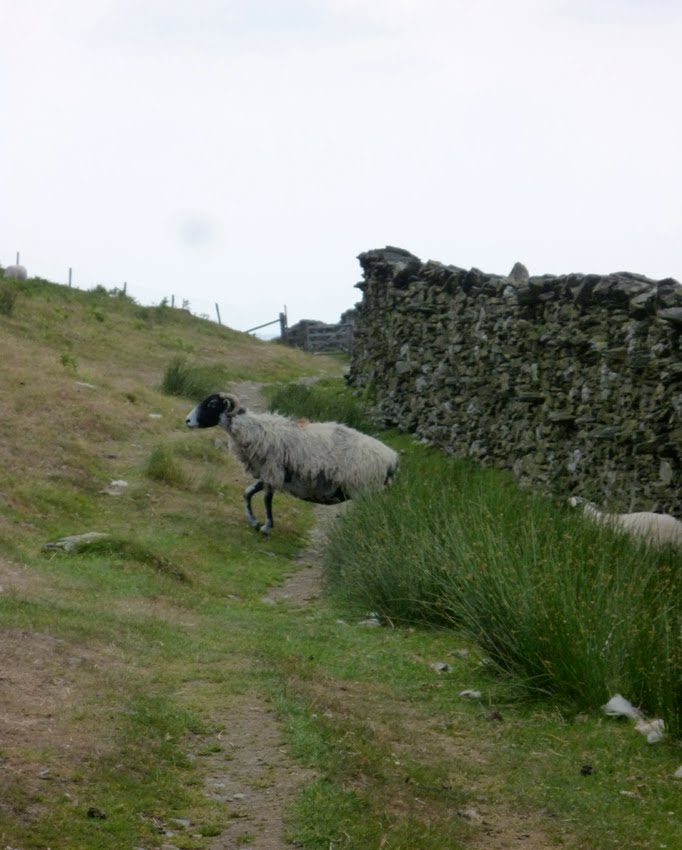
I think these are Swaledale, but they might be Rough Fell. Whatever they are, they are shedding their fleece naturally as it snaps at a weak point where the new growth meets the old. This is a ‘primitive’ trait: modern breeds such as the Merino have been selected to keep their fleece, allowing it to grow until the sheep is sheared. Shrek‘s story is amusing, but eventually that fleece would have killed him: if he’d fallen and rolled, he’d probably have been unable to regain his feet, and sooner or later it would have completely obscured his vision. Not to mention the effort needed to carry the weight!
This shows how walkers get over stone walls and sheep go through them: the gap (which is closed by a piece of chicken wire) is a creep. After some discussion I decided discretion would have the better of valour this time, and voted for Hall’s Fell as the route up. Some scrambling and a little less exposure seemed a safer option, given that I have been almost physically sick from vertigo at times. It makes me incredibly angry that my body can do this to me, and I am determined to train myself past it. Mind over mind over matter. But it’s easy to say that on the flat.
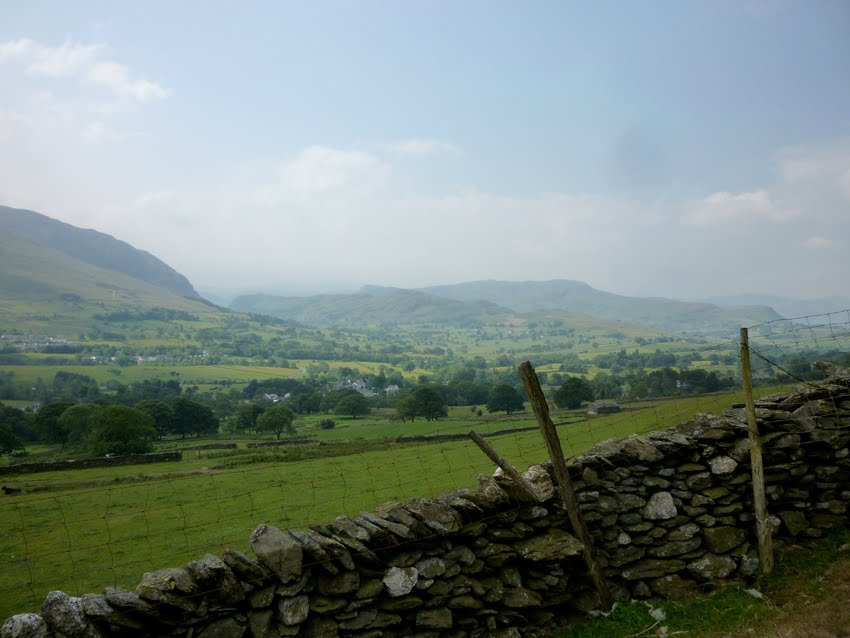
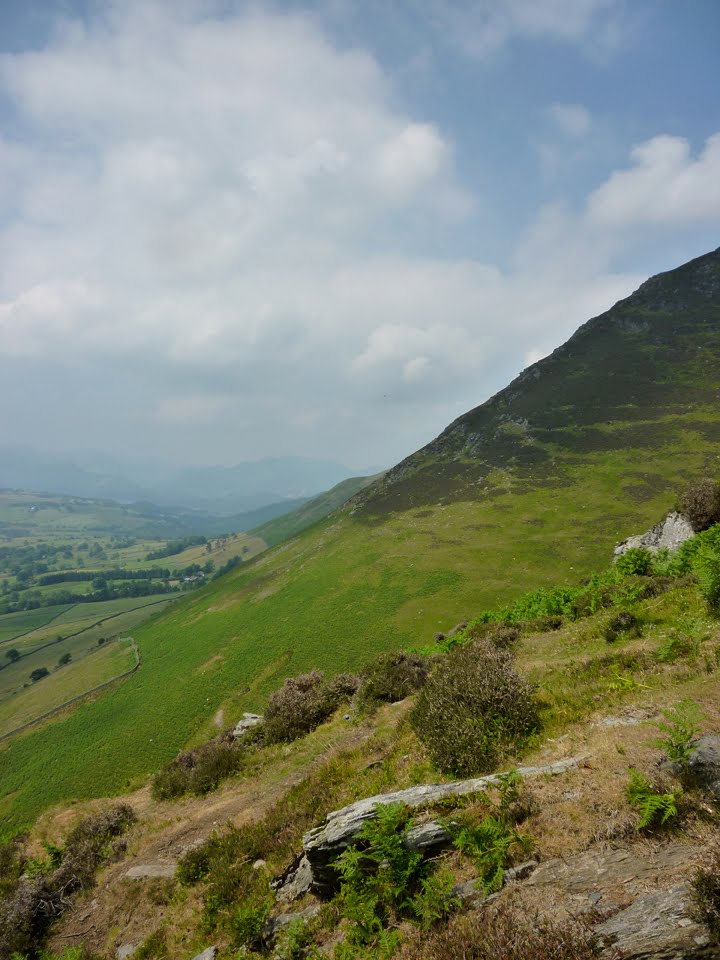
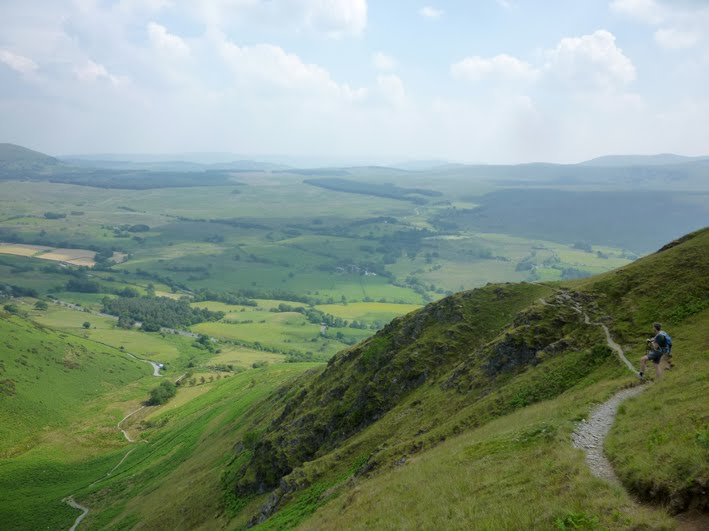
That’s the view south part-way up Hall’s Fell, showing the point where civilised, walled, fertilised pasture meets the fellside. The lower part of the fell is also green with grass (and bracken), and probably gets a little fertiliser from time to time (or did in the past, before nature conservation came to the fore). Higher up the slope the green-brown of heather is broken by the first rock outcrops.
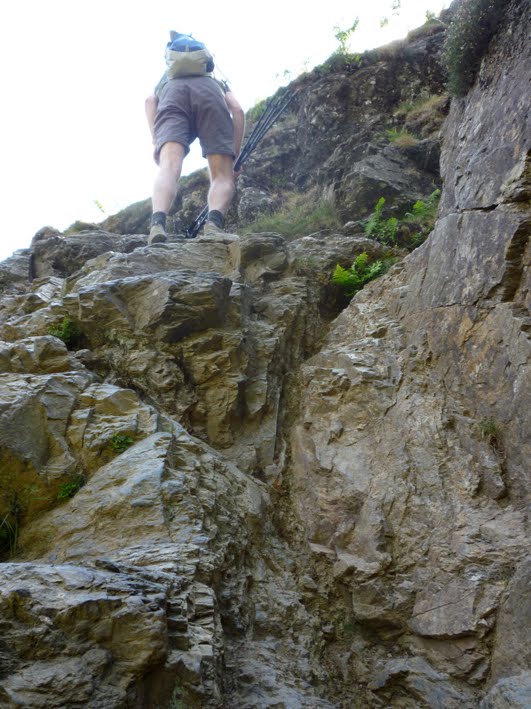
And that’s the last photo you have of this ascent, because soon after this the ridge began to fall away to either side and the path began to run across rock. Scrambling. Not difficult at first, but as we climbed higher, onto rock polished by the passage of thousands of feet, I realised I was forcing myself up and forward by willpower as much as muscle: my hindbrain, the remnant of lizard where my sense of self-preservation lives, was increasingly afraid of falling, and my legs were responding to that fear. Rebelling, slowing, faltering. Which was silly: I’d have had to be both stupid and unlucky to fall any distance, but still. I felt as though my body was made of lead and I was forcing it up by mental effort alone. It was exhausting. I narrowed my focus: I didn’t look at the drop, I didn’t look at the view. I looked at the path no more than 3 feet ahead, I looked at the (firm, secure, good, friendly) rock I was grasping. And kept going. And we reaped our reward. It’s not a big hill, not a high hill. The Lake District is a (whisper it) bijou landscape by comparison with Scotland. If we’d taken the broad motorway worn into the hillside from Threlkeld, it would have been nothing more than a slog uphill. But this, for me, was a triumph.
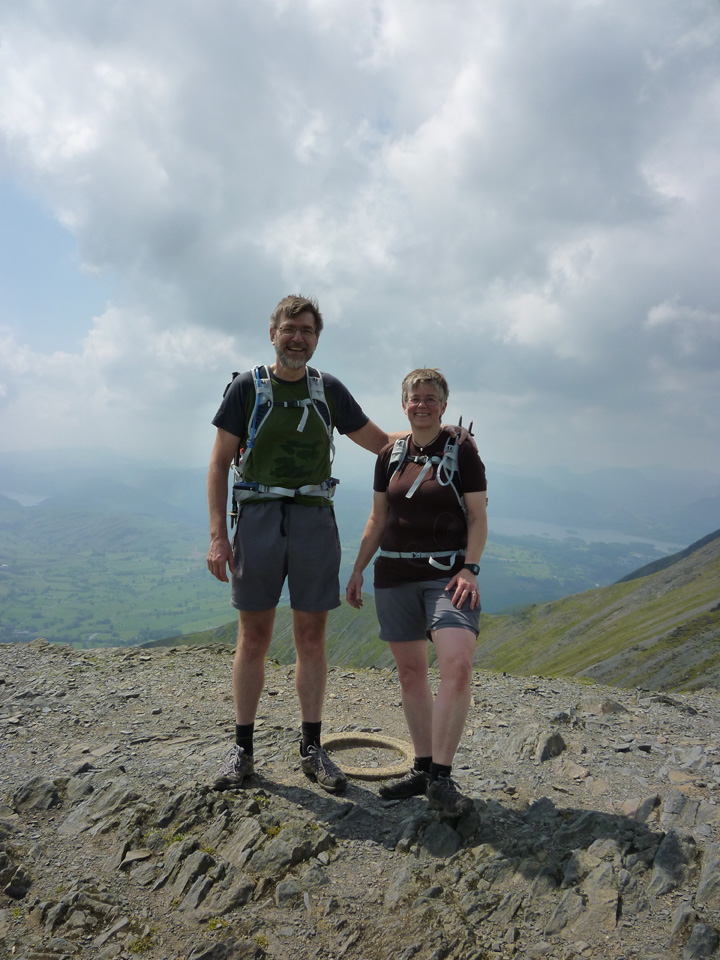
The top of Blencathra is broad and long, sloping away to the west. People were picnicking everywhere.

Looking westish, towards Skiddaw

We wandered from one end to the other discussing various options for the descent.

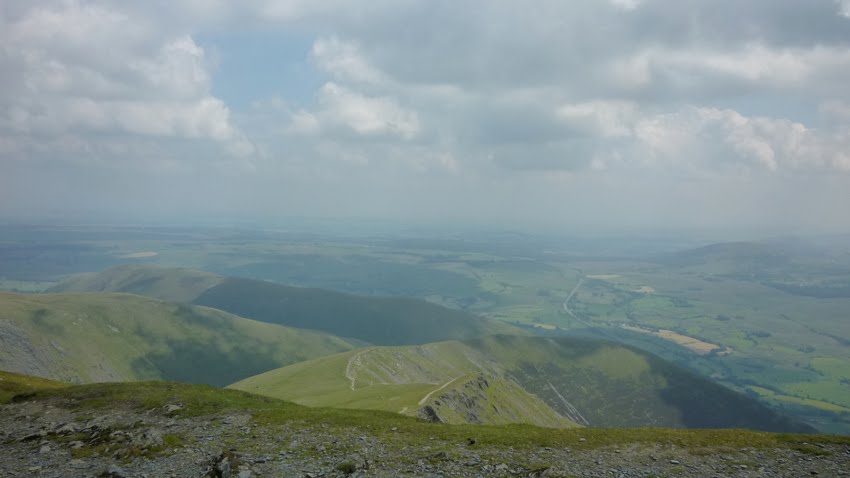
The view northeast, away from the Lake District to Scotland. Eventually.

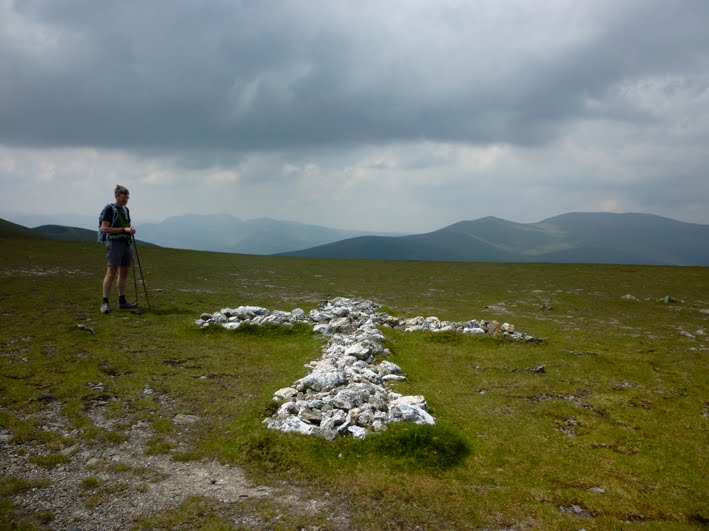
North of the summit a cross of white quartzite is laid out on the turf. The Internet doesn’t seem to know why it’s there, but that quartzite is not found on the mountaintop: each one has been carried there.

The remnants of a small Armistice Day cross was tucked under one of the stones and that, for me, made the quartzite cross a reminder of all the mountaineers, mountain-lovers, shepherds and walkers who died in both the Wars.
Lest We Forget.

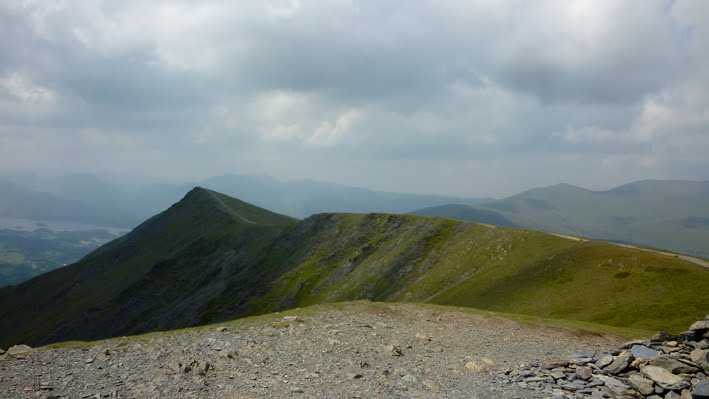
The southern summit. Yes, we walked all the way there, too. And back again.

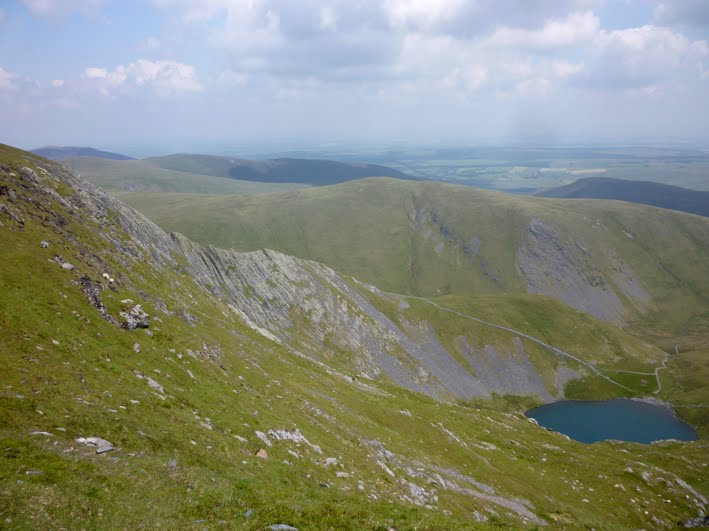
Eventually we decided to head down the hillside to Scales Tarn, which looked quite attractive from up here.
The steep bare rock ridge above it is Sharp Edge. As we descended the hillside we could see a steady trickle of walkers head up the path and slow dramatically as they moved onto the rock. Most continued, but a few eventually turned around and came back down the path. I think… I don’t know. The memory of fear had already faded, an hour or so later. I think… I could do it. In good weather with no wind. But I know I wouldn’t enjoy it. That’s no reason not to do it, though. And he wants to, I think.
Picnickers were wading in the tarn, and the hillside above it was dotted with sheep. Count the sheep… there are at least 23 (I counted in Pshop). Further down it felt like Scotland in miniature.
Briefly. The Northwest Highlands are not so green, so pastoral:
The path loses height constantly as it curves south around the base of Blencathra. Into fresh, green bracken.
A place to consider our Western change in attitude to beauty in the landscape. In the distant past, when life was hard, the friendly green valley, covered in tame, fertile fields would have been regarded as a beautiful landscape. The wind-lashed peaks, the harsh stony hillsides were frightening, lonely, inhuman places. Only relatively recently, in the last two centuries or so did we (or at least some of us) begin to see the wild places as romantic, even attractive. The Lake District is one of the places where that link between wild and beautiful was forged, with the works of the Lake District Poets and their descendants.

The online guides to the route mentioned a brief scramble on the path at Gategill. Brief it was and, with no drop to speak of, it was fun.
But what we REALLY wanted at this point was ice cream. And, eventually, we found some. Our joy was complete: a Glorious Day Out indeed.


Exploring a Fleece: Grading and Sorting

Confession time: although I’ve done a lot of research about grading and sorting a spinning fleece, enough that I feel I should know how to do it, I’ve only dealt with two fleeces in my spinning life. I’ll share my experience of the third fleece with you, in hope that it helps someone as nervous as I was when I unrolled my first fleece. If that’s you, take heart: it’s less difficult than you might think. And, as Beth of The Spinning Loft says, “The sheep are growing more even as we work”. There will be another fleece along shortly.

Sitting in its bag in the sunshine is one of my Woolfest 2010 acquisitions, a Shetland lamb fleece from Lenice Bell, Todhill Shetlands. It’s a spinners’ fleece, thoroughly skirted, so I don’t expect to find any dags (dried lumps of manure) hanging from the edges. It’s important to encourage farmers to sell clean, well-skirted fleece: you may not mind removing the dags, but dried sheep dung poses a much greater risk to animal health than does clean raw fleece. This lamb lived in Scotland, I bought the fleece in Cumbria, I’m dealing with it in East Anglia and I plan to send some of it overseas: if by chance there was a harmful organism in the fleece, I’ll have done it a great favour (and farmers a great disservice) by moving it across the country so quickly. It might seem that this is a lot of fuss about next to nothing, but having lived in the UK through the Foot and Mouth epidemic in 2001, I will do everything in my power to minimise the chance of that happening again. Ever. Anywhere. If any of this fleece contains dried dung, I’ll remove it carefully and dispose of it safely. Traditionally spinners use it as mulch, but I’ll bury it deep in the bean trench or compost bin where it won’t surface for at least 18 months. If I didn’t have a garden I’d put it in the non-compostable rubbish. I don’t want birds or other animals moving dirty fleece out into the wider environment, just in case.

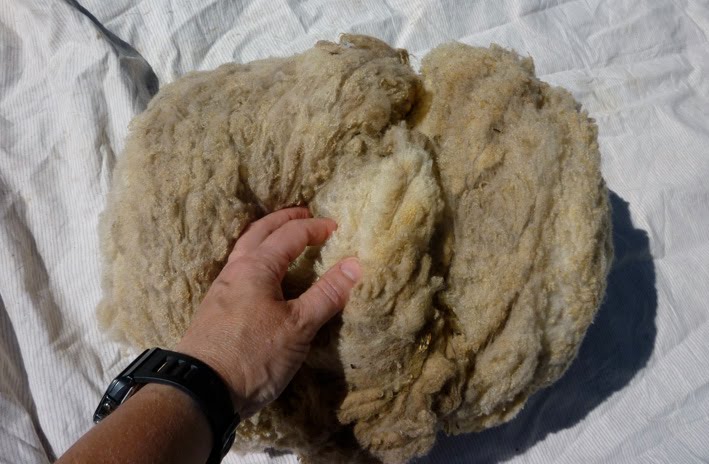
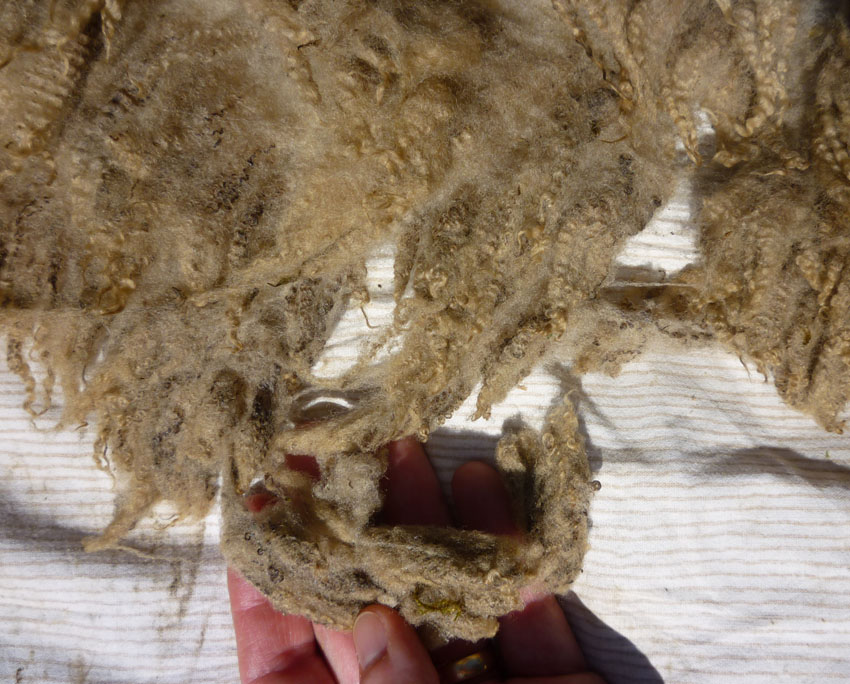
The rolled fleece is intimidating. Where’s the way in? Fortunately I know that the British Wool Marketing Board (hereafter BWMB) approved method of rolling fleeces is staple side up/cut side down, sides to the middle, roll from back end to front, pull the neck out into a long strip and wrap/tuck it under itself to hold the roll closed. Here I’ve just found the bit of the neck that’s tucked under.
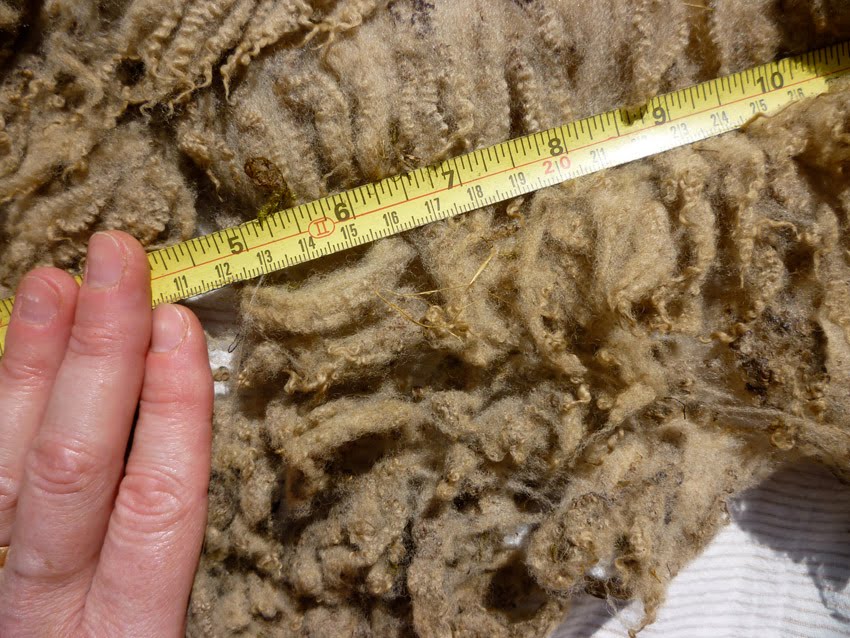
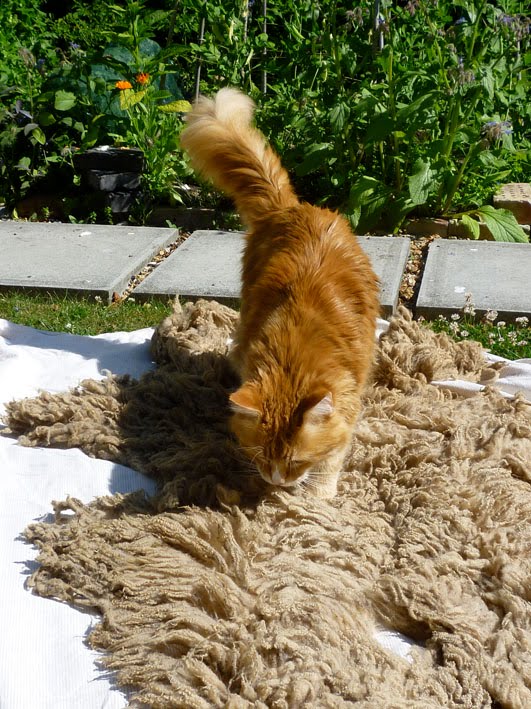
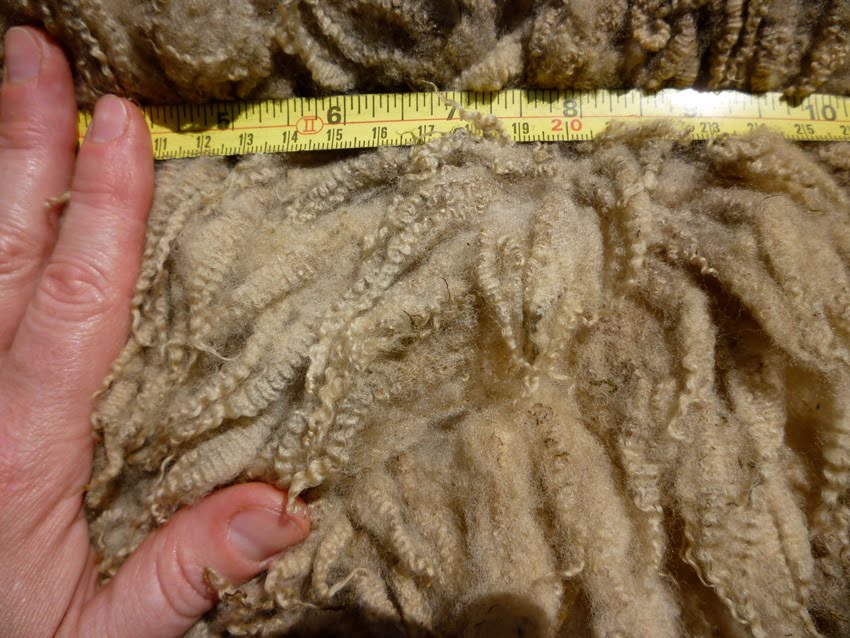
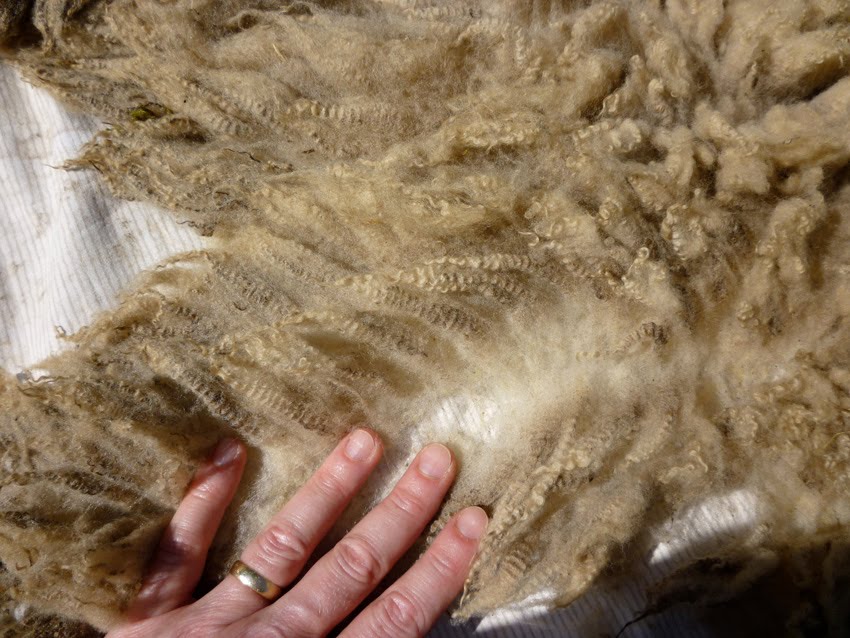
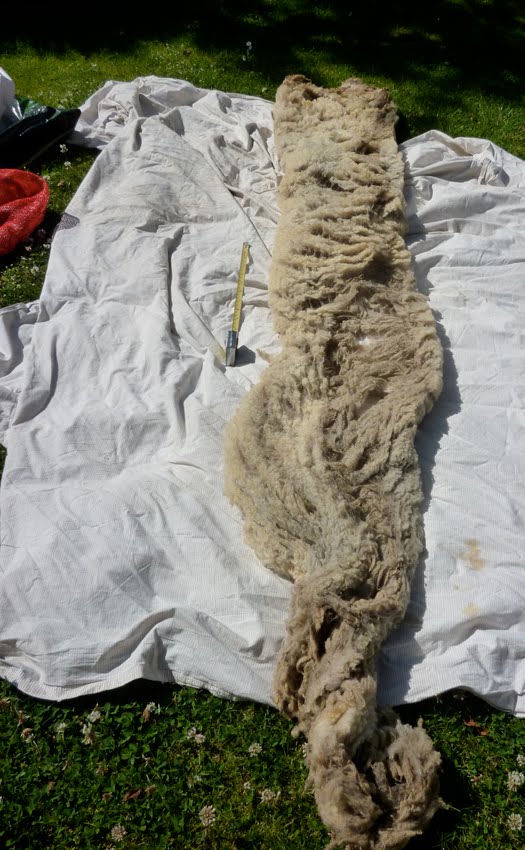
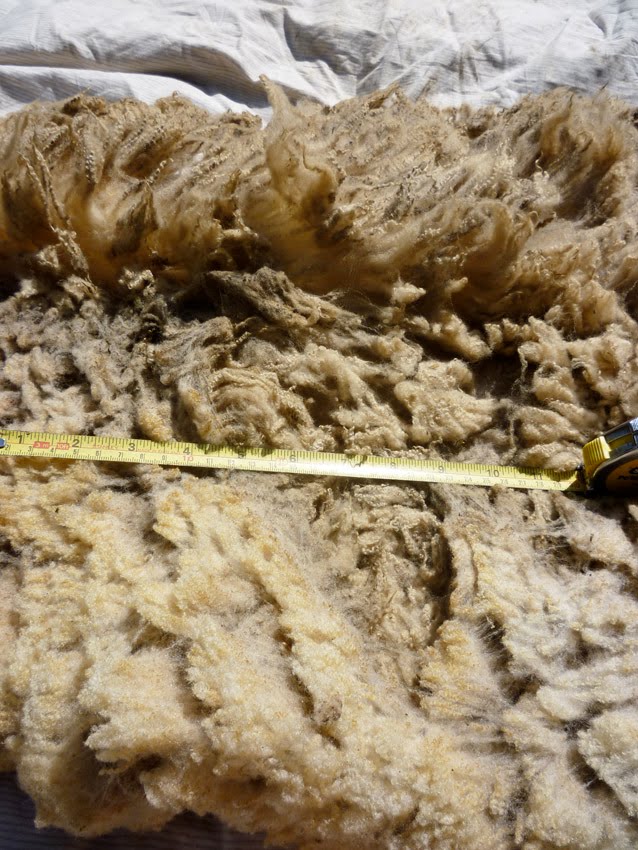
Unrolled it doesn’t look like a sheep to me… I wouldn’t want to meet whatever that came from on a dark night! For reference the tape measure has 12″/30cm extended. If you could look closely, you’d see that the cut surfaces are on top, folded one over the other BWMB-style. You can tell because the cut surface, close to the lamb’s skin, is relatively clean, a beautiful cream tinted gold with drops of lanolin. After I unfold one side of the belly I can show you what I mean:
Furthest from the camera, beyond the tape, the upper surface of the fleece is greyer, dirtier, with the tips of the staples gathering into pointy bits. This side of the tape you can see the underside, paler, cleaner, creamy in colour, with drops of golden lanolin, and the staples breaking naturally into rows. If you ever had long hair, you may remember that even after it was combed into a beautiful flowing sheet of hair, it would break/clump into long locks. Fleece is the same, clumping naturally into what are known as locks in longwools and staples in fine wools. One thing I can’t show you on this fleece is what are known as second– or double cuts, short (1-1.5″) tufts on the underside of the fleece that result from the shearer cutting a bit high, then going back over the same area and cutting lower down. The sheep looks tidier for this, but those second cuts must be removed or they can form nepps when you process the fleece.
Unfolded, with gentle reminders from me that sheep have four corners, a bottom, two sides and a head, it looks like this: a very long lamb, but a lamb. The neck, stretched long, is nearest the camera. I know from my reading that the finest, cleanest, longest-staple is likely to be the base of the neck, the shoulders and down the back. The legs are likely to be muddy and have more VM (vegetable matter). The backside or britch is generally coarser, stronger wool: sheep, being sensible animals, stand with their backsides into the wind and rain so the britch bears the brunt of the weather. If it’s not properly skirted, there may be dried dung at this end, too.
Here’s the edge of the belly. It’s generally discoloured by dirt, there’s some VM, some of the staples are stuck together with dark glossy stuff that I think is dust and dirt and grease. At this point my supervisor arrived…

This is the middle of the britch, the backside. It looks surprisingly attractive, relatively clean, but the soft skin of my wrists can feel that this area is coarser than the middle of the shoulders. And there seems to be black grains of dirt and lanolin buried deep in the staples. What does the good bit look like?
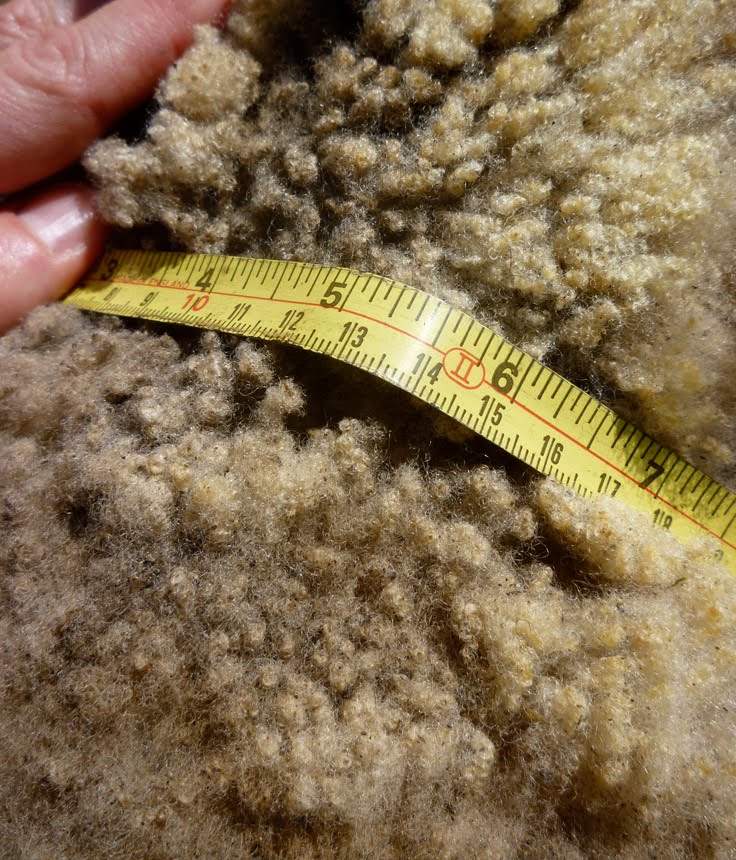
The staples are thinner, with more and finer crimp than the britch. There’s no dirt at the base of the staples and, when I hold my wrist to the surface, there’s no prickle at all.
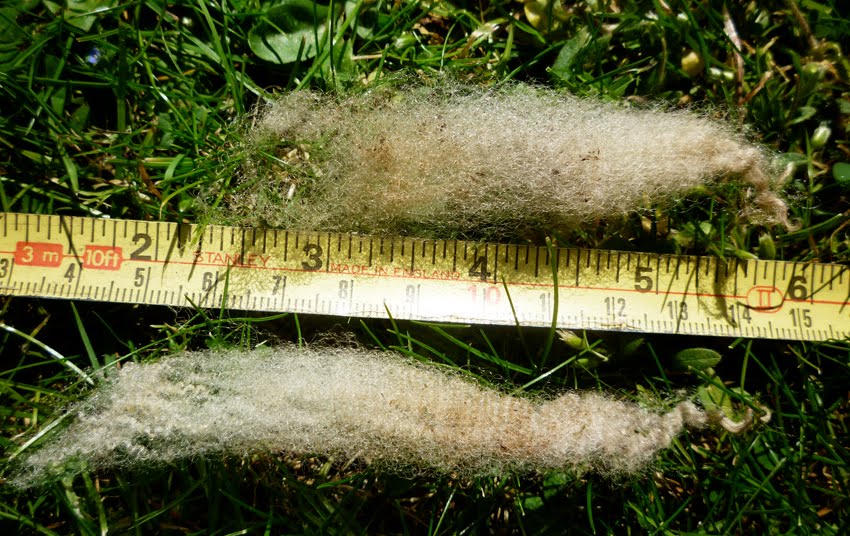
Here’s a staple from the britch (above) compared with one from the middle of the shoulders (below). With luck you can see the dirt at the base of the britch, the more obvious, fine crimp, and the greater length of the shoulder. Both have lamb tips, the tightly twisted ends of the animal’s first fleece. These may be relatively dry and fragile; if so, they could break away to form nepps when carding. I have to remember to check that at some point.

So it’s decision time. I have a reasonable idea of what I’ve got; what am I going to do with it? Because I want to be able to send nice clean fleece to friends, encouraging them to buy British Shetland, I’m going to put the leg fleece and more of the discoloured belly fleece to one side. I think it will clean up reasonably well, and would spin into a softish sturdy yarn. Here’s the sort of thing I’m removing, plus some of the lanolin- and dirt-matted locks above it.

You should find that the fleece rips apart cleanly and easily down natural partings between the staples. If it doesn’t, the fleece may be cotted, matted and felted on the sheep before it was sheared. This is a fatal flaw for a spinning fleece unless the staples/locks are long enough to be spun after the cotted areas are cut away.
Here’s the fleece with the legs and belly edges piled on a sheet of newspaper, and my best guess at a dividing line between britch and ‘the good bit’. It is still a bit of a guess for me, so I was pleased to see this
when I flipped the edges back. The good bit is on the left, the britch on the right. Can you see that my division by fibre quality matches the cleanness of the underside? Here’s a close view of the cut surface of the britch just to the bad side of the dividing line
You can see the dirt driven into the fleece by the wind and rain. Sensible sheep, not putting their heads into the weather. All that’s left to do today is roll and bag the three different bits of fleece separately, each labelled with supplier, date and breed.

Speaking of sensible sheep coping with bad weather…
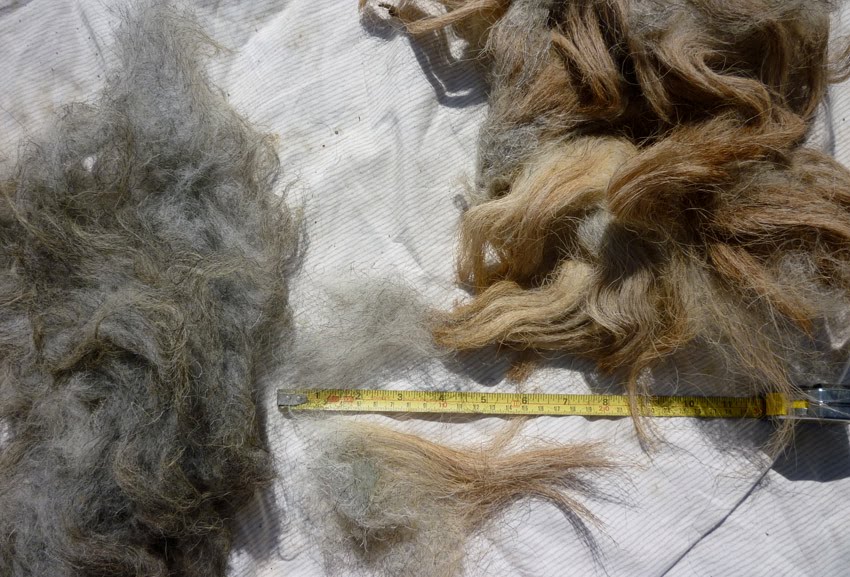
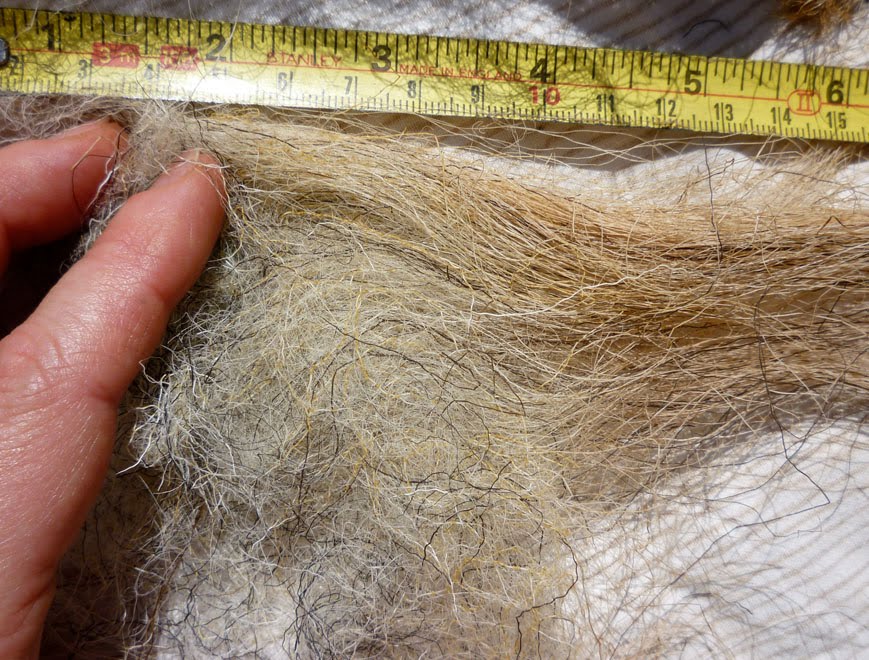
On the left, a sample of the best bit of a Herdwick fleece; to right, the britch. Herdwicks are seriously hardy sheep, bred to deal with the worst weather. Their wool is best used for weaving and commercial carpet production.

I can vouch for the fact that it makes glorious, beautiful carpets and rugs because I bought one at Woolfest. Handmade. I’ll post a picture of it next time, together with an overview of our two days of adventure in Cumbria.

I wonder…

Is one extremely long post once a month equivalent to four much shorter posts? That’s not a real question! Honestly, if I had more time I’d post more often, but it does take quite a lot of time to write this much. Perhaps I should try limiting myself to 140 characters :-)

Anyway. His ankles are still not allowed to walk, so last Saturday he cycled 80k while I walked 13.7 miles. More accurately, he cycled, showered, painted the shelves, ate lunch, then sat and relaxed while I walked 13.7 miles. 5 1/2 hours. For some reason I don’t entirely understand I am considering trying the C25k – or rather, I tried it and discovered I am utterly, completely rubbish at running for reasons that impact (literally) my walking and posture. I have some interesting foot alignment issues that my sports massage person is working on, and the walk was intended to test some theories. And I needed to see some features in one of the parishes. So… would you like to come for a walk?
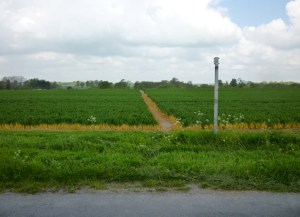
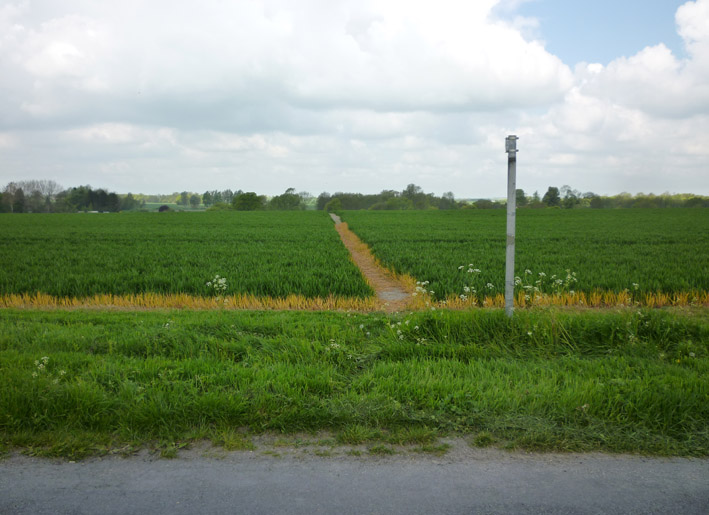
Here the cross-field path leaves the road. The stripes of bright autumnal colour mark places where glyphosate has been used to clear the path (cross-field paths are supposed to be clear ground for walkers), and to kill everything in a ‘sterile strip’ around the field margin. Striving to drive forward from the hips, powered by the glutes, with a mid-foot strike rolling to push off and up from the ball of my foot (instead of hammering my heels into the ground) I stride off, totally distracted by paying attention to my feet. Try it. I dare you.
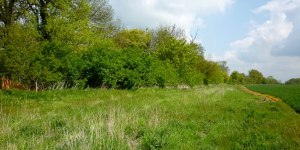
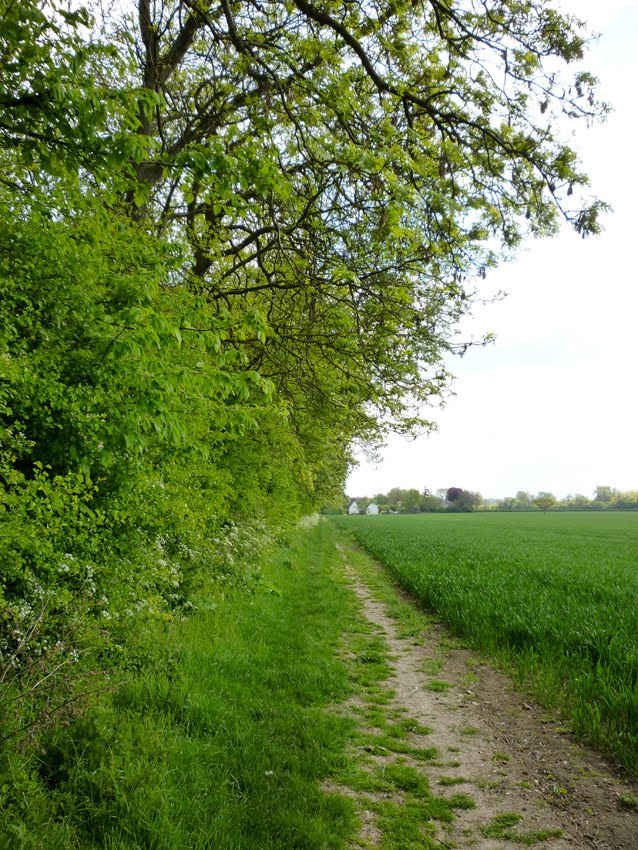
Another farm management photo. The crop is to the right, sterile strip just visible. There’s a ditch hidden in the trees and this wide uncropped field margin is intended to protect the water from agrochemicals, runoff and sediment washed down the field.
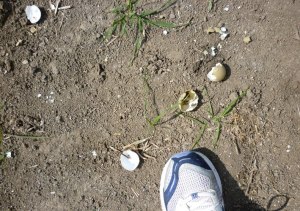
Eggshell fragments are scattered across the path. I don’t do egg ID; I thought these might be wood pigeon eggs, but those are white. What is interesting is the moisture around the eggs and the smear of yolk visible against the shell: these are signs that the eggs were broken open and the contents eaten, rather than dropped by one of the parents to clear out the nest. I doubt it was a mammalian predator – this is the middle of the field – so it was probably a bird that dropped the eggs to break open on impact. I’m guessing this because there were no signs of beak penetration or chipping away at fragments.
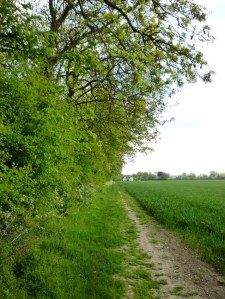
Spring Greens! Every year I enjoy watching the shades of green change, from the acid bright greens of spring to the deep glossy greens of high summer and, finally, the tired dusty brown-edged greens of late summer.
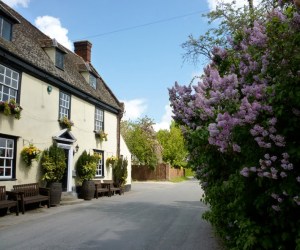
Lilac is one of the scents of my childhood summers. They were everywhere around the town where I grew up, but those I remember most clearly had gone wild in what were once the gardens of abandoned farmhouses hidden in the woods around the town. We were strictly forbidden to visit these places – tales were told of Bad Men, of concealed wells, of children who disappeared forever or, worse, reappeared as ghosts – but still we dropped our bikes on the roadside and explored the lilac-scented ruins on endless summer afternoons. Oh, and the building across the road is a traditional pub, the Pig and Abbot.
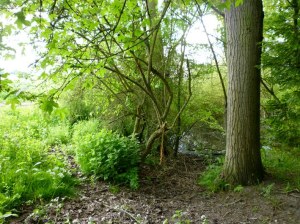
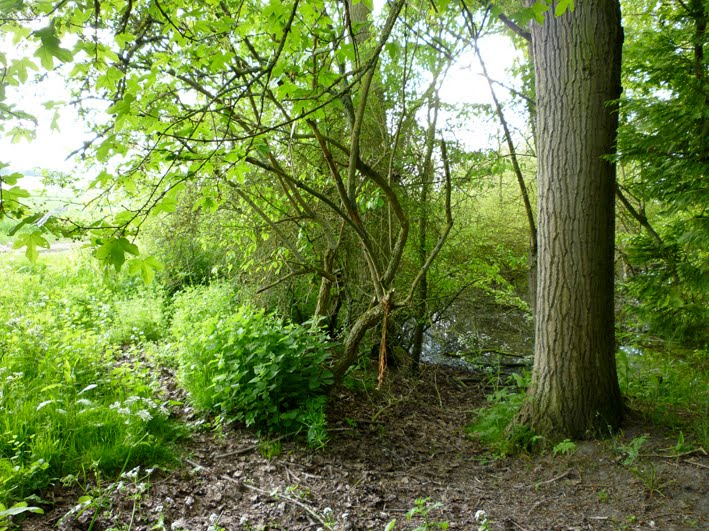
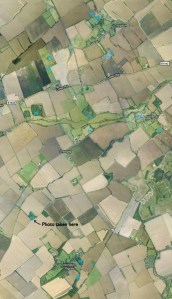
This is a view into the moat of a medieval moated manor, one of many I encountered on this walk. Tourist brochures suggest that moated manors are quaint or impressive half-timbered houses surrounded by a well-maintained rectangle of water, all set in beautiful lawns, but the majority are much less impressive unless you know what you’re seeing. Like this, many are completely overgrown by secondary woodland. Here’s an excerpt from Google Maps with moats marked in blue regardless of whether or not you can see anything on the ground. It was a very different landscape 500 and more years ago; the modern villages existed, but there were additional settlements – and these manors – outside the modern village boundaries. Note the village of Croydon at the top right, with moats to the north of it and a track leading south of the village to two more moats. Also, you may remember a walk to the Deserted Medieval Village of Clopton, which is the patch of green (with two more moats) across the road to the west of Croydon. Just to the right of that very dark field.
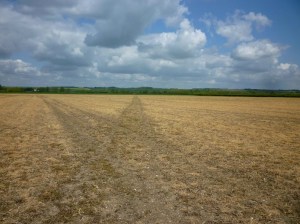
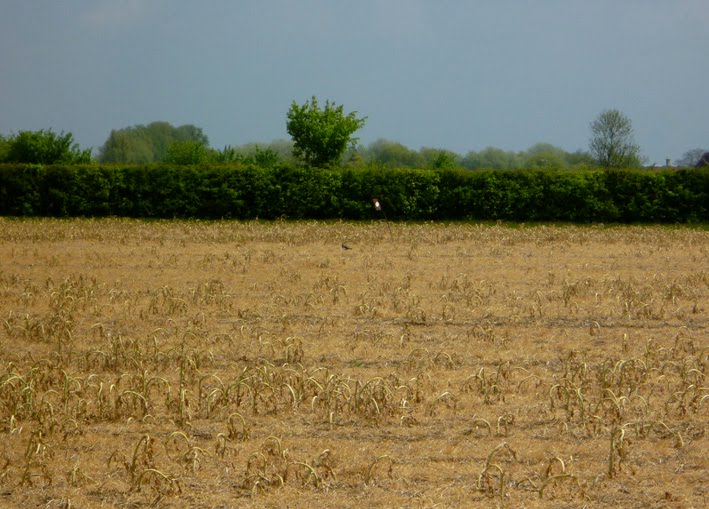
The path is marked by a tractor driven across an entire field of glyphosate autumn. I hate this: it’s spring, this should be green and full of life. But there is some life here; although there’s relatively little food available, sparsely vegetated ground is what some birds prefer for nesting. A lapwing was displaying to my right as I took this picture, so I tested the zoom to its limit…
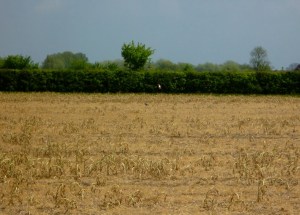
It’s just about in the centre of the image. Lapwings are wonderful birds. The individuals are pretty, but it’s the flocks I love best: their wings are largely black, but with large white patches on the underside. As the flocks swirl the white patches flash like laughter against sullen winter skies.
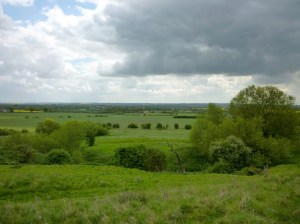
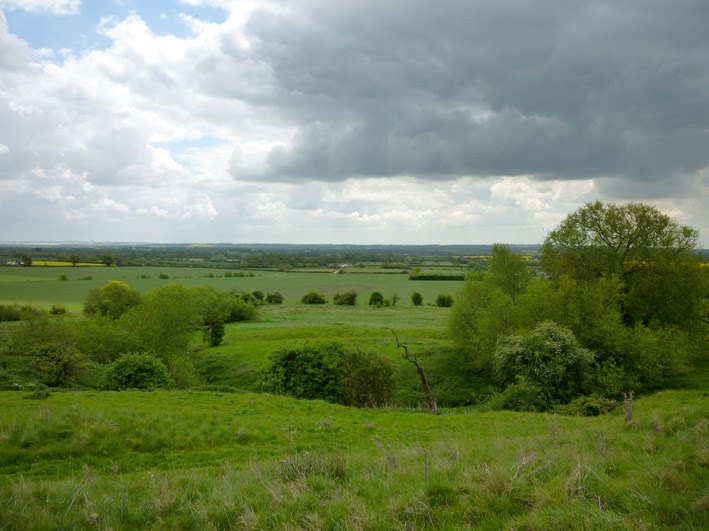
Looking back across the valley over the mound of the Bury, the moated manor at Clopton, with trees growing in the moat.
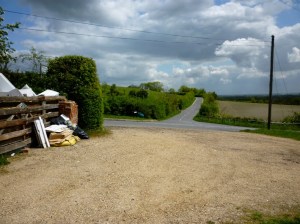
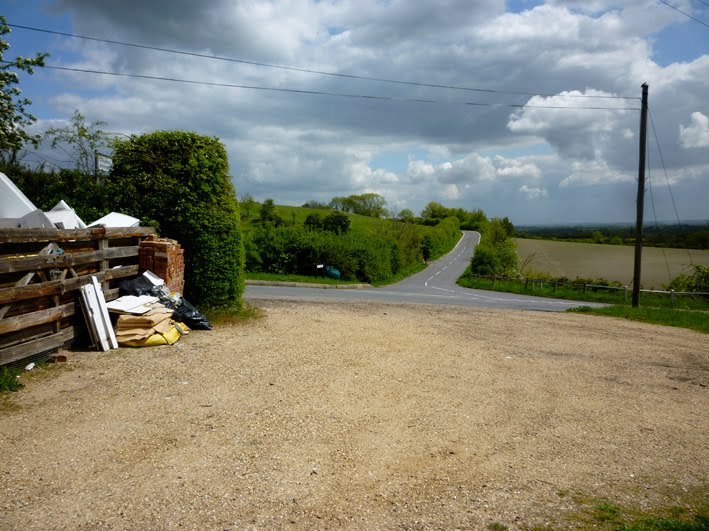
The car is usually parked in this gravel area when I walk to Clopton, but this time it’s nearly 7 miles away! The white objects seem to be junked refrigerators and freezers, possibly left to leak their refrigerants until they can be disposed of without paying for storage and disposal of freons. Grrrr. Cross the road and head down the High Street…
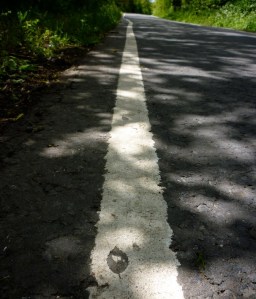
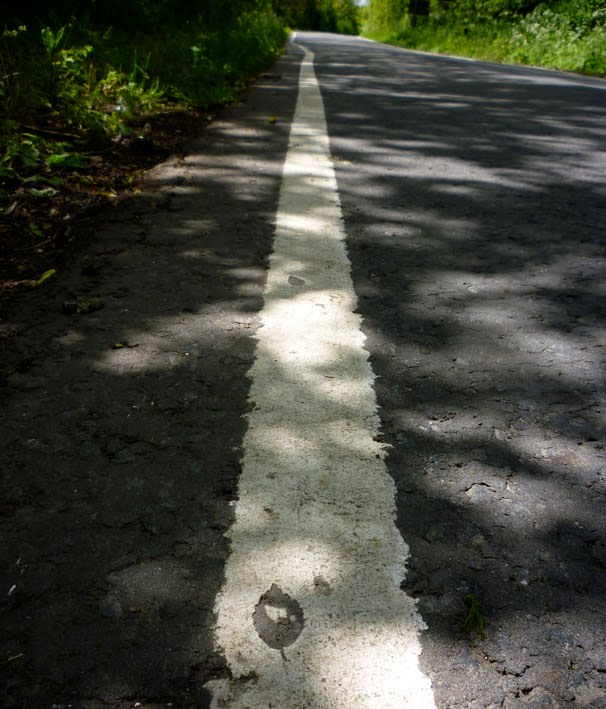
And find leafprints preserved in the thick paint marking the edge of the road! So well-made that it’s possible to identify the species – this is elm, with a serrated edge and asymmetrical base. For some reason I find this absolutely charming. Small things amuse small minds, perhaps :-)
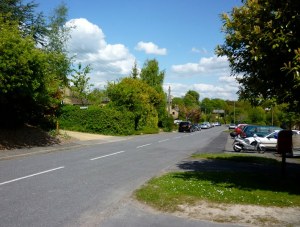
Croydon High Street on a quiet Saturday afternoon. It’s just the one road, lined with houses. A couple of footpaths run north between the houses and up the hill

to one of the things I was hoping to find.
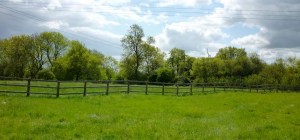
It doesn’t photograph at all well, but fortunately someone’s built a fence to show the undulations of the ridge and furrow of medieval arable preserved beneath this pasture. It’s a feature of medieval farming in this area, and farmers created it on purpose by ploughing their strips of land in the same direction year after year, with the plough shifting a little more soil from the hollow up toward the ridge every year. No one today is certain why this was done, but the usual theory is that it improved drainage on heavy soils: water ran down the ridges into the hollows.

Here’s the mound of yet another moated manor house.
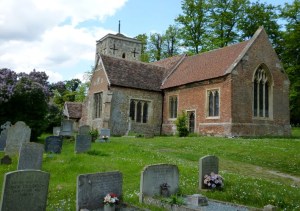
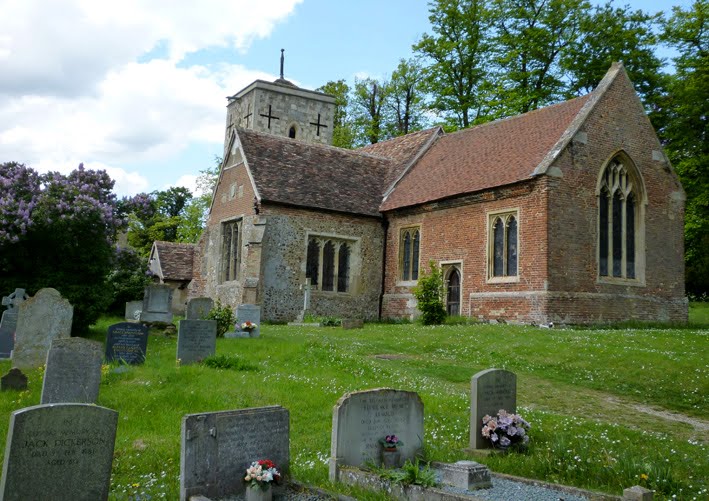
And, down the hill, this is All Saints, Croydon. A classic small church for a small village. The original nave, the main part of the church, is built using a wide variety of stones that would have been found in local fields – not a lot of money here in the 13th and 14th centuries. And perhaps they didn’t choose the best location or the best architect: one of several large brick buttresses is just visible between the entrance porch and the chapel, and those large black crosses on the tower are not windows, they’re the fixings for metal bars that run across the tower to stabilise it. The brick chancel was built in 1684, replacing the ruinous original.
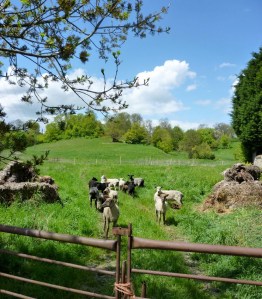
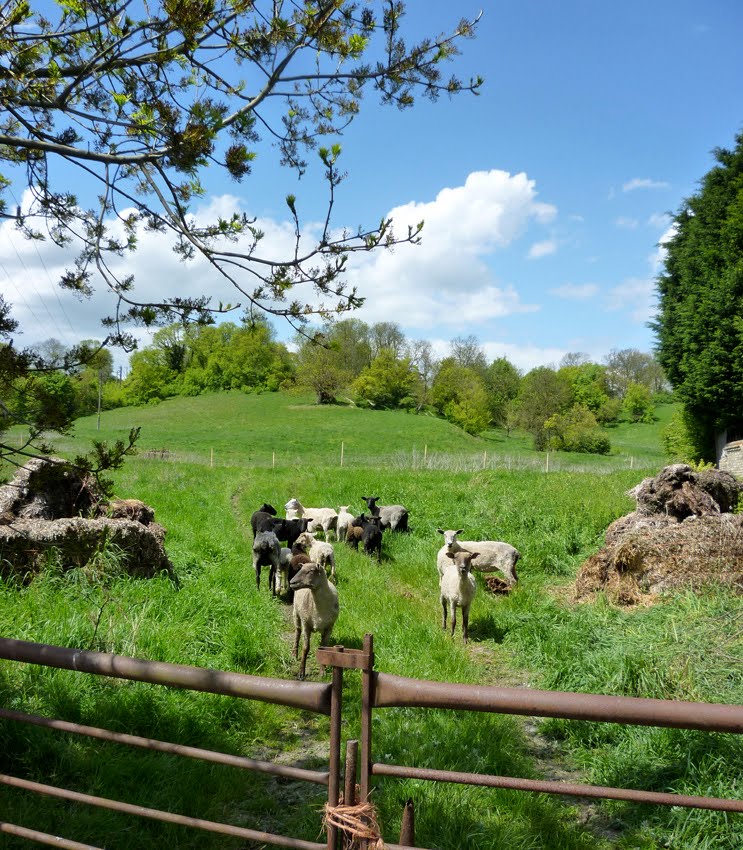
In the centre of the village I thought I could smell sheep, and there they were. The hillside behind them is the site of the medieval village of Croydon, now only earthworks, but (frustratingly) there is no public access.
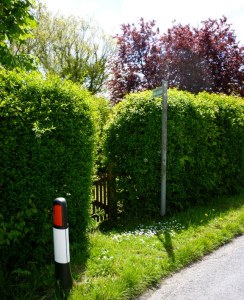
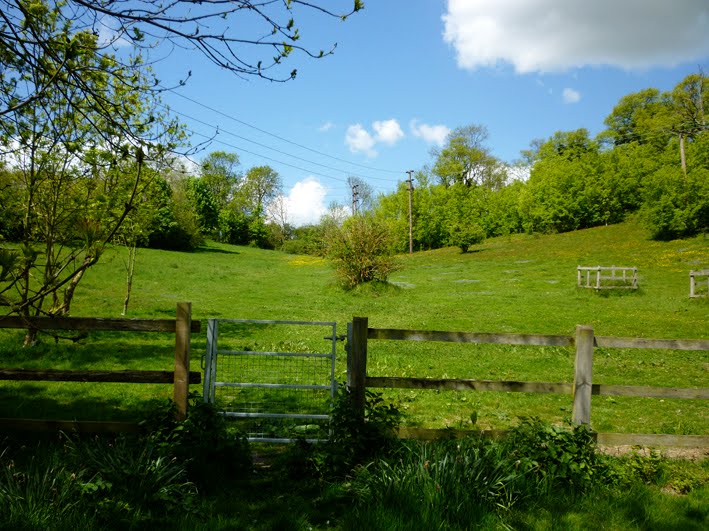
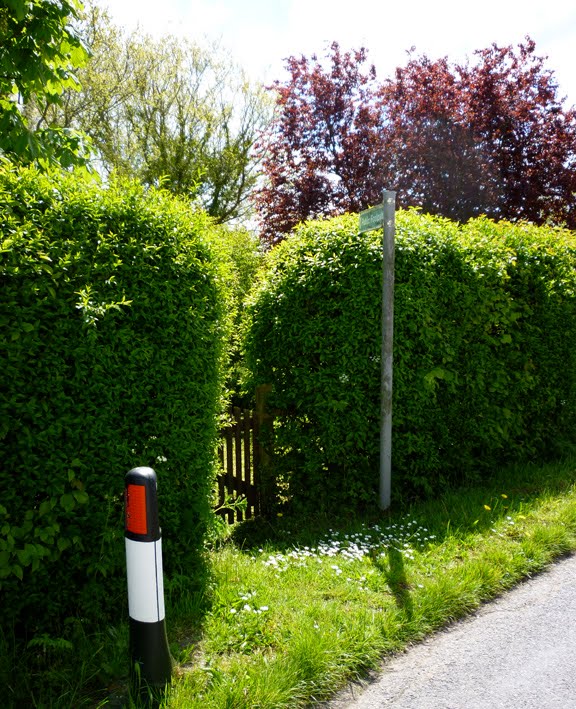
This is another of the things I came to see. The gate in the hedge marks the entrance to what in 1750 was Croydon Lane, running south from the village between the two moats I mentioned earlier.
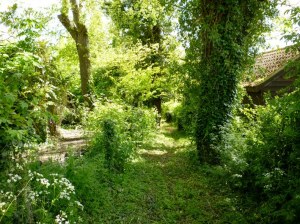
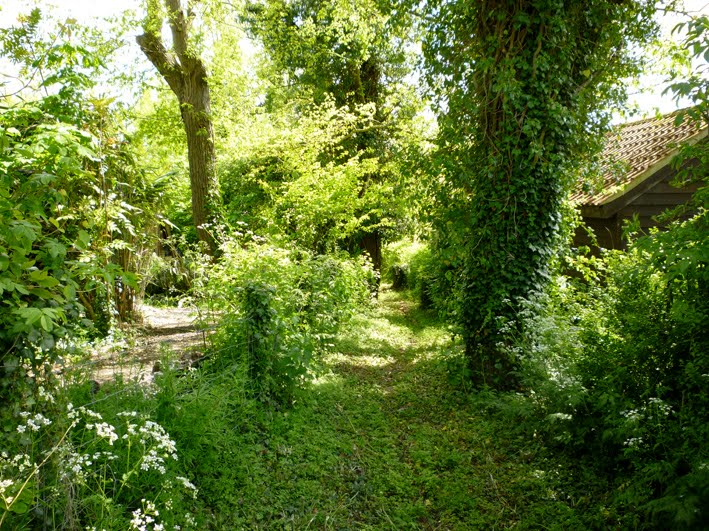
Today it’s just a footpath, but there are indications that it was once a more important route. It’s difficult to see in the photo, but the path is at least 18″ lower than the ground to either side, worn down by traffic over many years. I’d hoped for significant old trees on the banks beside it, or signs of traditional managment such as multi-stemmed trees growing from old coppice stools, but judging by the dense growth of young elms, the old trees may well have been elms that died of Dutch Elm Disease many years ago.
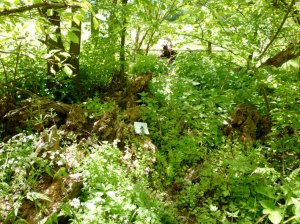
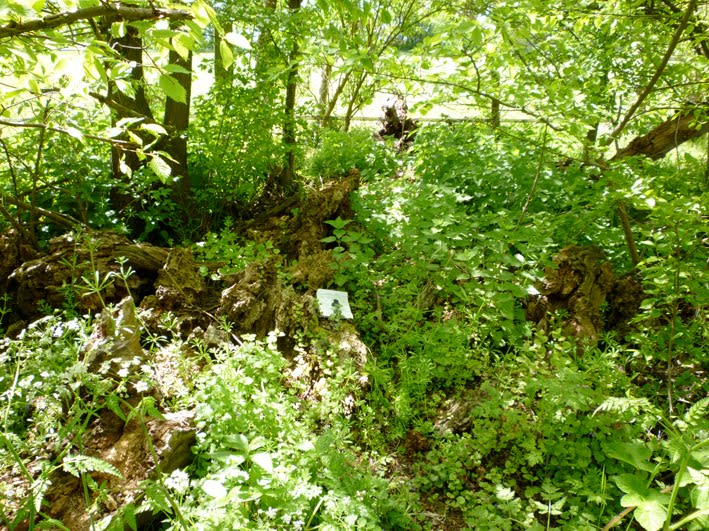
Here is what may be the remains of one giant, slowly returning to soil beside the path. My watch is sitting on the map to give some sense of scale.
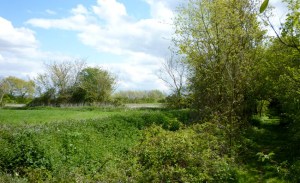
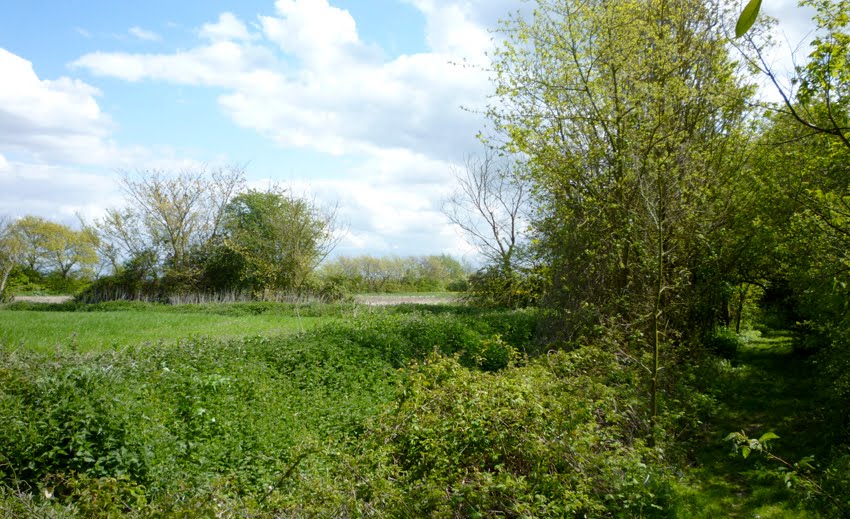
One of those two moats stood inside the ditched enclosure marked by trees in that photo. It’s also possible to see the height of the field surface compared to the track of Croydon Lane.
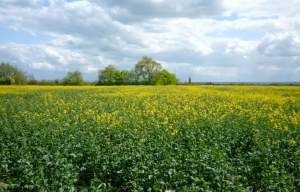
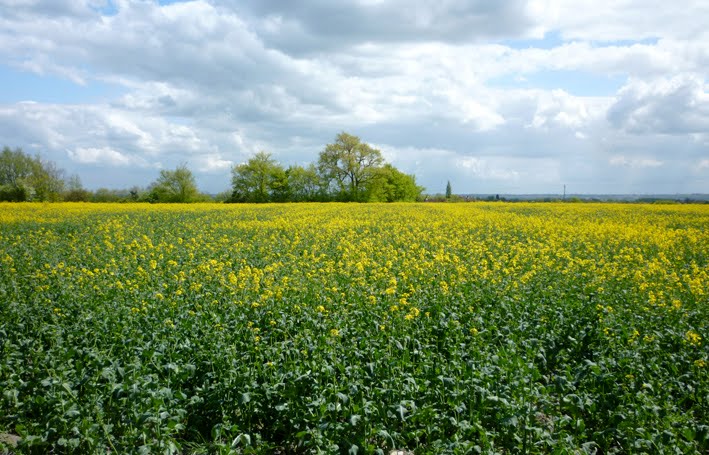
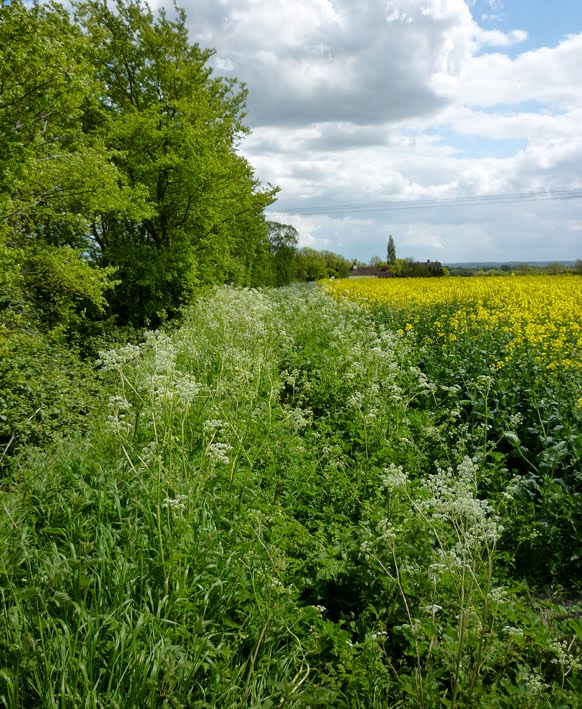
Croydon Lane originally continued straight ahead, across this field of Oil Seed Rape (canola to North Americans) to the line of trees (the footpath did, too, until relatively recently). The second moat would have stood to the right of the line of the Lane.
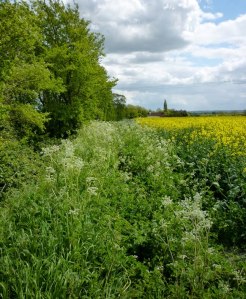
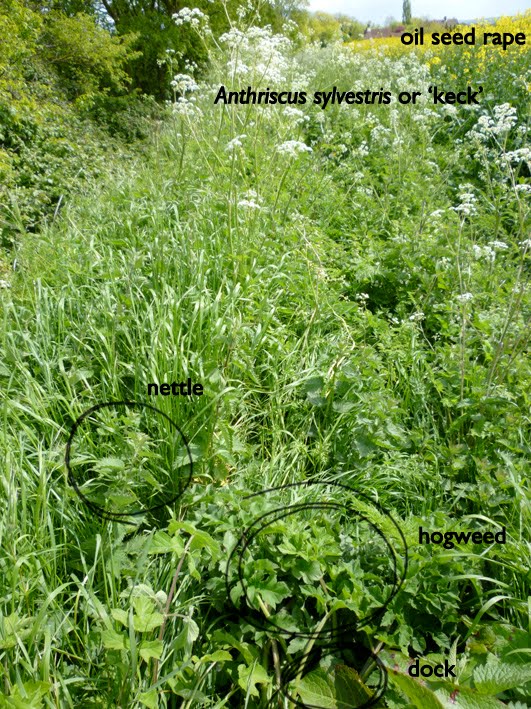
The path beside the trees is not walked frequently :-) Here’s a closer view of the vegetation:
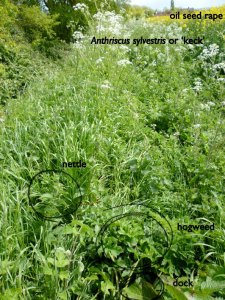
I was wearing shorts. The keck (that’s what my husband, born in Lincolnshire, uses as a generic term for all white umbellifers) is just a nuisance, but nettles sting and the sap of hogweed (Heracleum sphondylium) causes photosensitivity: it disables the skin’s response to sunlight, resulting in sunburn. It’s not nearly as bad as some of its relatives, such as Giant Hogweed and Cow Parsnip, but still… I walked carefully here.
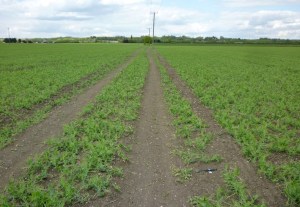
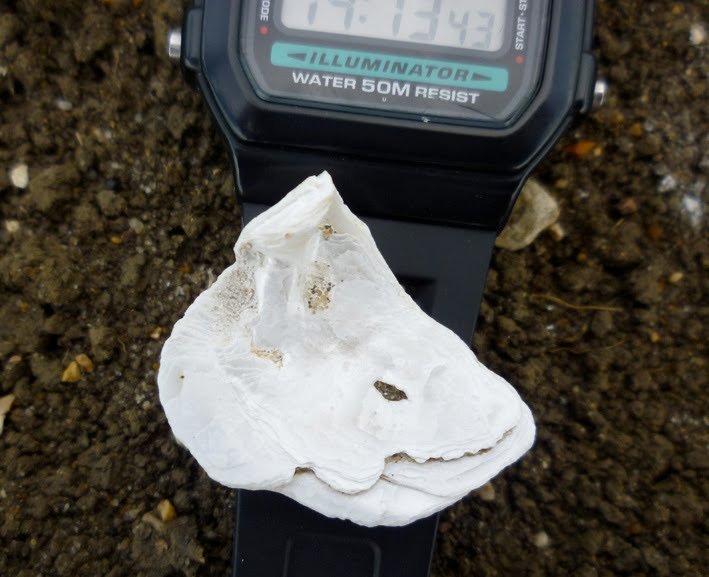
And then a mystery to occupy my mind for the rest of the walk (instead of fretting about how my feet were hitting the ground): there’s my watch on the ground in the middle of a field of field peas, next to something white.
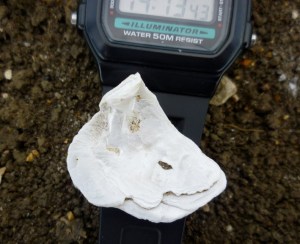
It’s a fragment of shell. A very waterworn fragment of shell, but it’s still got some sand cemented to it with what looks like white mud. In a pea field, full of silt and clay. Next to a stream, admittedly, but the stream is full of silt and clay and besides which, that thick large shell is from a saltwater mollusc. Why is it here? Perhaps it’s in some way related to the Roman villa site about 2 fields over. Or perhaps it’s much, much older, about 95 million years older, eroded out of a lump of chalk. That would explain the white mud. Debating the matter in my head occupied me nicely until the SMS discussion about whether or not he’d meet me at the pub about 15 minutes from home. In the event I opted for a shower first and after that I was too tired to move. Except to eat our well-deserved dinner!
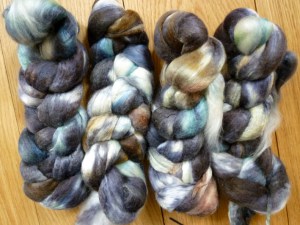
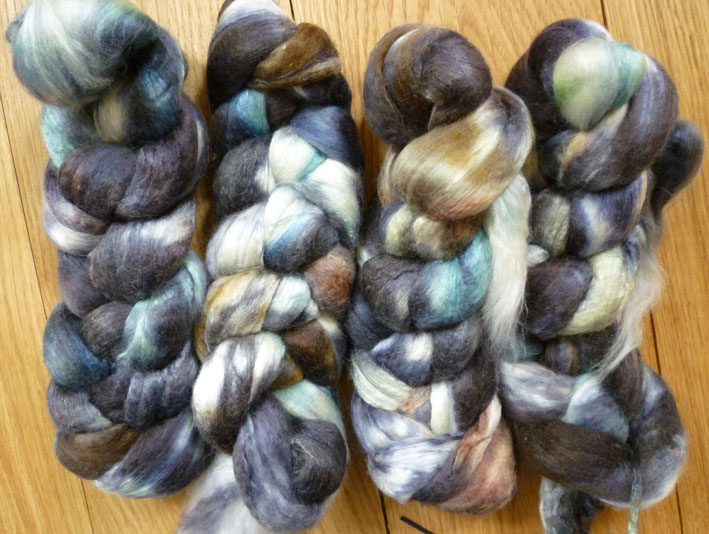
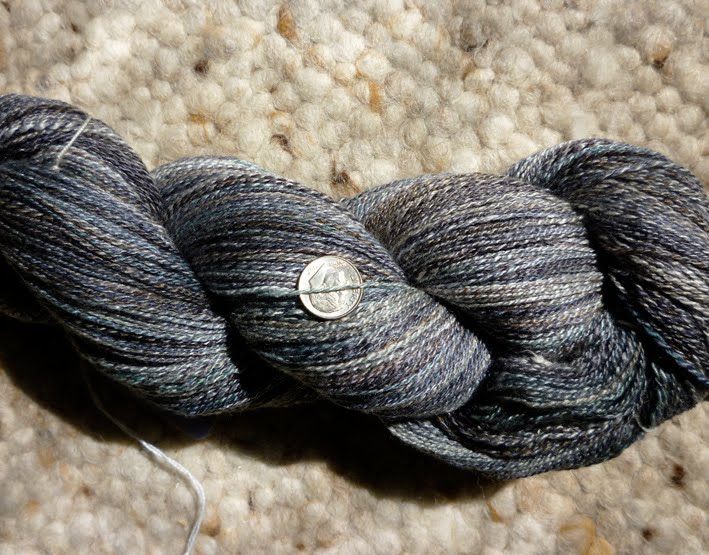
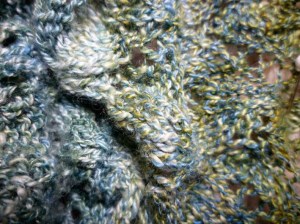
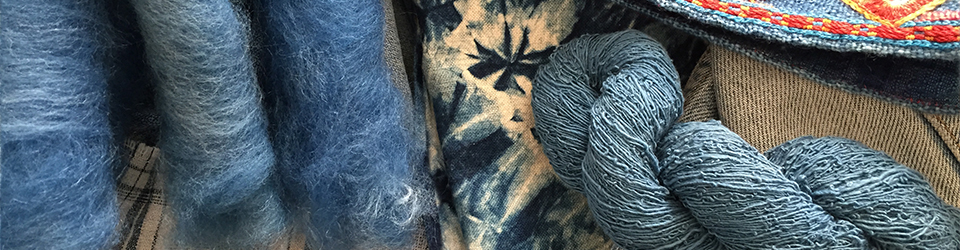
Have a picture of some fibre. It’s a promise: I have an entire post sitting in my head about how that became this
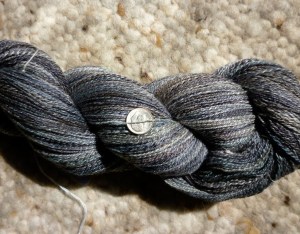
and why it’s much better than this:
But now it’s time for lunch.
It’s not coffee

Crumbs, it has been a while. But I haven’t been idle. First and still foremost in my mind is the story of the 2010 Ravelympics. For those who don’t know it, the lighting of the Olympic torch at Vancouver not only marked the opportunity for athletes from across the globe to strive for gold; knitters and spinners across the globe also set off on personal journeys to try to achieve their own goals. I find a challenge like this can spark my competitive spirit to achieve far more than I might otherwise manage. This year I set myself a goal that seemed both possible and ludicrously impossible: to spin cotton for warp and weft, weave and finish a bag inspired by Sara Lamb’s book Woven Treasures. Doesn’t seem unreasonable to you? Although I’d taken Stephenie’s Cotton class at SOAR last year, I’d never spun more than a few metres of it at any one time, I’d scarcely done any plying, I’d never spun for weaving… I’d never woven a project, I’d never used a rigid heddle loom, the Flip double heddle loom I planned to use wasn’t even in the country when I ordered it, I’d only sleyed (the term for putting all those threads through the right holes and making a warp) a warp once in my life, and that had to be cut off the loom… this was a big deal for me. The only thing I did before the Olympics began was assess the cotton stash (acala sliver and a box of naturally-coloured cotton slivers, both from Cotton Clouds), spin about 10m of acala sliver, make 2-ply and 3-ply, and solicit opinions from some weaving friends (including Sara Lamb) on Ravelry to establish which of them was most likely to be a ‘good’ weaving yarn.

I did not fancy staying awake past midnight to start spinning as the torch was lit, so I began on Saturday morning, UK time. I spun and I spun and I spun. I spun in the morning and the evening. Cotton needs a lot of twist, and having read that weaving yarn needs even more, with the Suzie Pro at the highest ratio on the high-speed whorl, I treadled like mad. My husband was so impressed that he counted: when plying reasonably fast, my right foot hit the treadle twice each second, 120 rightfoots/minute. And still I had to hold the forming yarn back for a count of 7 treadles to get what looked like sufficient twist, and even after that I ran the 2-ply back through the wheel to add more twist before I warped. I learned that the willful, twisty singles becomes much more biddable if allowed to rest on the bobbins for at least 24 hours before plying, and the plyed yarn is happy to take more twist if it too is allowed to rest. It’s very obedient, is cotton. I like it. It’s completely different from wool/animal fibres, and incredibly satisfying to spin.
The end result was an unknown quantity (but I hoped ‘enough’) of 2-ply cotton, still lively with twist, in five natural shades (those colours are not the result of dyeing: the cotton has been bred to produce them). I should have spun more of the pale brown to start with, as I ran out and had to spin more while warping the loom.
After plying, warping. And at this point things went downhill faster than Amy Williams. In order to produce a warp-dominant fabric of the stiffness I desired for the bag, the 2 10-dent heddles (ie loom set up at 20 ends per inch, epi) had to be threaded 1,1,2 to get my 27 epi. I discovered that, while I find reading a lace chart to be easier than falling off a log, my brain does not do well at warping a loom. It took me three days, during which I went from thinking “I’ll just whip through this” to “Oh, no, I’ll just do it again” to “AAaaaaaaaargh” to “Wood burns. Cotton burns. I have a fire.” In the end I found the still, quiet space beyond despair, where my stubborn lives.

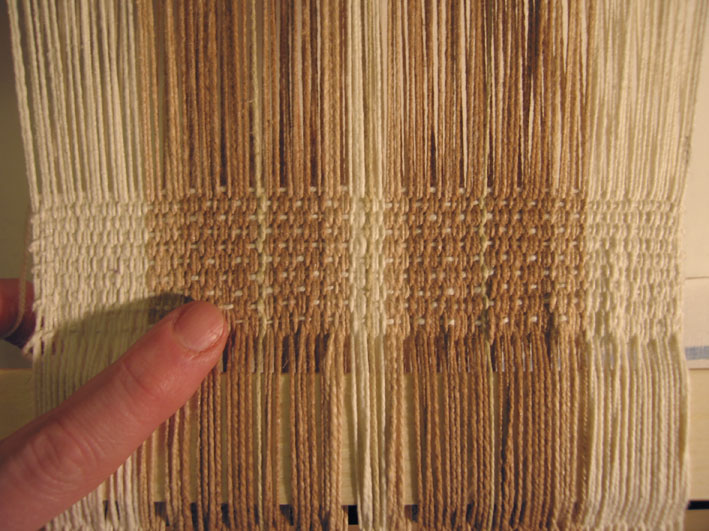
I drew a little diagram showing how each end (length of yarn in the warp) should be threaded through the slots and holes of the 2 heddles; fortunately there was a ‘repeat’, so I didn’t have to do this for the entire 200-odd ends. And then I spent an entire day hunched over the loom, counting, hooking yarn through holes and slots, counting again. Finding an error, going back, counting again. The next morning I started to weave… and found the sheds were not clearing (raising and dropping the sheds lifts and drops various warp threads, forming a gap between two ‘sheets’ of warp threads in which you place the weft thread). My one other loom-weaving project FAILed because the warp became worn and stuck to itself, so I assumed this was the problem. Especially as I now remembered being told about ‘dressing’ cotton warp to make it less hairy and easier to weave. So I ran downstairs, made a gelatin dressing, painted it onto the exposed portion of the warp and set the entire loom on the bathroom radiator to dry.
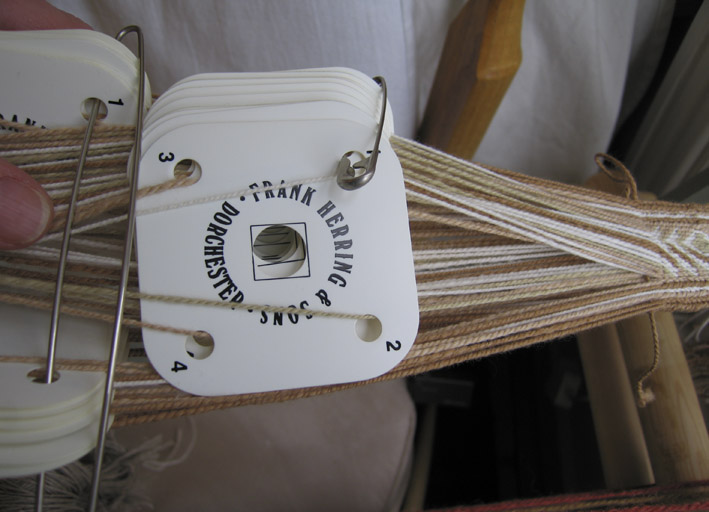
Because I couldn’t afford to waste any time, I’d already warped my TWinkle (Tablet Weaving Inkle) loom to make a tablet-woven band to form the sides and straps of the bag. I’ve done a little more TW, so was much, much happier with this… almost able to relax and watch the pretty patterns form.

For those who’ve never heard of tablet weaving, the above shows how a set of square cards with holes in the corners creates a shed through which the weft is passed. After each pass the cards are rotated either forward or back, which changes the threads in top and bottom holes, forming the pattern on the band.

And then the warp on the Flip was dry and I tried again. And noticed that the lively cotton had twisted while I was sorting out the warp, and it was those twists holding the warp threads together and preventing the shed from opening properly, not a sticky warp. So I forced the twist back, out of the way, and…
began to weave, fast! And it was quite fast, once I established a rhythm. Perhaps I would finish in time after all.
I cut the cloth and band from the looms, washed them in warm water, and ironed them dry.
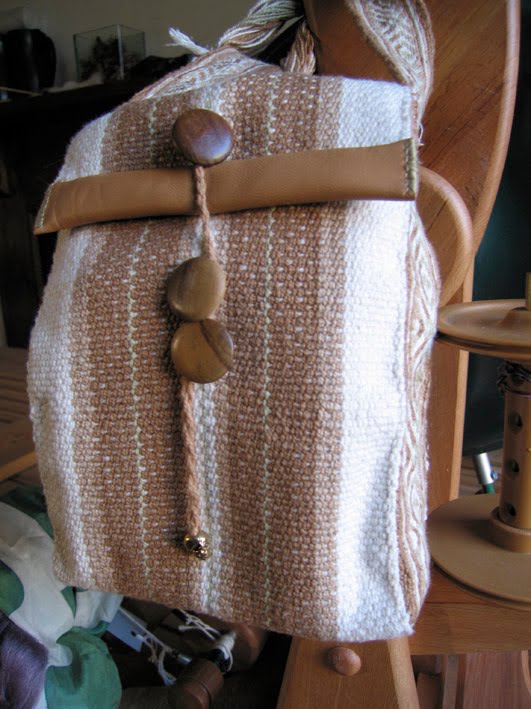
And realised I’d woven about 2′ more of the fabric than I needed. Never mind. I’d bought lining fabric to back my handwoven cotton, and now began the (for me) extremely arduous task of sewing the lining to the woven fabric. Remembering to include a strip of leather to form/strengthen the bottom of the bag, but forgetting to sew the ends of the band in. The first time. I remember thinking how much hassle it would be to disinter the sewing machine from under the yarn stash behind the chair in the front room; four hours later I was thinking I should have thought harder. At least I managed to keep the bloodstains on the brown of the band instead of hte cream, where they’d show (I am utter rubbish at sewing). A friend had given me some beautiful fine, soft leather to finish the top and flap of the bag; sewing that gave me new respect for her and anyone else who sews leather. Although apparently there are needles designed for sewing leather. Who knew?

At any rate, I finished the bag with about 8 hours to spare. I could have used this time to properly finish the ends of the band/handle, but needed to actually use the bag for a while before deciding the best way to do this. So I submitted the photos to the Finish Line, and sat down with a large glass of red wine in celebration.

I can keep the spare flyer, oil, allen key, wrench and other odds and ends close to hand while spinning on the Suzie. And I can admire my medal.

And we can wash our faces. With the very small washcloths I’ve made from the leftover fabric! I wanted desperately to see what happens when I finished the cotton ‘properly’. Cotton sliver contains oils and waxes from the plant itself, so is usually boiled with a little washing soda to remove these and make the fabric softer and more absorbent. I didn’t want a soft, absorbent bag, so I didn’t boil that fabric. So I didn’t see this until today:
The brown liquid is not coffee, it’s the water in which the flat cloth under the bag was simmered for 30 minutes with a drop of dishwashing liquid and a tsp or so of washing soda. Which famously changes the colour of the natural cottons. You can’t clearly see it in any of these shots, but the tan/yellow-browns of the unboiled bag and band have lost the yellow tinge, becoming almost dark milk-chocolate. The most striking change is in the green, which was a pale sage green and is now a dark olive.

I have to say, it’s better than a medal. I can’t describe the feeling of satisfaction or fulfillment I feel when I handle this fabric: I have made cloth. Woven cloth. If I made more of it, we would have clothing.

A passing thought

On the Ravelry group where I seem to be living at the moment, there’s a thread for the ‘Year of Making Stuff’. In it we egg each other on to greater feats, and enthuse, and feel inspired even while turning pale green with jealousy at some of the items some of us make. We’re all making beautiful things, and learning new ways to make beautiful things. Sara Lamb’s book Woven Treasures: one-if-a-kind woven bags inspired me to try pick-up weaving. It’s a folk weaving technique, the sort of thing people have been doing for thousands of years to enrich their lives by making everyday objects a little more beautiful. As I reached into the sewing box to find a needle to finish the ends of the band I was struck by the way I took those needles and my other odds and ends for granted.
I don’t know what brings these thoughts to mind. They’re not random, they’re always related to something I’m doing. Usually something that people just like me, my ancestors, have been doing every day for longer than I can think about. Baking bread, boiling water, spinning. I am so fortunate. I don’t have to grind grain and gather wood to fire an oven for 3 hours to bake bread for an entire household for a week; I just buy flour and turn on the oven. If I want a hot drink, I turn a tap to get fresh, safe water that boils in minutes at the flick of a switch. If I want a needle, I take one from the packet I bought more than 20 years ago in Canada. For 60 cents I had 50 steel needles, incredibly sharp and fine, suitable for a variety of uses. I still have lots because I sew as infrequently as possible (I dislike fine sewing, so it’s just as well I can buy ready-made clothes). By contrast, a thousand years ago, this one needle would have been someone’s prized possession. Most people used bone needles. Even in the Middle Ages, metal needles were nothing like those in the packet I take for granted. Not to mention the crochet hooks, the scissors, the safety pins and dressmaking pins so cheap they’re used in packaging the clothes we buy. To be thrown away, or sworn at when an overlooked pin finds its way into flesh as well as cloth.
After pausing to consider my good fortune, I did my best to finish the ends of my first pick-up band.
It’s shown here above my first complex tablet-woven band. That tablet-woven band is a sad sight: now a bookmark, it was meant to be much, much longer, long enough to be a belt. But after spending several hours over the course of a week or so getting to grips with the diagonals, I worked out how to make the diamond ‘eye’ at right… and then, for some reason, I had to put the loom to one side. I did make some notes about what I’d done, but by the time I got back to it I’d lost the knack of doing the diagonals, and I think some of the tablets had been rotated by accident. That strip and its warp sat on the loom for the next three years, reproaching me. Occasionally I’d try to work out how to get back to the diagonals, fail, and put it to one side again. Until a month ago when, after another afternoon spent staring thoughtfully at it, turning tablets to and fro, I took Denny’s advice and cut the dog off the loom. I can make another one. It is, after all, the Year of Making Stuff.
And I have been making stuff. There’s been quite a lot of spinning, some of which is being knitted.
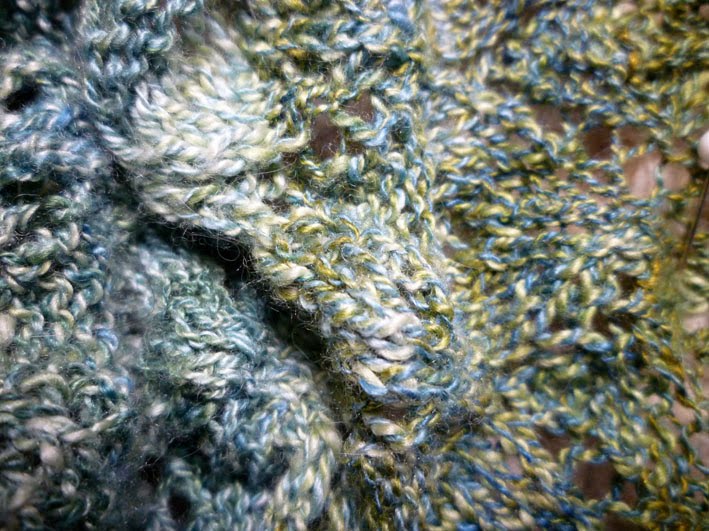
The 400m of cashmere/silk is becoming another shawl based on the Rampton Lace Swatch pattern. It’s become overly difficult for a beginner, so that ball of Jo’s red merino/silk will become yet another version, with the complex ending of the green as a variant for more knitters willing and able to keep an eye on the orientation of their YOs. I can’t knit that lace AND remember to write down what I’ve done after wine, or when I’m tired, so I need some simpler knitting as well.
These will be fingerless gloves, a gift for a good friend. Apparently she has an opal ring in exactly these colours; how fortuitous! And when those are finished, I need a hat because the brown one I knitted in a hurry is both too short and too loose. And it’s boring. The last installment of the Socktopus Fibre Academy, ‘Magic Dust’ batts from FeltStudioUK
became a bouncy woollen 3-ply that I think will do nicely. Can you see the firestar in it? My new hat will *sparkle*!
There is of course more spinning occurring; 2 oz of Switzer-land alpaca from SOAR on the Suzie. I’m practicing long draw because after I finish that it will be time to compete in the Ravelympics. My chosen project? Spin cotton warp and weft for a small bag, then weave it on the Schacht ‘Flip’ rigid heddle loom that hasn’t yet arrived. We’re getting close to the wire here. I need to know the grist I need to spin! In the interim, I also have to work out how to crochet a friend’s knitted squares together to make a baby blanket.
When I finish *that*, there’s the Christmas present that arrived last week. I wonder if the fates are telling me to spin that 100g of silk on a spindle?

And there’s another big project hinted at by the background in all these images. To be fair, we don’t have to MAKE anything from scratch, but still…
that’s roughly 34 m^2 of solid oak floorboards to replace the worn and maltreated pine that is our current downstairs floor. Spinning wheel and cat for scale. That’s a lot of work even starting with the boards made by someone else. I’m hoping for warmer weather for the project, because there’s a chance that we’ll have to mess with the central heating pipes and radiators to get some of the old boards out. The snowdrops know the sun is moving north once more.
If by any chance I have time to feel bored, I will warp the loom for another tablet-woven band.