Category Archives: Uncategorized

Success: it’s not just string after all.

That’s Sundara‘s aran silky merino in a non-repeatable colour, black over blue used to make Wendy’s ‘Something Red‘. I had 5 skeins, 1000 yds of the yarn and used about 3 1/2. I have plans for the rest… this stuff is so soft I want to wear it next to my skin. Oh, and the colour scarcely ran at all when I washed it which, in my limited experience, is extremely unusual for something this dark. There are many very good reasons for Sundara’s yarn selling out within minutes of its appearance.
The pattern calls for a single large button placed just below the bust. I wasted ages (procrastinated happily) searching for the right button online and in every haberdashery/antique shop I passed, without success. Then I thought of a brooch I’m fond of that’s too large for everyday wear. I think it works, although it’s a shame it hides the buttonhole. I’m very proud of that buttonhole, researched the best technique and everything. I prefer the photo above, even if I don’t understand why it looks as though there’s a line across the sleeve and I do like the brooch. I comfort myself with the thought that In Real Life relatively few people will ever be looking straight at me as I crumple with laughter at his efforts to use my little-ass camera. Shortly after this he stalked off saying “If I WANTED to use a camera I’d get an SLR.” Many more people are likely to appreciate the side view as I walk elegantly through any available crowd. ON LEGS. These photos are definitive proof that legs are slimming.

On to other news. Apparently it’s not ‘just string’. He said. Want to see what made him understand this?

Nacy Finn’s ‘Chasing Rainbows’ fibre from Teyani at Crown Mountain Farms. This is 50/50 merino/silk in ‘Hydrangea’, a light DK weight after plying (it looks larger in this close-up). The intensity of colour in this fibre is simply amazing: the photos absolutely do not do it justice at all. Its ability to stun may be judged by the fact it changed his mind about fibre!
That’s to record the colour repeat: there are about 2 7/8ths repeats in the roving I’m working on. The skein above is one colour repeat spun from lengths of roving so that the colours match at beginning and end (think blue-green green-blue blue-green), then ‘Andean’ plied on itself. It’s incredibly pretty. Next colour repeat will be spun to make two lengths of matching repeats to ply so that the colours match. Last one will be whichever I like best of the two. But what on earth do I do with this? I’ve got 4oz which, with luck and a following wind (that’s ‘wind’ as in ‘Blow the wind southerly, southerly, southerly’) will yield roughly 300m of yarn. Socks too beautiful and fragile to wear? I could carry them around for others to admire… I don’t really do scarves, and at this point I can’t bear to contemplate parting from it. I’m thinking instead of spinning what I’ve got and, over time, spinning more in similar colourways. I’m thinking about a loose cardigan/kimono,* perhaps knitted vertically to stripe in interesting ways. I’m slightly intimidated by the way that the possibilities inherent in a stash of yarn are multiplied in a stash of fibre that can be spun to be almost any weight the spinner desires.

Speaking of spinning, I’m re-reading Jonathan Raban’s ‘Bad Land‘, an exploration of the homesteading of Montana. Books and many other tangible fragments of lives still lie in the farmsteads abandoned as a result of drought and the Depression. I have many of his books; even more than McPhee he inspires my thoughts to explore beyond the boundaries of his writing. I’ve read online of spinners falling in love with wheels in antique stores; some paint pictures of previous owners sitting peacefully at the wheel, spinning to relax as they themselves do today. As I read Raban, I find myself considering the accuracy of those pictures, seeing instead a woman determined to produce the yardage promised for a sweater, socks, anything to earn hard coin. I’m sure both have been — and still are — true. It’s just that I am incredibly lucky to be spinning for love rather than money.

* to be worn over a fitted top with a v-neck, OK?

Exemplar


As in ‘concrete example of knitwear design’. This is a sweater chosen for me by the consultant at Liberty, after she’d assessed my character and body shape. Note (if you can from the bad photo) that it’s marginally too big for me: I’m only 5’4″, but my 38″ bust means off-the-rack clothing that fits my height will be far too tight across the, er, chest. One reason I drifted into wearing over-size sweatshirts. But I digress. Points brought to my attention by M and the consultant: 1. It has a v-neck, albeit small and off-centre.* V-necks break up an expanse of chest, making it less obvious to everyone bar the wearer. This one isn’t really deep enough. 2. Patterning also breaks up what I perceive as a ski slope south of my neck. Here the horizontal ribbing is broken by that incredibly strong vertical, so it doesn’t make me look wider than I am. Which works with 3, slight waist shaping, to make clear that I do have a waist. 4. The emphatic horizontal hemline that would draw attention to my hips is replaced by movement sweeping away from the strong vertical – and it’s even got vertical detailing to make that panel look narrow. With a pocket that I gather really should be sewn almost shut. Mind you, it’s too small to be useful. I couldn’t even put my pocket knife in that. (Yes, I tried) 5. Long sleeves bell at the end to make my arms seem longer and thinner (why is that a good thing?).

The consultant got it absolutely right. I love this sweater, and will continue to love it until it falls to pieces, at which point I will be very sad indeed. I know I look good in it, which means I carry myself properly upright and therefore look even better. The detailing is delightful. It’s like a building designed by a really good architect. Look:
The designer used the curl of plain stockinette to perfect advantage: the vertical is just a strip of knit fabric allowed to curl. (All the garment edges are simply bound off and left to curl, too. Here‘s another top that uses that to good effect.) The perfectly placed triple increases make one small rib widen until entire groups of small ribs are perceived as ribbing across the garment front. Isn’t that clever?

This is the shoulder. The ribbing for the arm grows organically away from the seam. Even the increases for the bust are beautifully placed.

There’s more I won’t show you, because I don’t think it’s fair to put all the design details online for reference. But the waist shaping is due in part to a repeat of the ribbing&triple increase down the back, and this also gives the sleeves their shape. A single strong, elegant idea used everywhere to advantage. I wish I could afford more stuff like this. As it is, I’ll have to apply the principles to garments I knit for myself. Or divorce him and marry someone really wealthy… no, there are some things in life more important than architectural clothing. Just barely.

* Seen the Spring 2007 IK? ‘Slanted Neck Pullover’? I think it’s not slanted anything like enough: on the model it looks as though a knitter got a normal v-neck wrong and hoped it might pass for art.

As promised

How to build a sourdough starter.

First, a bit of knitting for those who aren’t interested in bread…
The Alligator (pronounced ‘amalgamator’ in this household. Don’t ask.) Socks in his chosen yarn, Lorna’s Laces in ‘Forest’. The instep is a twisted rib, basically four rounds k2xp2 rib, then k2t, slip that back onto the left needle, knit the left-most of the original k2 stitches, then put the slipped stitch on the right needle with its new partner. And so forth. Chosen because the twist should tighten the rib a bit (he said the first pair were too loose).

And I’d like some advice. I posted a lot of words about design yesterday. I have some photos of a purchased sweater to illustrate some of the points I made (or rather, was shown at the time I bought it). Is it reasonable to post detailed images of design features in a commercial sweater? It’s not a hand-knit, but it is a designer-ish item.

Back to the bread. This isn’t the only way to build a starter, it’s the way I do it. I distrust those whose instructions require organic grapes or yoghurt or potato water and similar. A sourdough starter is a community of bacteria and yeast that feed on the sugars and starches found in wheat and other grains and produce CO2, more sugars and the vast array of other organic molecules that give sourdough bread its distinctive flavour. If you want a community that lives on grain, why add organisms that live on fruit or potatoes? The appropriate yeast and bacteria are in the flour. Speed isn’t important here. If you want fast bread, use commercial instant yeast, which has been bred (ha) to work fast and reliably. Don’t ever add commercial yeast to your starter, it’s not the yeast you’re looking for. If you want speed and reliability in a particular batch of bread, you can (like many commercial sourdough bakers) add it to the dough, or you can use it to make a biga or sponge 24 hours or so before baking. The additional time adds flavour to the dough.

Day One. Everything you need is shown in the photo. Organic rye flour (that’s 1.5kg, the smallest available bag), organic bread flour (from a 25kg bag on the floor), bottled spring water. That’s crucially important: tap water is treated to remove organisms such as yeasts and bacteria, and contains chlorine (amongst other things) to discourage their growth. Put your chosen container on the scale, zero it (I love digital) and add a mix of flours. I used 75g white (you could use brown) and 50g rye (125g total flour). The actual proportion of white/rye don’t really matter, but for some reason bread yeasts love rye, so adding it makes this process easier and faster. I don’t like a strong rye bread so I’ll gradually decrease the amount of rye in the starter as I proceed. The amount of water you add does matter, because that determines the hydration of the starter. Weighing ingredients is more accurate and precise than using cups; if you do use cups, keep a record of everything you do because you must know the proportion of flour to water in the starter when you use it for bread. I make my starters at 100% hydration (this is something called bakers’ percentage*) because it’s easy to work with: equal weights of flour and water. So add 125g of water, stir in well, sniff the result and try to remember what it smells like,

then put the lid on, and leave the container somewhere at cool room temperature. Our kitchen is about 60F, at a guess. A little warmer might speed the process, a little cooler will slow it. Changing temperature might also influence the strains of bacteria and yeast that thrive, but it’s your kitchen they must thrive in.

Day Two: the next day (time doesn’t matter), check the smell of the batter? dough? stuff, then put roughly half the volume on the compost heap or flush it. Add more flour and water in the same proportion. I usually add about 100g flour (total) and 100g bottled water. There’s the advantage of the 100% hydration: no matter what the weight of the starter, I can always work out the weight of flour and the weight of water in it: just divide the weight of the starter by 2.
I use plastic or wooden spatulas because eventually the starter will be sufficiently acid that, over time, it might etch vulnerable metal. I don’t want metal in my bread!

Day Three: Peer closely at the stuff through the side of the box. Can you see any bubbles? Look carefully at the surface and sniff again. Any sign of bubbles? Does it smell different? If the smell has altered and you can see bubbles, you’ve got a starter. But the process is the same: discard half, add some more food and water.

Day Four: the bubbles are large enough to photograph through the side of the container, and you can clearly see them on the surface. The starter definitely smells… ‘different’ is the kindest word. It’s not appetising, at least not to me, but it’s very young. Discard half, add more flour and bottled water (always, always bottled water) and put back in its place. Just for reference, here’s the surface of my own starter, which is several months old now, at the same stage after feeding:

It smells almost fruity, a rich, complex scent full of aldehydes and ketones. There’s a hint of acidity, but this is not and never will be the vinegar-scented ‘San Francisco’ sourdough. Many people have wasted a lot of money trying to duplicate the conditions for that. What you will get will be your own local bread. A. brought me a loaf of SF sourdough from his last trip to the city: the bag smelt so ridiculously strongly of acetic acid I thought at first he’d brought me salt-and-vinegar crisps/chips. But the bread didn’t taste of it and (frankly) I thought mine was just as good. Down, ego, down!

Today is Day Six. There are more bubbles visible, and the smell is slightly more attractive. I’ve just done the discard/feed and I will continue to repeat the process for the next few days with a view to using this for a batch of bread on the weekend.

I took a bread-making weekend course a couple of years ago, primarily for the chance to fire and bake in a wood-fired oven. It was fascinating. But I also saw how a commercial baker maintains his/her starter. Starters. A litre or more of each in different stages of development, some full rye, others a mix of flours. We discussed the financial cost of this for home bakers, something he hadn’t considered. For most of us, the discarded flour and bottled water (he had spring water on tap!) adds up to considerable expense over time. There are two solutions. One is to build a new starter whenever I want to bake sourdough. Plan a week or more in advance? No chance. The other, which he didn’t like but agreed was feasible, is to keep your starter in the fridge for most of its life. Once you’ve got a healthy starter you can feed and water it, allow it to work for a couple of hours, then put it in the refridgerator. This slows the action of the bacteria and yeasts so you can feed and water it less often. Mine lives in there for four or five days at a time: two days before I want to use it, I take it out, discard half, feed and water it and leave it at room temperature to become fully active. Before going to bed I’ll feed and water it again (no discard), and I’ll do that again the next morning to build the volume I need for baking. After I’ve taken what I need, I feed and water the remainder, let it work a couple of hours, then put it back in the refridgerator. This undoubtedly changes the species composition of the starter, but as long as it works, I don’t mind.

For bread-making you’ll need a plastic or ceramic container holding at least 5-6 litres don’t tell anyone, but I used a (clean) washing-up bowl when I started. Not a new one, I wanted to be certain that any peculiar volatiles in hte plastic had leached into the washing-up water. Your life will be made much, much easier if you also have a dough scraper. Mine looks like the Nisbets one, but it’s mild steel rather than plastic. I have no idea whether that King Arthur one works on bread dough! Sheets of non-stick baking parchment are also really, really useful. For the best possible bread, you’ll need a baking stone or something similar in the oven to provide bottom heat. I have a slab of kiln shelf c. 15mm cut to fit my oven shelf (allow a gap all round for air circulation). Other people lay (clean!) ceramic floor tiles to almost fill an oven shelf. If you use baking parchment the bread won’t be in contact with the tiles. I know of one person who used an entire concrete paving slab. I think there’s something about this in the RFS FAQ, too.

* that link takes you to the rec.food.sourdough FAQ. rfs is a Usenet group, which you can read using a dedicated newsreader or via Google groups, and it’s a fabulous resource for people who want to bake really, really good sourdough breads. Or any other stuff, for that matter. Just check the FAQ for answers to any question you might have before posting to the group: they put an incredible amount of time and effort into compiling that resource.

"Are you spinning?"

“Yes. Why do you ask?”
“Because there’s this frequent sound of dropping something.”
“IT’S NOT FREQUENT.”*

He was sitting downstairs on the sofa and I was sitting in my chair in front of the monitor listening to back issues of Quirky Nomads and, yes, spinning. By which you may take it that I met that work deadline. I even considered skipping a blood doning session in order to meet that deadline, instead I made up the time by stoking up with dark chocolate and working flat out Friday, and therefore had a splitting headache when, on Friday afternoon, I sent the last file through for approval… that didn’t arrive. And didn’t arrive. I did not have a good night Saturday night, thank you. Saturday morning I received an email message saying the client had moved the deadline back to the middle of next week. Life, eh?

Incidentally, he said he wound the yarn-ball like that because he thought it more likely to result in a completely circular ball, which must be the point of winding a ‘ball’. I said I’d been told mine looked tidy by comparison. He gave me That Look, and I said “You think ‘tidy’ means ‘anally retentive’ in this context, right?” He just smiled.

Now it’s Monday, I’ve received and dealt with the amendments and posted the CDs, the hardcopy and the invoice (huzzah for the invoice!) to the client. I can stop and think a bit. Or read. There is fiction waiting downstairs by my chair, but sitting on the desk bed beside me are two knitting books. I am struggling to learn how to make knitwear that fits, as in is shaped to my body, and also suits my body shape. The struggle is due to ignorance (I’ve never really been deeply interested in clothing, so have to learn how and what someone my shape should wear), and mindset. Researchers have apparently found that people have to eat recognisable (taste-able?) quantities of a disliked food at least 40 times to overcome the distaste. That suggests I’ll have to wear figure-hugging clothing at least 40 times to begin to become comfortable in it. Gah. Anyway. Neither of these books is intended for a new knitter: the authors assume you know how to knit. The first is probably the more generally useful of the two, but the second is a good introduction to a way of thinking about designing sweaters that are more than things to keep you warm.

Sweater Design in Plain English is just that, a guide to designing sweaters that fit. Properly. Maggie Righetti starts by comparing the design of clothes to be sewn from fabric with the design of knitted clothing, discussing how and why the techniques used for woven fabric may not (probably will not) work for knits. I didn’t need this, but others may find it useful. What I wanted most was an explanation of how different clothing shapes and styles suit different figures. And I got one, hurrah! There are a lot of very useful sketches, showing how pattern and line can distract the eye from what one might regard as figure ‘flaws’. She makes the point that the ‘standard’ sweater, basically a square front, a square back and sleeves that continue the straight line across the shoulder, is easy to design but actually suits very few people. There’s a section discussing how to choose a flattering colour, which is probably a good idea. Me, I just stick with sludge. Fitted and colourful? On me? Pull the other one, it has bells on. Armed with the necessary information to (in theory) choose a flattering pattern or even design one, she leads her readers to attack gauge with very detailed instructions on how to use that crucial information to calculate size and yarn requirements. Math-haters will be terrified by those pages, there are actual formulae. But it’s essential. That’s a little over half the volume. The rest is filled with patterns for ’14 classic sweaters’ where (as usual) ‘classic’ means ‘at best slightly frumpy’. But the patterns have unusually lengthy, patient instructions which, if followed, will produce garments that really will fit the knittee. I haven’t knitted any of them, and I can’t imagine doing so as written, but I am certain that the first half of the book will enable me to use any one of them as the basis for something I do like. And which not only fits, but suits me.

The second book is Designing Knitwear by Deborah Newton. This, too, does exactly what it says on the tin. There is no detailed discussion of what suits who and why; she states firmly “Over the years I’ve designed knits to fit the typical fashion model, whose measurements are far from average … The worst fitting problem she presents, since I never actually meet her, is that I never know her real arm length!”. But we real humans are not completely ignored: she stresses the importance of working from accurate measurements of well-loved garments as well as the body in question, asking about the fit and style the knittee prefers. There’s also a brief section on ‘quick fixes’, possible ways to avoid ripping and re-knitting entire sections of a garment that doesn’t quite fit, and a good summary of the basic shapes for sleeves, necklines, etc. But this is primarily a book about how to choose yarns, how to create particular fabrics using those yarns, and how to work out what those fabrics are best used for. Lots of photos of swatches and garments, of textures and colours, and discussions of what inspired them. I prefer Newton’s patterns to those of Righetti, and might even knit that kimono one day. ‘Dressmaker Details and Finishing Techniques’ is more ‘details’ (pleats and pockets and collars and ruffles) than actual finishing techniques, alas. I realised today that garments knitted flat are far more easily blocked than those knitted in the round. Duh. But you know what that means? I’ve finished a sweater. It’s drying flattish even as we speak. When it’s no more than damp I will try to work out how to block it. And then I will take pictures! Even if I look ridiculous :-) It’s February, everyone needs a laugh in February.

Jo? are you there? Barring accidents I’ll post instructions for making a sourdough starter tomorrow. To do it properly you’ll need reasonably accurate kitchen scales (I do metric, but you don’t have to), 1-2lb of organic wheat bread (‘strong’ as they call in the UK) flour, 1lb organic rye flour, fresh or bottled spring water (NOT tapwater or any other treated water!), a plastic or wooden spoon and (ideally) a transparent-ish plastic container with a lid (a largish sandwich box or similar). Glass is not a good idea in the long term: it breaks. Later this week or early next, what to do with your new friends!

*Non-spinners need to know that the simple manual tool used to spin fibre into yarn is generally known as a drop spindle. It’s not meant to drop, like, free-fall onto the floor, though. Spinners should stop sniggering, it’s not polite.

Travel Chaos

It’s so frustrating. I’ve been thinking, I have so many ideas I need to crystallise as words on… whatever this is. It’s not paper, it’s better (for this) because I can add pictures so easily. I have a duff toe (it’s getting better) and a skein of Colinette sock yarn and a copy of Norsk Strikkedesign and a fabulous summer top knitted in cotton from Liberty as souvenirs of Saturday in London. I want to examine that top and see how it was made so I can work out how to make something similar. I’m 1.25 sleeves away from finishing ‘the sweater that fits’; it looks as though it does, but he’s asked for socks before he goes away in March so I’ve cast on sock yarn on 2mm needles. Oh, the relief to have socks on the go again! But I’ve got a cast-iron dyed-in-the-wool project deadline on Friday, so I must be strong. And hold all the words and ideas pent up until they tumble out through the penstock to drive my creativity. Ha. Here’s what I wrote on Friday, before the deadline arrived.

That was the view from our kitchen door at 0630 on Thursday. I’ve been unkind to my little Canon S70 — it’s not a big-ass Nikon, but then I’m not a big-ass photographer. Did I really say that? Anyway, I found the book of words and investigated changing shutter speeds before trying a handheld (braced against the wall) 1 second exposure. By rottweiler light (as the infra-red sensor security lights are sometimes known). Alas, the snow falling gently from the sky looks more like rain sheeting down. The things on poles are birdfeeders; the big one holds about 4litres of seed.

After he’d left for work (dedication or stupidity? Place your bets now), I took this, a 30 second exposure with flash to try to ‘freeze’ some of the falling snow. Which it did, but not in a good way. It could be a really bad case of dandruff. It has just occurred to me that the snow was not incredibly deep, perhaps 2-3cm, so it can’t have been snowing for longer than an hour or so.

And this was the view from my window at about 0845. It’s still snowing. It didn’t stop snowing until about 1500, although for the last two hours it was melting faster than it fell. Looking at this I am reminded that I shouldn’t sneer quite so strongly at the travel chaos. Remember, all you northerners, that most British people are driving on ‘summer tires’. Snow tires are extraordinarily rare. The usual winter hazard is ice, which is dealt with by sending out trucks to spread gritty salt on the roads whenever frost is forecast.

Today? Rain. Grey, green, brown. The magic carpet that covered the trash, the dirt, the broken dreams to create a brief-lived wonderland has melted.

Never mind, I have bags of yarn and roving. I can make dreams reality.

One of these things is not like the others,
One of these things just doesn’t belong,

Can you tell which thing is not like the others
By the time I finish my song?

I didn’t watch Sesame Street, honest, my sister did. I was 17, she was 2. So why can I remember all the songs? There are actually several differences, so think like a non-knitter. I noticed this yesterday evening. He kindly offered to finish winding my ball of yarn while I made dinner. Does the difference mean something? How do you wind your yarn?

Thank you


For your compliments. Honestly. You’ve all got remarkably good timing, too… it’s been a difficult week so far. First, we’ve had an outbreak of electricians which, with unerring lack of intelligence (see? My fairy godmother gave me a bust. When there are so many other more useful things I could have.) I’d arranged for the beginning of February because that’s the time of year when having no power/heat in the house all day is so, what’s the word, refreshing. That’s it. Refreshing. It’s cold here, winter is fighting back. There’s a lovely clear glass marble with an iridescent surface looking even more beautiful obscured by frost. It might be hidden by snow soon if the forecasts are accurate. A weather emergency, seven inches of snow and Complete Travel Chaos is on the cards for tomorrow. Anyway. The electricians finished Phase One yesterday (nice lads, seemed far too young to be playing with powerdrills and electricity. I wonder if their parents know where they are?), but the house had not yet warmed up when I discovered that one particular client has decided to dispense with my services on a project I’ve been hassling with since September. I’m not grief-stricken, just frustrated and embarrassed with an thin overlay of relieved. It’s the first time in 18 years I’ve been unable to find a satisfactory compromise solution to a problem, which (I tell myself) means this one’s probably not my fault. But still. It’s a failure.

I was truly intrigued by your wishes. Most of them* seem in some way to be about wanting confidence. I wonder if that’s got something to do with how much we expect of ourselves these days? So many skills are needed, and every new thing we try leaves us open to criticism as we learn. Criticism from others hurts (me) more, but I think self-criticism is far more dangerous. I set myself unreasonably high goals (based on what I see others have achieved, not thinking that they actually know how to do [whatever] perfectly). Failure is almost inevitable, and there’s another blow to my battered confidence. Or yours, if you do the same. So… I wish us all self-confidence. More than that, I wish us a firm belief in our ability to do anything at all if it’s within our capability, provided we take time to learn how to do it well. Oh, and the ability to remember to think of the things we CAN do well, not just the things we can’t. Anyone else who wakes up at 3am to find their ‘Life List of Failures’ scrolling endlessly before their eyes? I hate that. I feel so small, so stupid. We can’t change the past, I can’t undo those mistakes, only try not to repeat them.

Anyway, have some knitting AND some spinning. My alpaca/silk handspun is not wiry! From bottom to top: my little Bosworth spindle and the alpaca/silk roving; 45-ish metres (a spindle-full) of light fingering weight singles (weighs c. 10gms); a sample knitted from a 2-ply made from similar singles. It’s wonderful. I love it. Soft, warm, and I’m particularly taken by the way that plying followed by knitting evens out all the unevennesses in my handspun :-) He looked at it and said “You could knit me socks out of that”. Which is true, but extremely unlikely.
I feel better already. There’s something I couldn’t do, wouldn’t have dreamt of trying six months ago, and the end product is really not too bad. If we grant ourselves confidence, we can move mountains. Believe it.

* Alice, stop worrying! The world needs people with intermittently red hair and mildly evil thoughts who look fabulous in their handknits :-)

What would you have wished for?

You know. When the fairy godmothers were giving gifts.* Lips as red as rubies, hair that curled without benefit of breadcrusts**, effortless elegance, the inability to get a foot anywhere near your mouth (let alone insert both of them and still be able to speak). Intelligence and the ability to act on it would be nice. As in never opening the door that the monster is hiding behind: it’s so obvious, dammit. Wit would be good, especially if not combined with crushing shyness. A decent sense of intuition and willingness to pay attention to it. The ability to remember the lessons learned from experience. Patience would be marvellous. I mean, who’d want to be able to get things right first time, every time? The entire world would hate you, even if you were always the first one picked for anyone’s sports team. But patience would mean you’d get it right eventually and still have a friend or two.

Patience means taking time to learn how to swim before jumping into the deep end of the pool. Researching the picking-up of stitches for button bands before beginning my first-ever button band. The instructions might say ‘200’, but the books say it’s permissible to pick up the number that’s right for me, which is more than that because my row gauge was off (but still an even number to make the 2×2 rib work. I’m not stupid. At least not today.) Patience means spending all my knitting time this morning ripping out the button band I knitted during my knitting time last knight (that’s a real typo :-) for another attempt at a smooth curve rather than a 135° angle across the collarbones. If this one doesn’t work I might try duplicate stitch on the offending corner. Does that still count as patience? If so, I’m glad I was given the ability to learn from experience. It’s much more useful than effortless elegance.

Really, it is.


Look! Spring!

* Leaving aside those that fate you to fall asleep for ages to be woken by a kiss/the consequences of something much less pleasant

** Didn’t your mother tell you to eat your crusts, they’d make your hair curl? I not only didn’t like breadcrusts, I wanted a shimmering waterfall of straight hair, like Whatshername in Grade Eight. I found the secret – you had to iron it – but my mother wouldn’t let me try.

Snow!

In the view from my workroom window I posted a month or two ago, you might just have been able to make out the faint blur that was the chalk escarpment, about two miles south of the village. This is a closer view. Look, it’s REALLY winter, or it was last week! Travel Chaos!* The low mounds silhouetted on the skyline are barrows, mounds raised over burial sites. Most of these are Bronze Age (5,000-3,000 years ago), but one is Neolithic (over 5,000 years old). If you look closely, you can see people walking past the mounds, which gives a sense of scale. They’re big, even after 5,000-odd years of erosion. Barrows were often built on the highest ground visible from local settlements; no one today knows why. Perhaps people were comforted by the thought that their ancestors were keeping watch, or it may have been a territorial statement. Today the mounds are obstacles on a golf course.
The trees to the right are beeches, often planted on chalk hillsides: their shallow root system copes reasonably well in the shallow soil that develops over chalk. Beech wood is lovely, often used for wood-turning, also known as ‘bodging’. Many Chiltern oakwoods were felled and re-planted with beech to support the chair-making industry… I was going to continue to describe the history and archaeology of the chalk, but I must get some work done!

Some knitting content: I’m making progress on ‘Something Red’ in Sundara’s aran silky merino. It’s so soft!
I’m not yawning, I’m trying not to laugh too hard. I feel ridiculous holding the two sides of the cardigan together (it looks as though I’m bursting out of it already) while staring into a camera balanced on the mantleshelf. Anyway. I am a bit worried about the fit under the arms. My 38 is actually a 32F. The armholes seem a bit large to me. I’m debating ripping back a bit. Although I can see the sense in continuing, just to see how the pattern as written ends up fitting me. If I’m right, I should have increased the rate of increase across the fronts from the beginning (increasing every 7 rows instead of every 8 would have given me another inch or so on each side to cover the bust) and called it quits on the sleeve raglans about a half-inch above the current join. On the gripping hand, the yarn is very… malleable. Sundara advised knitting slightly tighter than specified, as it will stretch. I simply knitted to my usual tense tension :-)
So perhaps it will block to an appropriate shape, and I hate tight sleeves anyway. The only way to find out what works is by finding out what doesn’t work. Which means knitting a few (if I’m lucky) tops that don’t quite fit. Oh, well.

Doesn’t that sofa look inviting? The bit with the sun on it is my knitting seat; my ‘current’ knitting bag is just out of shot. I could wander back downstairs, settle in, and see what happens with that top. Or I could persevere with Seraphim^2. At the moment it looks like a giant woolly jellyfish, with c. 130st/quadrant, just about time to start the first pattern chart (I’m doing extra repeats to compensate for dropping needle size). Or I could cast on a pair of socks. It truly must be an addiction, because I desperately crave sock-knitting. I thought I’d love the speed with which aran yarn makes fabric; instead I miss the rows and rows and rows of tiny stitches on 2mm needles. I miss the changing colours, the developing patterns *sniff*. If I’m honest, I also miss the confidence I’ve developed. I can now knit socks that fit, but sweaters are a different matter. Of course this WILL change, once I’ve learned from a few mistakes. I just hope they’re not completely unwearable.

Back to work!

*Only on the roads. This was ‘normal’ British snow, which falls from the sky in soggy lumps. A few years ago we had proper cold weather, complete with proper snow drifting on a knife-edged easterly wind. Complete Travel Chaos. A Network Rail spokesperson explained that this was ‘the wrong kind of snow’: the diesel train engines suffered from indigestion when the fine crystals were sucked into their air intakes.

Of sweaters and sizing,


Of cabbages and kings. I could say quite a lot about cabbages, as we’re two years into our/my attempt to seriously reduce food miles. Alas, there are not many winter vegetables grown in the UK. Well, there are, but most of them seem to be cabbage or its relatives (brussels sprouts). But I digress… I wanted to say something about sweaters. Specifically my attempt to make a sweater that will fit, as in not hang about me like a very large tent. Late last year I was unventing a top-down v-neck raglan in a lovely butter-soft black-over-blue silk/wool aran singles hand-dyed by Sundara. Given that I’d never knitted a raglan, let alone a v-neck, top-down, bottom-up or sideways, I was relying on brute force: mathematics and luck, plus advice from Joanne and anyone else who happened to pass by. Note the past tense? I got to a point halfway down the shoulder where I worked out that I needed to change the frequency of the raglan increases or gain a lot of weight, and just stopped. I love the yarn, I need a warm sweater, but I just left the shoulders coiled miserably about the yarn on the table by the couch, half-buried under sock yarn and books. For weeks I looked past it until a few days ago I had the sense to ask myself why I was ignoring it. Answer? I wasn’t enjoying the knit. It’s not the yarn or the needles, it’s the fear, no, fear’s too strong. The nagging uncertainty about whether or not I was going to create something I could wear. All those stitches, hours of my time. The sheen worn off the fabulous yarn. All possibly? probably? wasted because I really did not know what I was doing. The solution was obvious. Earlier this week I frogged the shoulders. Sighs of relief from me and the yarn, which thought I hated it. Then, by sheer chance, I came across Wendy’s pattern for Something Red. Despite being a cardigan this looks a lot like the sweater I was hoping for, and my washed (yes, I actually washed it and everything. I want to do this right) swatch is *precisely* on gauge. Row and Stitch. Crumbs. I assume this will change completely once I start knitting but, well, it’s encouraging.

While clearing the bedroom for decorating, I found this sweater, knit c. 1980 just after we arrived in the UK. Ah, the memories. I remember agonizing over the cost of the yarn. Really: we had very little money, living on my wages as a trainee accounts clerk. We were living in ‘Married Students’ Accommodation’, a bedsit the likes of which I, a coddled middle-class Canadian, had never imagined. A large room (perhaps 20′ x 20′, with 12′ ceiling) with immense bay window (single glazed, draughty sash windows) in a large Victorian house. No insulation anywhere. Heated only by a 3-bar gas fire.* Winter 1981/2 was bitterly cold, with deep snow even in Surrey. I wore this sweater constantly. It didn’t keep my legs warm, though; I developed chilblains on my shins after huddling too close to the fire.

I wasn’t going to wear the sweater again (we’ve got central heating!) and it was too worn and mis-shapen to pass on to someone else. So I cut the sleeves off, slit it up one side, then unravelled a sleeve to get yarn to stitch a freeform cat bed, as seen below. Left: empty; right: as seen from my corner of the couch. Clearly three thicknesses are needed to make bits stand up. I may fold and stitch some structural uprights now, just to see how that works. It’s appreciated even when flabby. Incidentally, the cat tree is as large as it looks, and the solid wood construction means it doesn’t move as two Maine Coons thunder about on it. Much better value than those things made of cardboard tubels available from any pet store we’ve visited. From ZooPlus.

Some alpaca/silk from Handweavers. 15g for 80p (about $1.60). It’s incredibly soft, steel grey, and as slippery as a wet bar of soap (the least offensive comparison that came to mind). I’ve been spinning it, very carefully, trying to create a reasonably even singles to ply. I’d spun about half the bag when I thought of looking online for advice on spinning alpaca, and found the comment that if spun too tightly it resembles wire. Already suspecting that I spin too tightly on principle (tense? moi?), I immediately stopped, hung the spindle from the ceiling light fitting (don’t worry, it’s safe), wound the yarn off the spindle into a center-pull ball on the fingers of my left hand, then plyed it from both ends back onto the spindle. This worked so well I was so thrilled that I wandered downstairs to show him. He was not enthralled. ‘It’s just string,’ he said as he stared into the bottomless depths of his laptop screen. Pah. Philistine. The washed skein looks like it was spun from dead rat, but not strongly twisted dead rat, so I’m hopeful. Spinning has got to be one of the cheapest hobbies going… 40p of fibre has kept me excited and interested for about 2 hours (not counting time spent gloating before I started), and I’ve yet to knit it. Or perhaps I’m just a bit sad :-)

Please forgive me if posts and email messages become erratic over the next few weeks. This is the season when many organisations granted funding for various projects last spring realise they’ve done absolutely nothing to date, but if invoices for the finished items aren’t submitted before April, they’ll lose the money. So hard work and real deadlines are piling up apace. Tense? Moi?

* The bathroom/loo was worse. Same ceiling height, heated only by a tiny radiant heater mounted about 9′ up the wall so we wouldn’t electrocute ourselves. And shared with three other couples (as was the kitchen). It took us three years to find affordable private accommodation: in a tiny converted Portakabin at the bottom of someone’s garden. Even colder. Every time I think life is too good these days I remember those days.

Handweaver’s Studio handspinning course

Sorry, this is a long post with almost no pictures (there’s another one at the end). It’s intended to remind me of what I learned, or at least should remember! There’s a lot – it’s a fabulously useful course – for only one day (10am – 5pm).

I started by arriving early to assemble the weaving yarns I wanted.
Nancy started by pulling a rolled raw fleece from Pongo, a Jacob x Texel onto the table. We handled/hefted the roll, assessing its smell (sheepy!), lanolin content (too much is unpleasant, too little may not spin well), the feel of the wool, and the weight of the roll (too heavy may mean a wet or particularly dirty fleece, an off-centre weight may mean someone’s thrown in a few handfuls of sheepshit). Most sellers will not object to the removal of a small lock from the fleece: holding each end firmly, tug on the lock to see what the wool does: if the fibres snap, this indicates a weakness that makes it unsuitable for spinning (and thus unsaleable to the Wool Marketing Board: handspinners beware, some farmers may be selling reject wool). Then assess the fibre quality, the lustre and fineness. We opened the fleece up (it was huge, spreading to completely cover a 5′ long table, draping to the floor on either side), and explaining the anatomy of a fleece to us: at one end (usually) is the head and neck, where the seeds and grass are most abundant. Moving back down, the shoulders are next: slightly cleaner, fleece softer than anywhere else. own the middle is the back, more densely packed, drier (less lanolin), more sun-bleached, often with some vegetable matter. To each side the flanks, with locks of good fleece hanging in rows like shingles on a roof. Below that, on each side, the skirt, dirty, often slightly felted, could be best as compost. Behind the back is the rump/tail, which is the coarsest wool, often with lots of hair and relatively dirty. I liked the grizzled appearance of the dark wool and paler hair. Wool categories: Mountain and Hill (coarser, good for mattresses, rugs, loft insulation), Lustre Longwool (finer, softer fibres, glossy, often with curl), everything else (I didn’t write this down!). Different parts of the same fleece may look like fleece from different breeds.

Put Pongo away, look at fleece from a variety of hybrids. See how different breeds produce yarns that feel different and behave differently when washed (a sample scarf, varying in width, also provided a good lesson on how to diagnose moth and what to do when you find it. The cocoons are very nearly invisible). Then a relatively brief description of what can happen to wool during processing. Dyed in the wool (a sample of lovely tweedy yarn, together with a bag of the bits from which it was spun, which looked like scraps of stuff that no one wanted to spin, short, slightly felted, some bright blue, some black, a lot of white from many breeds), vs dyed yarn, vs dyed in the piece garments. Machine-spun perfect yarn, and yarn machine-spun to look like handspun, suspiciously even with a kink every 2 inches.

Out came a bag of fibre, again texel x jacob, and we were shown how to use drop spindles to spin in the grease, completely unprocessed fibre. Just pick a lock from the fleece, loosen the fibres by spread it carefully and evenly (which allows the dirt to fall away), feed a bit onto the leader yarn, and spin. It felt sticky and wiry – very different to my lovely smooth Blue-Face Leicester roving – a good and interesting experience. After lunch, introduction to carding. Place the fibre in the middle of the surface, leaving a 1″ margin all round and being particularly careful to stay away at all times from the handle side, as looping fibres around the pins here will create a ridge in the rolag. Avoid carpal tunnel syndrome: hold the handles in fists, without extending fingers. I need to practice carding. Do it to create an even, uniform fibre mass. If you want to retain the character of the locks, especially the bleached ends, spin from uncarded locks… example, a beautiful lap rug woven from hand-spun wool sheared after the summer of ’76 (one of the hottest, sunniest on record in the UK). The warp was spun from the coarsest wool on the fleeces, yielding a beautiful, grizzled hairy yarn. The weft was the softer shoulders and flanks, softer, with the colours of the sun-bleached tips preserved by spinning from individual locks. Much of the brittle, bleached wool will break away during the first wash, but enough remains to make the colour variation visible. Woolen vs worsted, and a demonstration of the principles of worsted combing on a carder.

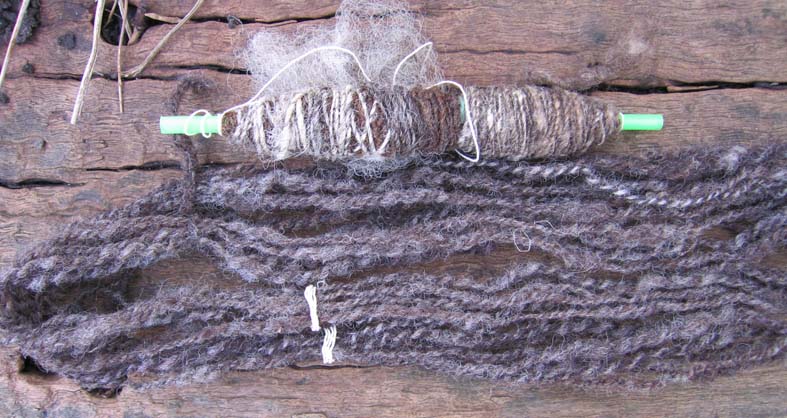
When we’d carded enough to at least understand the principles, a bag of rolags appeared, and we were introduced to spinning in the grease on a spinning wheel. The mechanism is far simpler than I’d imagined, but the co-ordination is a bit more difficult… and it just eats wool. Even treadling as slowly as I could. The feel is feeding the yarn to the bobbin rather than let the bobbin pull it. With incipient yarn held gently between finger and thumb, slide the finger and thumb up the yarn allowing the twist to follow. The wonky skein in the photo is my first wheel-spun handspun. It looked very different before it was washed – lanolin makes everything a dark golden brown. Principle is like handspun, clockwise rotation on singles, anti-clockwise to ply. We plyed by winding the singles into a centre-pull ball (Memo to self: BUY BALL-WINDER, it’s magic), then plying both ends. Count the treadles needed to put twist in an arm’s width, assess the twist (it should just gently twist back on itself), when satisfied, allow the 2-ply onto the bobbin. Continue to ply length by length. How to wind a skein, tie it. If for knitting, wash it. Hang very lightly weighted. If for weaving, leave to be washed in the fulling process.

Bags of exotic fibre appeared, and we were encouraged to change the character of our original wool by carding in camel down, silk, tussah silk… and shown, quickly, the principles of spinning plant fibres such as flax and linen, and how to manage the long, smooth silk roving (I’d guessed right with mine, hurrah!).

hey, when did the sun go down? It’s dark outside! Run around frantically grabbing stuff, small carders for luxury fibres and sample bags of fibre to play with… camel down, silk noil, grey alpaca, a steel-grey alpaca/silk blend, grey-brown BFL, manx/silk (it felt soft and it’s soft pale grey-brown). I haven’t got photos of these yet, and I’ve got to go make the pizza dough. If something important about spinning isn’t mentioned here, chances are I jsut forgot to mention it.

Here’s a close-up of the yarn I spun. The rightmost stuff on the straw is TxJ carded with silk and with camel down, spun on the drop spindle. There’s so little of it, I’ve no idea what to do… knit a tiny box or something, perhaps. I want to feel it, but it must be washed thoroughly. By the end of the class I no longer noticed the sheep smell, but when I arrived home the cats followed me everywhere, sniffing eagerly. Incidentally, cat ‘wool’ felts ferociously. Apparently it must be blended with wool, preferable merino, to make a very soft yarn.