Monthly Archives: December 2023

Bad cotton.

Over the last few weeks several people have asked a FB spinning group about spinning cotton wool/cotton balls – the things sold for makeup removal – as a cheap, easy to find version of cotton. I said cotton balls aren’t like REAL cotton; they’re made of heavily-processed waste fibres so they won’t make a lovely even yarn but I do enjoy spinning them. I discovered I didn’t have any when I looked for the bag in the stash to take a picture. My local supermarket (this is the UK) also didn’t have any so I added a bag of 100% cotton balls to the Amazon basket.

Can you read the label? It looks like the label on the Amazon website but there are different words: ‘Vacuum packed to reduce packaging size’. Cotton isn’t elastic, it doesn’t rebound to its original shape in the way that wool does. The label claims the cotton balls will expand after the pack is opened, but that seems extremely unlikely.
What to do? I can’t send the stuff back, I’ve opened the pack.

Was this decent cotton before it was abused?

No, and I didn’t expect that it would be. Cotton balls are a way of making money from waste fibre. In the photo below the top fibre is cotton sliver (technical term for the cotton version of what spinners know as wool top) opened to show fibre alignment and nepps. Fibre below it is one of the cotton balls.

At this point spinners are wondering why anyone would bother. Keep reading :-)

Rehabilitating bad cotton
First thing is to encourage the cotton to rebound and expand as much as it can. Heat and moisture help, so I put the balls in a colander over a bowl of steaming water and left it overnight, mixing top to bottom a few times before I went to bed.

That helped but not much. I tried Extreme Steam at the spout of a boiling kettle; do this with real cotton sliver and you can actually see it expand; this, not so much.
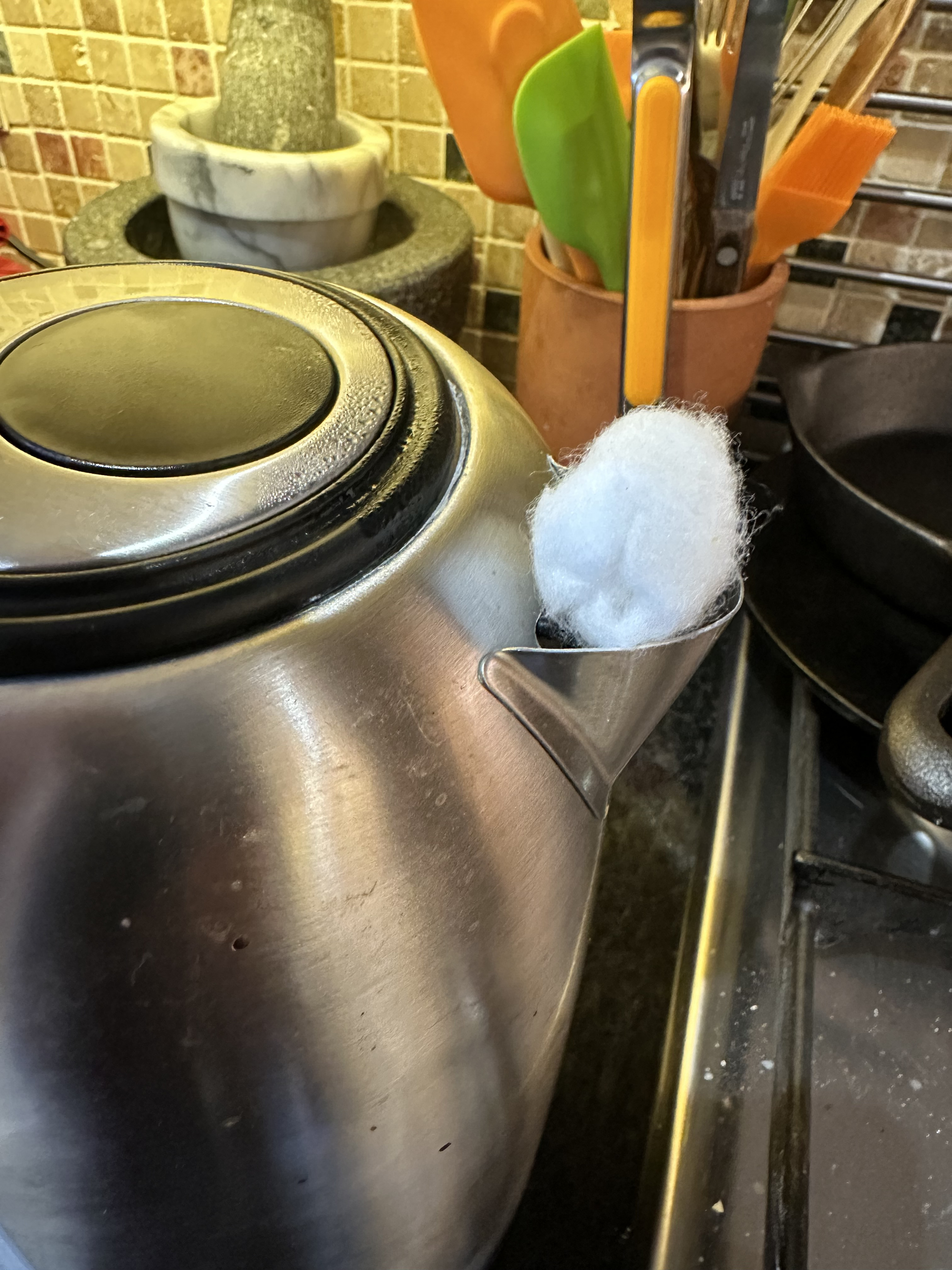
Oh well.

How can I prep this for spinning?
The three obvious options are shown in the photo below.
Centre, one of the cotton balls and above it, a couple of the balls unfolded to show the firmly set creases, a truly awful thing to see in cotton, each compacted area will be a difficult or undraftable slub in the yarn. But I can spin this.
To the right, next to the ruler, one of the balls unfolded and then carefully passed through steam from the kettle, allowed to rest, then steamed and rested again. The creases are still visible but it’s an improvement.
At left, five punis. Each is 2 1/2 (3 was too much, 2 seemed ungenerous) cotton balls unrolled and carded on my small Clemes & Clemes handcards. I don’t doff all the fibre onto one card at the end; instead I use a fine knitting needle to roll the fibre off each card, then slide the rolled fibre off. Moisten the needle with just the right amount of spit to catch the fibres at the start of the roll.
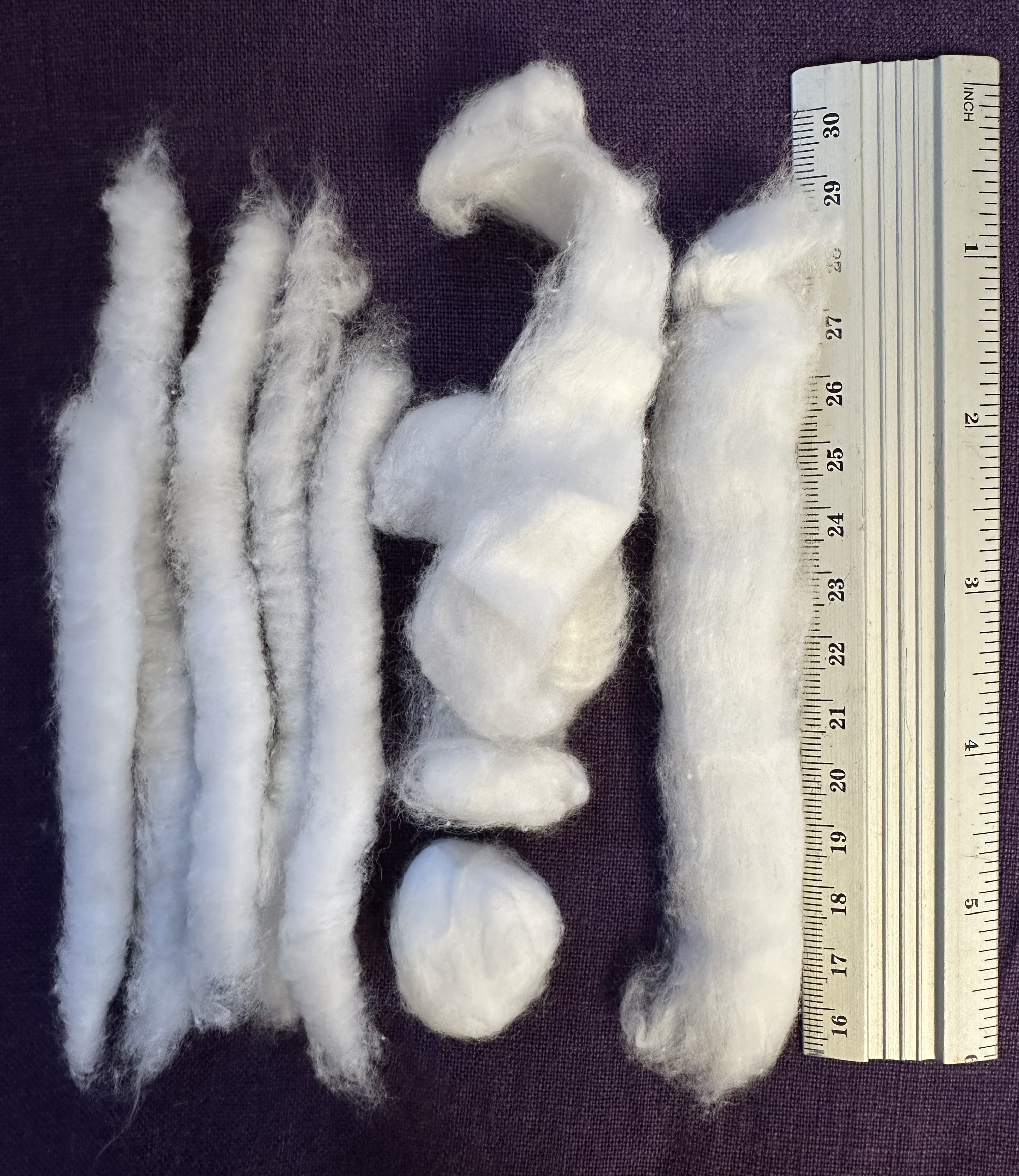
There wasn’t a lot of difference between spinning the unfolded fibre and the steamed unfolded fibre. Spinning with the tahkli (a support spindle with high speed good for spinning fine fibres) yielded a finer yarn but dealing with the slubs was more fiddly than spinning on the Majacraft Rose; both methods yielded a good somewhat slubby singles that plied up nicely.
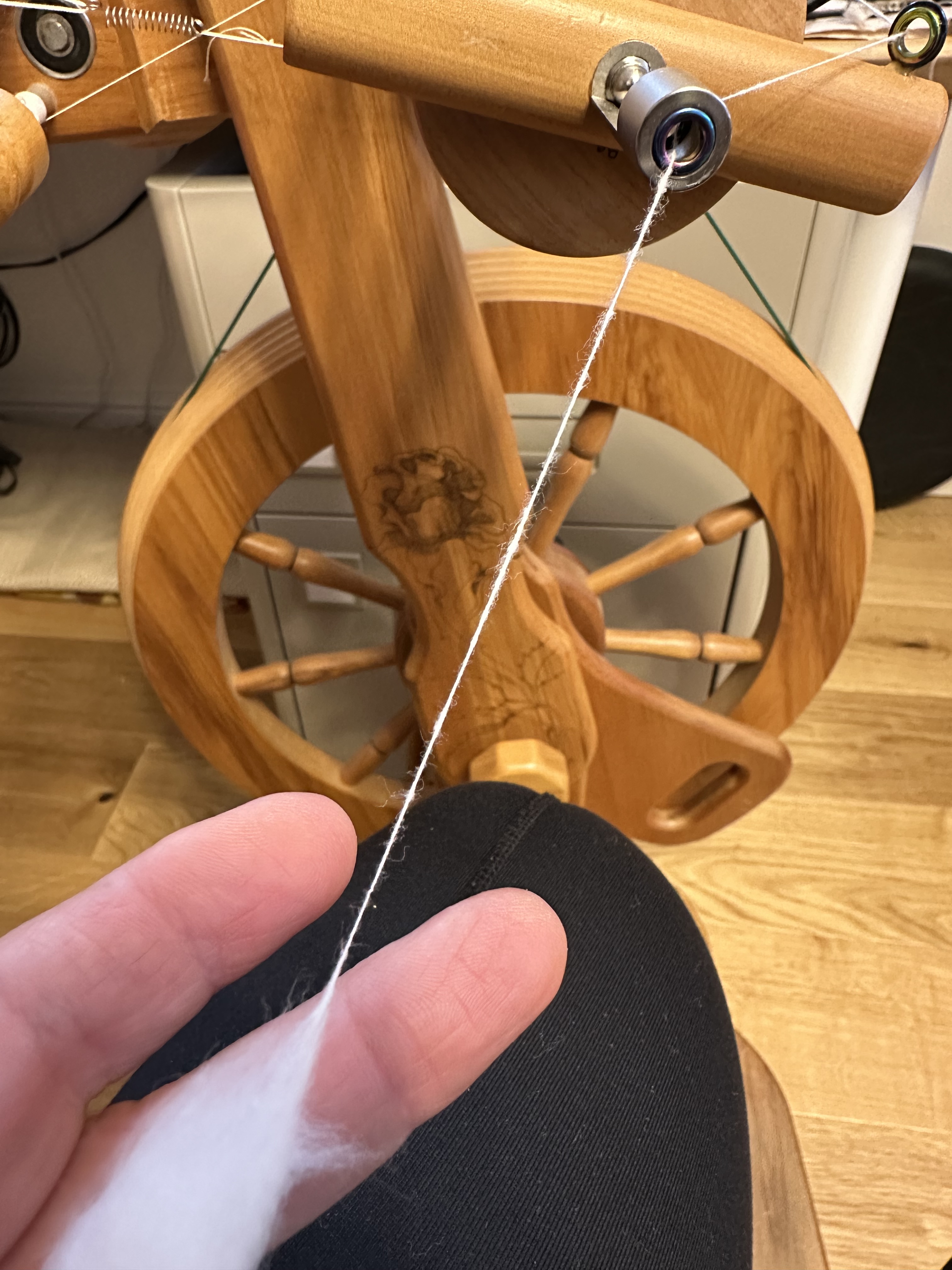
Spinning a singles from the unfolded cotton ball on the Majacraft Rose lace flyer.

Carding the cotton for the punis opens and rearranges the fibres, so I’d hoped they would draft more easily even if the yarn was still slubby. They did, but not in a good way. The cotton drafted easily into a succession of long slubs that, when double-drafted for a competent yarn tended to snap in the thin sections between the slubs. My theory is that the additional carding, even if only 2 brushes of the cards to spread the fibre evenly, did too much damage: too many of the fibres had been weakened or shortened.

Spinning a singles from a puni made from cotton balls. Note the long, large slubs.

Verdict
I’d spin this from unfolded balls, steamed once or twice and allowed to rest before I spin them. Why bother? Because the end result is a good and interesting yarn.
On the left, tahkli-spun; on the right, wheel-spun. Both are competent. The really fluffy bits of the wheel-spun are the puni slubs; these will probably shed fibre and pill even if a weave structure locks the fibres into place, and they might fail under warp tension. So if I was spinning this for use in knitting or weaving I’d avoid slubs this large and loose.
Best way to do that is buy nicer cotton balls, avoiding ones that have been vacuum-packed. The ones I bought from Superdrug in Canada were lovely.

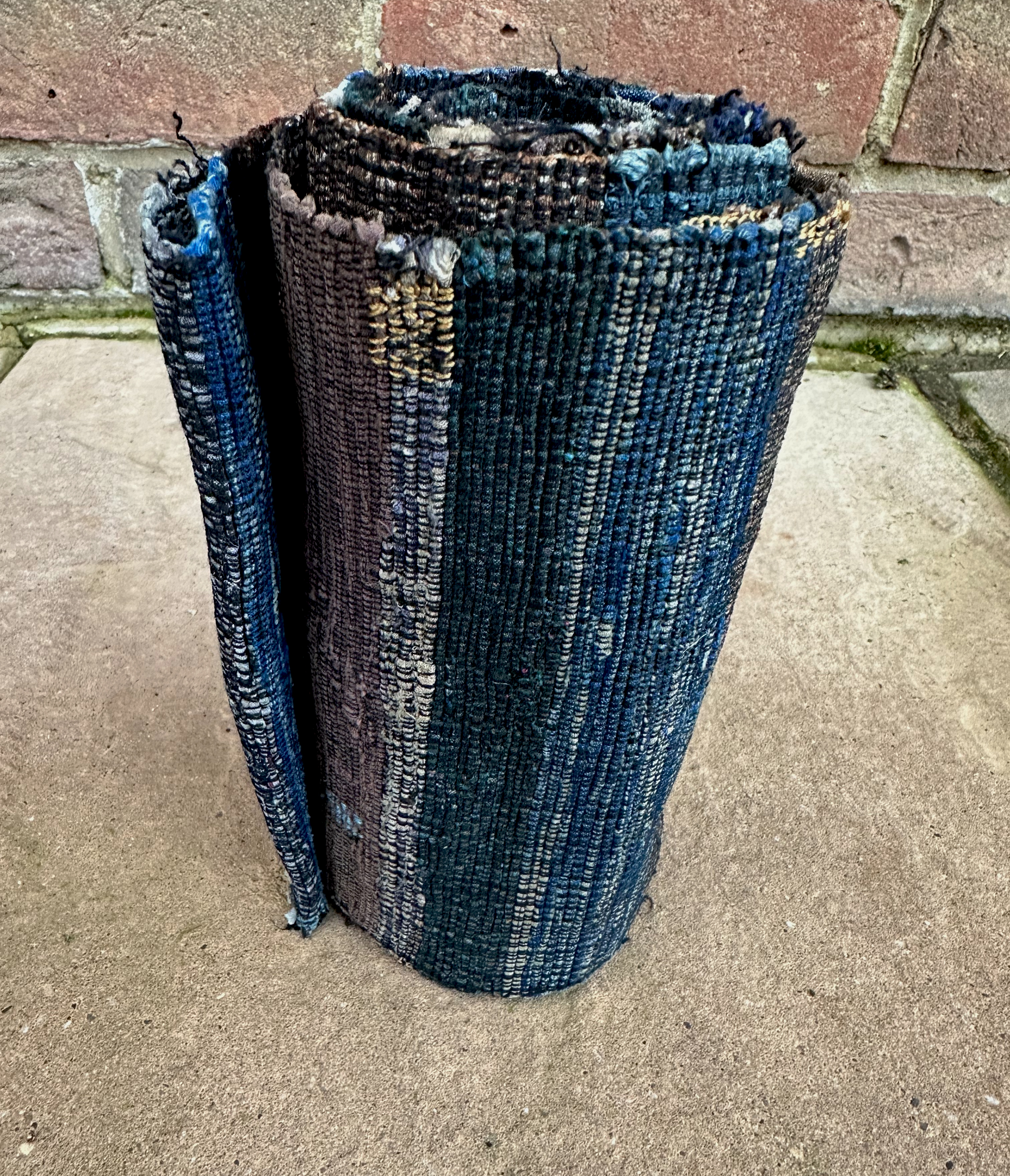
My new scarf

In March 2020, just before COVID, he and I went to New York, sharing one carry-on bag (we travel light and fast). I’ve just checked my calendar to see how long we were there; in my memory it’s both forever and no time at all, but in fact it was an intense fun- and food-filled ten days. One was spent walking from our hotel in The Bowery to see Japanese textiles at Sri Threads, with lunch at a Polish restaurant that we still remember for fabulous food and our first Żywiec beer. I’d been following Stephen @Sri for years and his collection did not disappoint. The wisteria bast fabric, the museum-grade boro were beyond my means, but I brought home some wonderful and meaningful textiles including a worn but very beautiful sakiori obi. My plan was to cut it and make a series of small bags to showcase the fabric, but I found I just could not put the scissors to it. Not just because it’s a wonderful long beautiful thing, but because it was still a thing. It wasn’t so worn that it couldn’t be used in its entirety. And also because this was made by someone’s hands as that single thing. Someone dismantled the garments for fabric, cut strips, wound that warp, warped the loom, chose or simply took strips to weave as weft. There is no repeat. When I’ve woven random yarns like this I’d sometimes pause to admire some unexpectedly beautiful progression: did the person who wove this pause, and for which colours?

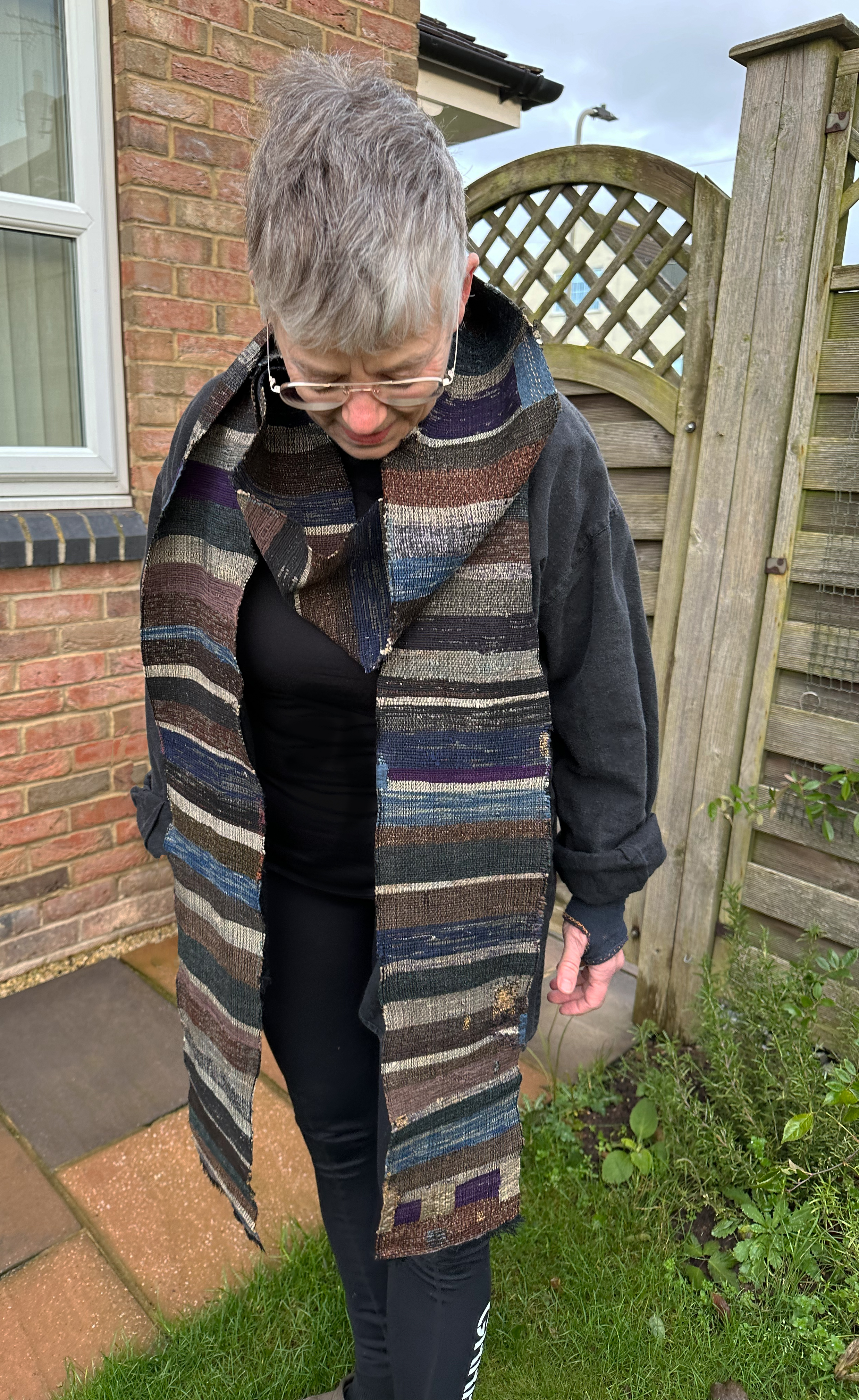
Packing my workroom for the move made clear to me how many unfinished projects require my attention. They weigh me down: i am finishing some and disposing of others. This beautiful thing could become a striking if somewhat long scarf to be loved and admired into the future if I repaired it to withstand light use. 

Obi?
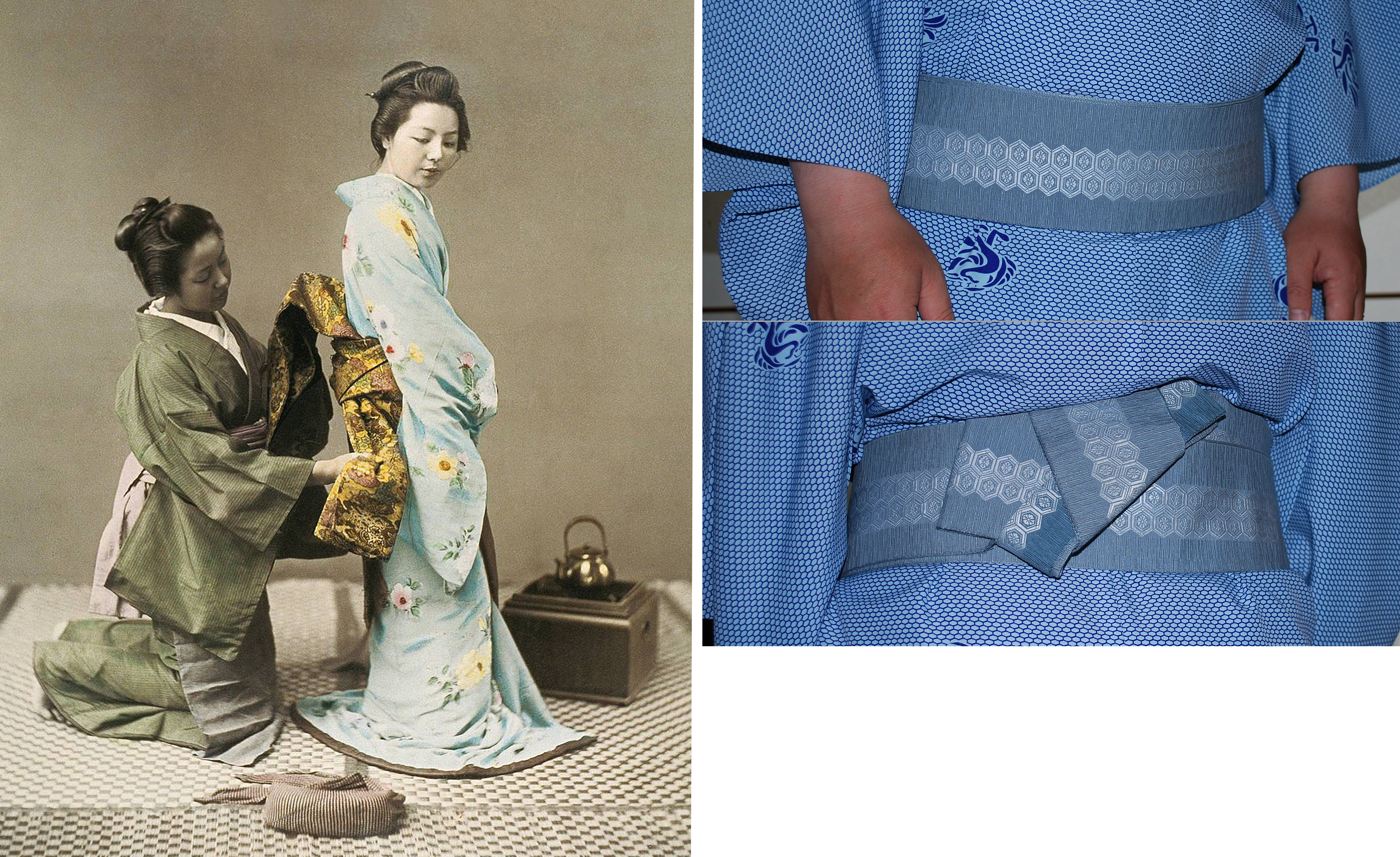
An obi is a Japanese belt, traditionally a woven fabric but modern obi may be made of many materials. There are obi (several types) for women and for men; men’s obi are narrower, longer (men wrap three times around the waist, women two) and usually more sombre in colour than those worn by women.

Left, an 1890s photo of one woman tying a complex obi knot. Right, a modern man’s kaku obi (my reading suggests this would be more stylish with the knot worn a little to the left).

My obi is roughly 15cm/6″ wide and 3m/9.8′ long, the standard dimensions of a hanhaba or ‘half width’ everyday casual woman’s obi. If that’s what it is, given the age of the obi, it would have been wound unfolded twice around the waist then tied with a simple over-and-under knot.

Sakiori: an examplar of mottanai
Meaning something like ‘what a waste/shame’ in the sense of ‘don’t be wasteful’, mottanai is a Japanese philosophy born of poverty and respect for crafts and materials. There is no need (it is inappropriate and disrespectful) to buy new if the old can be repaired, re-used or recycled. Garments can be repaired and remade for further use and when repair is not possible the fabric itself still has value: it can be cut into strips for use as weft in a new woven fabric (sakiori) or even unravelled, sound weft thread by weft thread to be re-used as weft in a new zanshi (‘leftover thread’) fabric.

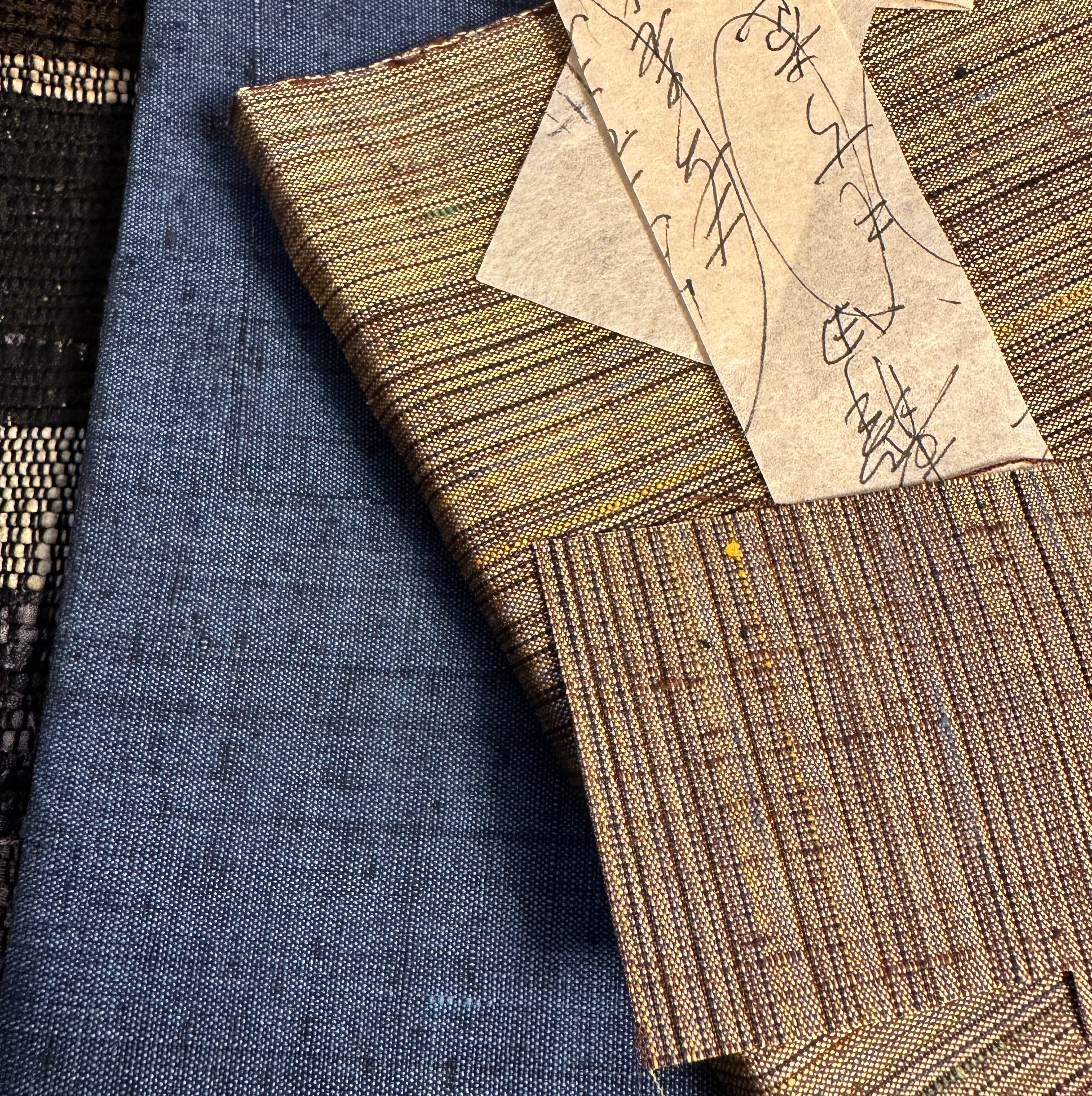
A burn test suggests the black warp is silk; it burned briefly and sullenly with the scent of burnt hair. The wefts are strips of at least 23 different silks ranging in colour from palest grey to various blacks with grey patterning. The narrowest weft stripe is 3 passes of a pale grey similar to that in the middle of the image above (but the strip is thinner); the widest is 26 passes of a blue and white silk similar to that near the bottom of the image. A true vivid deep purple is the least common colour, only 5 stripes. Most of the silks are rich shades of brown combined with greys and blacks.

Think for a minute about the possible age of these fabrics. Folk textiles are difficult to date, but sakiori fabric is no longer widely woven. The obi is worn beyond use, from long use. As were, probably, the garments dismantled and woven into it. If it was woven at the beginning of the 20th century, the fabrics may date from the 19th century. All those years, all those people making and wearing the garments.

The photo above shows some of the damage. The worst is the selvedges, in many areas eroded to nothing but worn ends of weft strips. Within the body of the obi the warp is worn or has disappeared entirely over bumps in the weft, creating weak points where the weft strips part. There is no central wear line, so it was not folded in use. At one end there are large open holes several cm wide. It might be that this is the result of wear due to knotting, or it could simply be moth or beetle damage.

I tried various blanket and buttonhole stitches on the damaged selvedges, then unpicked most of them leaving only two small areas to remind me that they don’t work, the pattern and texture is inappropriate. In the end I repaired the edges as I did the weak areas in the fabric, re-weaving the warp over-and-under. I worked as close to the edge of the obi as I dared before locking every second or third stitch back into previous stitches. Where the weft fabrics were too badly damaged to hold the new warp I stitched patches of vintage silk, indigo blue or zanshi multicolour and gold. I used 60/2 grey silk where I did not want my stitching to show and Sajou Fil au Chinois where I wanted the repairs to glow like kintsugi gold.

I like the end result enough that I thought of signing it but that seems disrespectful to the person or people who made the obi. Instead I stitched a yatagarasu, the three-legged lucky crow-guide that may be sent by the gods, on the largest patch. Everyone can do with luck and guidance these days.